



 Chat with AI
Exam 6: Economic Growth

Exam 1: What Is Economics644 Questions
Exam 2: The Economic Problem503 Questions
Exam 3: Demand and Supply558 Questions
Exam 4: Measuring Gdp and Economic Growth375 Questions
Exam 5: Monitoring Jobs and Inflation434 Questions
Exam 6: Economic Growth450 Questions
Exam 7: Finance, Saving, and Investment260 Questions
Exam 8: Money, the Price Level, and Inflation616 Questions
Exam 9: The Exchange Rate and the Balance of Payments547 Questions
Exam 10: Aggregate Supply and Aggregate Demand452 Questions
Exam 11: Expenditure Multipliers: They Keynesian Model484 Questions
Exam 12: U.S. Inflation, Unemployment, and Business Cycle443 Questions
Exam 13: Fiscal Policy328 Questions
Exam 14: Monetary Policy284 Questions
Exam 15: International Trade Policy207 Questions
Select questions type


The more education that workers have, the is their human capital and _ _ is their productivity.
(Multiple Choice)
5.0/5  (81)
(81) 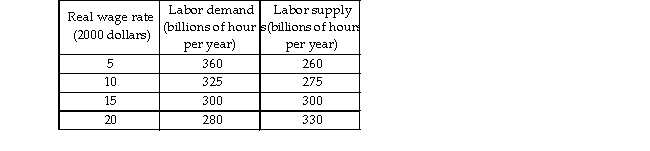 -The first table above gives the labor demand and labor supply schedules for a nation. The second table gives its production function.
a) What is the equilibrium real wage rate and the level of employment?
b) What is potential GDP? If you cannot determine a precise amount, give the range in which potential GDP m
-The first table above gives the labor demand and labor supply schedules for a nation. The second table gives its production function.
a) What is the equilibrium real wage rate and the level of employment?
b) What is potential GDP? If you cannot determine a precise amount, give the range in which potential GDP m (Essay)
4.9/5 (69)
(69) An aggregate production function shows the relationship between
(Multiple Choice)
4.8/5 (68)
(68) is the knowledge and skill that people have obtained from education and on- the- job training.
(Multiple Choice)
4.9/5 (79)
(79) Over the last 100 years, the average U.S. growth rate in real GDP per person was about
(Multiple Choice)
4.9/5 (87)
(87) Use the table below to answer this question. The data show national savings rates as a percentage of GDP; the growth rate of real GDP per person; and birth rates in 2006. 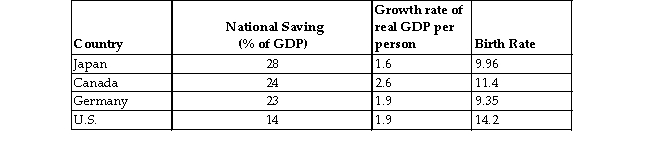 www.econstats.com; www.os- connect.com
If the data support the neoclassical growth theory, we would expect to see
www.econstats.com; www.os- connect.com
If the data support the neoclassical growth theory, we would expect to see (Multiple Choice)
5.0/5 (74)
(74) Which of the following is used to calculate the standard of living?
(Multiple Choice)
4.8/5 (73)
(73) The aggregate production function shows that an economy increases its real GDP in the short run by
(Multiple Choice)
4.7/5 (84)
(84) Why was there a slowdown in productivity growth in the 1970s?
(Multiple Choice)
5.0/5 (81)
(81) In 2006, capital per hour of labor was $250 and real GDP per hour of labor was $50. In 2007, real GDP per hour of labor was $55. If there was no change in technology between 2006 and 2007, then capital per hour of labor in 2007 was .
(Multiple Choice)
4.9/5 (78)
(78) The aggregate production function describes the relationship between
(Multiple Choice)
4.8/5 (89)
(89) If the price level rises by 3 percent and workers' money wages increase by 3 percent, then the
(Multiple Choice)
4.8/5 (69)
(69) The relationship between education and economic growth can best be summarized by saying that
(Multiple Choice)
4.9/5 (83)
(83) Discuss the aggregate production function. How does the aggregate production function relate to the labor market and potential GDP?
(Essay)
4.8/5 (79)
(79) Neoclassical growth theory is based on the proposition that real GDP per person grows when
(Multiple Choice)
4.7/5 (73)
(73) 
Filters
- Essay(0)
- Multiple Choice(0)
- Short Answer(0)
- True False(0)
- Matching(0)