



 Chat with AI
Exam 6: Economic Growth

Exam 1: What Is Economics644 Questions
Exam 2: The Economic Problem503 Questions
Exam 3: Demand and Supply558 Questions
Exam 4: Measuring Gdp and Economic Growth375 Questions
Exam 5: Monitoring Jobs and Inflation434 Questions
Exam 6: Economic Growth450 Questions
Exam 7: Finance, Saving, and Investment260 Questions
Exam 8: Money, the Price Level, and Inflation616 Questions
Exam 9: The Exchange Rate and the Balance of Payments547 Questions
Exam 10: Aggregate Supply and Aggregate Demand452 Questions
Exam 11: Expenditure Multipliers: They Keynesian Model484 Questions
Exam 12: U.S. Inflation, Unemployment, and Business Cycle443 Questions
Exam 13: Fiscal Policy328 Questions
Exam 14: Monetary Policy284 Questions
Exam 15: International Trade Policy207 Questions
Select questions type


Because the United States is a developed economy, every other country is catching up to the level of
U.S. real GDP per person.
(True/False)
4.8/5  (78)
(78) 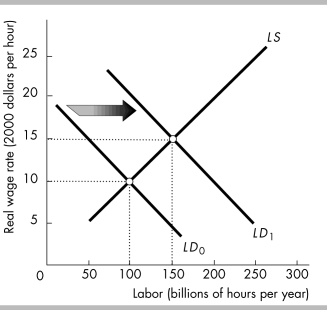 -As a result of the rightward shift in the demand curve for labor from LD0 to LD1, the equilibrium level of employment and potential GDP .
 (Multiple Choice)
4.8/5 (88)
(88) To achieve faster growth, economies can increase income tax rates in order to increase saving rates.
(True/False)
5.0/5 (69)
(69) Which of the following is NOT associated with the new growth theory?
(Multiple Choice)
4.9/5 (59)
(59) The table below shows data for China.  The economic growth rate in China between 2000 and 2003 was percent.
 (Multiple Choice)
4.8/5 (79)
(79) Which of the following statements about world growth during the last half of the 20th century is correct?
(Multiple Choice)
4.8/5 (78)
(78) If the real wage rate is $10.00 per hour and the price level is 100, the money wage rate is
(Multiple Choice)
4.7/5 (68)
(68) Which of the following statements regarding human capital is INCORRECT?
(Multiple Choice)
4.8/5 (77)
(77) Which of the following is NOT an important factor affecting economic growth?
(Multiple Choice)
4.8/5 (84)
(84) Classical growth economists believed that the real wage rate the subsistence real wage rate.
(Multiple Choice)
4.9/5 (71)
(71) Which of the following is consistent with classical growth theory?
(Multiple Choice)
4.8/5 (91)
(91) 
Filters
- Essay(0)
- Multiple Choice(0)
- Short Answer(0)
- True False(0)
- Matching(0)