



 Chat with AI
Exam 6: Economic Growth

Exam 1: What Is Economics644 Questions
Exam 2: The Economic Problem503 Questions
Exam 3: Demand and Supply558 Questions
Exam 4: Measuring Gdp and Economic Growth375 Questions
Exam 5: Monitoring Jobs and Inflation434 Questions
Exam 6: Economic Growth450 Questions
Exam 7: Finance, Saving, and Investment260 Questions
Exam 8: Money, the Price Level, and Inflation616 Questions
Exam 9: The Exchange Rate and the Balance of Payments547 Questions
Exam 10: Aggregate Supply and Aggregate Demand452 Questions
Exam 11: Expenditure Multipliers: They Keynesian Model484 Questions
Exam 12: U.S. Inflation, Unemployment, and Business Cycle443 Questions
Exam 13: Fiscal Policy328 Questions
Exam 14: Monetary Policy284 Questions
Exam 15: International Trade Policy207 Questions
Select questions type


Suppose the money wage rate and the price level both fall by 5 percent. As a result,
(Multiple Choice)
4.9/5  (86)
(86) Last year, capital per hour of labor grew 6 percent. Increases in technology and human capital brought about a 3 percent increase in labor productivity. Using the one- third rule, what was the total increase in labor productivity last year?
(Essay)
4.7/5 (94)
(94) If both the supply of labor and the demand for labor increase, then
(Multiple Choice)
4.9/5 (68)
(68) 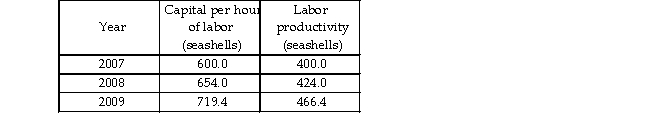 -The table above shows capital per hour of labor and labor productivity for the beach economy of Whitepool. In the year 2009, what is the contribution of the increase in capital per hour of labor and the contribution of technological change to the growth in real GDP per hour of labor?
 (Multiple Choice)
4.9/5 (81)
(81) A key feature of the new growth theory is the assumption of
(Multiple Choice)
4.9/5 (94)
(94) Suppose that capital per hour of labor increases by 18 percent while real GDP per hour of labor increases by 10 percent. What is the contribution to the increase in real GDP per hour of labor from changing technology?
(Multiple Choice)
4.8/5 (83)
(83) If capital per hour of labor decreases, real GDP per hour of labor
(Multiple Choice)
4.9/5 (86)
(86) provides a way for economists to calculate the impact of different determinants of economic growth.
(Multiple Choice)
4.8/5 (83)
(83) If capital per hour of labor grows by 3 percent a year and labor productivity grows by 2.5 percent a year, the one third rule says that the growth in labor productivity can be divided so that capital growth accounted for percentage points and technological change accounted for percentage points.
(Multiple Choice)
4.9/5 (83)
(83) An advance in technology that increases productivity and an increase in the working- age population results in a
(Multiple Choice)
4.9/5 (81)
(81) Real GDP per person in the country of Flip is $10,000, and the growth rate is 10 percent a year. Real GDP per person in the country of Flap is $20,000 and the growth rate is 5 percent a year. When will real GDP per person be greater in Flip than in Flap?
(Multiple Choice)
4.9/5 (82)
(82) 
Filters
- Essay(0)
- Multiple Choice(0)
- Short Answer(0)
- True False(0)
- Matching(0)