



 Chat with AI
Exam 10: Chemical Bonding Ii: Molecular Shapes, Valence Bond Theory, and Molecular Orbital Theory

Exam 1: Units of Measurement for Physical and Chemical Change192 Questions
Exam 2: Atoms and Elements174 Questions
Exam 3: Molecules, Compounds, and Nomenclature187 Questions
Exam 4: Chemical Reactions and Stoichiometry261 Questions
Exam 5: Gases163 Questions
Exam 6: Thermochemistry161 Questions
Exam 7: The Quantum-Mechanical Model of the Atom170 Questions
Exam 8: Periodic Properties of the Elements144 Questions
Exam 9: Chemical Bonding I: Lewis Theory155 Questions
Exam 10: Chemical Bonding Ii: Molecular Shapes, Valence Bond Theory, and Molecular Orbital Theory180 Questions
Exam 11: Liquids, Solids, and Intermolecular Forces144 Questions
Exam 12: Solutions167 Questions
Exam 13: Chemical Kinetics170 Questions
Exam 14: Chemical Equilibrium150 Questions
Exam 15: Acids and Bases156 Questions
Exam 16: Aqueous Ionic Equilibrium173 Questions
Exam 17: Gibbs Energy and Thermodynamics134 Questions
Exam 18: Electrochemistry122 Questions
Exam 19: Radioactivity and Nuclear Chemistry116 Questions
Exam 20: Organic Chemistry I: Structures109 Questions
Exam 21: Organic Chemistry Ii: Reactions102 Questions
Exam 22: Biochemistry55 Questions
Exam 23: Chemistry of the Nonmetals50 Questions
Exam 24: Metals and Metallurgy49 Questions
Exam 25: Transition Metals and Coordination Compounds55 Questions
Select questions type


How many of the following molecules are polar?
XeCl2 COF2 PCl4F SF6
(Multiple Choice)
5.0/5  (79)
(79) Draw a molecular orbital diagram and use it to determine which of the following is most stable.
(Multiple Choice)
4.8/5 (83)
(83) Determine the molecular geometry (mg) of the bolded and underlined atom CH3CH2NH2.
(Multiple Choice)
5.0/5 (74)
(74) Use the molecular orbital diagram shown to determine which of the following is paramagnetic. 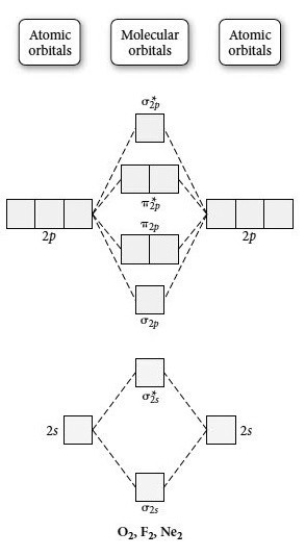
(Multiple Choice)
4.8/5 (66)
(66) Using the VSEPR model, the electron-domain geometry of the central atom in SCl4 is ________.
(Multiple Choice)
4.8/5 (96)
(96) Determine the electron geometry (eg), molecular geometry (mg), and polarity of SF6.
(Multiple Choice)
4.8/5 (82)
(82) Draw the Lewis structure for CCl4. What is the hybridization on the C atom?
(Multiple Choice)
4.8/5 (85)
(85) How many of the following molecules have sp3 hybridization on the central atom? XeCl4 CH4 SF4 C2H2
(Multiple Choice)
4.9/5 (79)
(79) Determine the electron geometry (eg) and molecular geometry (mg) of BrF5.
(Multiple Choice)
4.7/5 (83)
(83) Determine the electron geometry (eg) and molecular geometry (mg) of NCl3.
(Multiple Choice)
4.8/5 (72)
(72) Place the following in order of decreasing X-A-X bond angle, where A represents the central atom and X represents the outer atoms in each molecule. N2O NCl3 NO2⁻
(Multiple Choice)
4.8/5 (74)
(74) Determine the hybridization about each interior atom in the following structure. Sketch the three-dimensional structure and label the interior atoms with their corresponding hybridization.
CH2CHCCCH3
(Essay)
4.8/5 (79)
(79) Give the approximate bond angle for a molecule with octahedral electron geometry and square pyramidal molecular geometry.
(Multiple Choice)
4.8/5 (77)
(77) Determine the electron geometry (eg) and molecular geometry (mg) of BrF3.
(Multiple Choice)
4.7/5 (78)
(78) Determine the electron geometry (eg) and molecular geometry (mg) of CO2.
(Multiple Choice)
4.7/5 (63)
(63) 
Filters
- Essay(0)
- Multiple Choice(0)
- Short Answer(0)
- True False(0)
- Matching(0)