



 Chat with AI
Exam 10: Chemical Bonding Ii: Molecular Shapes, Valence Bond Theory, and Molecular Orbital Theory

Exam 1: Units of Measurement for Physical and Chemical Change192 Questions
Exam 2: Atoms and Elements174 Questions
Exam 3: Molecules, Compounds, and Nomenclature187 Questions
Exam 4: Chemical Reactions and Stoichiometry261 Questions
Exam 5: Gases163 Questions
Exam 6: Thermochemistry161 Questions
Exam 7: The Quantum-Mechanical Model of the Atom170 Questions
Exam 8: Periodic Properties of the Elements144 Questions
Exam 9: Chemical Bonding I: Lewis Theory155 Questions
Exam 10: Chemical Bonding Ii: Molecular Shapes, Valence Bond Theory, and Molecular Orbital Theory180 Questions
Exam 11: Liquids, Solids, and Intermolecular Forces144 Questions
Exam 12: Solutions167 Questions
Exam 13: Chemical Kinetics170 Questions
Exam 14: Chemical Equilibrium150 Questions
Exam 15: Acids and Bases156 Questions
Exam 16: Aqueous Ionic Equilibrium173 Questions
Exam 17: Gibbs Energy and Thermodynamics134 Questions
Exam 18: Electrochemistry122 Questions
Exam 19: Radioactivity and Nuclear Chemistry116 Questions
Exam 20: Organic Chemistry I: Structures109 Questions
Exam 21: Organic Chemistry Ii: Reactions102 Questions
Exam 22: Biochemistry55 Questions
Exam 23: Chemistry of the Nonmetals50 Questions
Exam 24: Metals and Metallurgy49 Questions
Exam 25: Transition Metals and Coordination Compounds55 Questions
Select questions type


Determine the molecular geometry about each interior atom in the following structure. Sketch the three-dimensional structure and label the interior atoms with the corresponding molecular geometry.
CH2CHCCCH3
(Essay)
4.9/5  (84)
(84) Determine the electron geometry (eg) and molecular geometry (mg) of the underlined carbon in CH3CN.
(Multiple Choice)
4.8/5 (79)
(79) Place the following in order of increasing X-Se-X bond angle, where X represents the outer atoms in each molecule. SeO2 SeCl6 SeF2
(Multiple Choice)
4.8/5 (79)
(79) Determine the electron geometry (eg), molecular geometry (mg), and polarity of XeO3.
(Multiple Choice)
4.8/5 (67)
(67) Using the VSEPR model, the molecular geometry of the central atom in XeF2 is ________.
(Multiple Choice)
4.7/5 (80)
(80) Which of the following best describes Cl F2-? It has a molecular geometry that is ________.
(Multiple Choice)
4.9/5 (77)
(77) Determine the electron geometry (eg) and molecular geometry (mg) of SiF4.
(Multiple Choice)
4.8/5 (85)
(85) Use molecular orbital theory to determine whether He22⁺ or He2⁺ is more stable.
(Essay)
4.7/5 (73)
(73) Draw the Lewis structure for BrCl3. What is the hybridization on the Br atom?
(Multiple Choice)
4.9/5 (64)
(64) How many of the following molecules have sp2 hybridization on the central atom? HCN SO2 OCl2 XeCl2
(Multiple Choice)
4.9/5 (74)
(74) The hybrid orbital set used by the central atom in SCl4 is ________.
(Multiple Choice)
4.9/5 (95)
(95) Consider the molecule below. Determine the hybridization at each of the three labelled atoms. 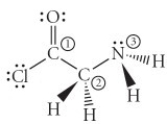
(Multiple Choice)
4.7/5 (90)
(90) Draw the Lewis structure for H3O+. What is the hybridization on the O atom?
(Multiple Choice)
4.9/5 (95)
(95) Determine the electron geometry (eg) and molecular geometry (mg) of the underlined carbon in CH3CN.
(Multiple Choice)
4.8/5 (100)
(100) Determine the electron geometry (eg), molecular geometry (mg), and polarity of N2O (N central).
(Multiple Choice)
4.7/5 (80)
(80) 
Filters
- Essay(0)
- Multiple Choice(0)
- Short Answer(0)
- True False(0)
- Matching(0)