



 Chat with AI
Exam 10: Chemical Bonding Ii: Molecular Shapes, Valence Bond Theory, and Molecular Orbital Theory

Exam 1: Units of Measurement for Physical and Chemical Change192 Questions
Exam 2: Atoms and Elements174 Questions
Exam 3: Molecules, Compounds, and Nomenclature187 Questions
Exam 4: Chemical Reactions and Stoichiometry261 Questions
Exam 5: Gases163 Questions
Exam 6: Thermochemistry161 Questions
Exam 7: The Quantum-Mechanical Model of the Atom170 Questions
Exam 8: Periodic Properties of the Elements144 Questions
Exam 9: Chemical Bonding I: Lewis Theory155 Questions
Exam 10: Chemical Bonding Ii: Molecular Shapes, Valence Bond Theory, and Molecular Orbital Theory180 Questions
Exam 11: Liquids, Solids, and Intermolecular Forces144 Questions
Exam 12: Solutions167 Questions
Exam 13: Chemical Kinetics170 Questions
Exam 14: Chemical Equilibrium150 Questions
Exam 15: Acids and Bases156 Questions
Exam 16: Aqueous Ionic Equilibrium173 Questions
Exam 17: Gibbs Energy and Thermodynamics134 Questions
Exam 18: Electrochemistry122 Questions
Exam 19: Radioactivity and Nuclear Chemistry116 Questions
Exam 20: Organic Chemistry I: Structures109 Questions
Exam 21: Organic Chemistry Ii: Reactions102 Questions
Exam 22: Biochemistry55 Questions
Exam 23: Chemistry of the Nonmetals50 Questions
Exam 24: Metals and Metallurgy49 Questions
Exam 25: Transition Metals and Coordination Compounds55 Questions
Select questions type


A molecule or ion with seven electrons in bonding orbitals and two electrons in an antibonding orbital has a bond order of ________.
(Multiple Choice)
4.9/5  (64)
(64) Draw the Lewis structure for COCl2. What is the hybridization on the C atom?
(Multiple Choice)
4.9/5 (89)
(89) Use the molecular orbital diagram shown to determine which of the following is least stable. 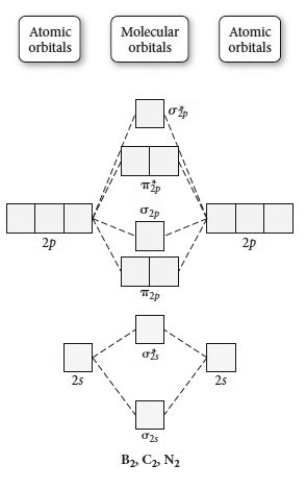
(Multiple Choice)
4.9/5 (79)
(79) How many of the following molecules are polar?
XeO2 SiCl2Br2 C2Br2 SeCl6
(Multiple Choice)
4.9/5 (72)
(72) Is it possible for a molecule to be nonpolar even though it contains polar bonds? Explain your answer and give an example.
(Essay)
4.8/5 (92)
(92) Place the following in order of increasing dipole moment. I. BCl3 II. BIF2 III. BClF2
(Multiple Choice)
4.8/5 (91)
(91) Use the molecular orbital diagram shown to determine which of the following is most stable. 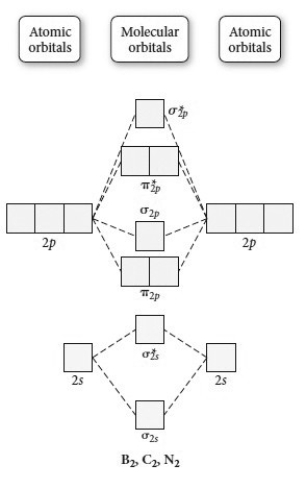
(Multiple Choice)
4.8/5 (72)
(72) Give the approximate bond angle for a molecule with a tetrahedral shape.
(Multiple Choice)
4.8/5 (77)
(77) Give the approximate bond angle for a molecule with trigonal bipyramidal electron geometry and linear molecular geometry.
(Multiple Choice)
4.9/5 (90)
(90) Consider the molecule below. Determine the molecular geometry at each of the two labelled carbons. 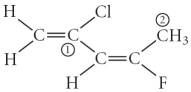
(Multiple Choice)
4.8/5 (86)
(86) Draw the Lewis structure for S  . What is the hybridization on the S atom?
 (Multiple Choice)
5.0/5 (72)
(72) Draw the Lewis structure for N2H2. What is the hybridization on the N atoms?
(Multiple Choice)
4.9/5 (75)
(75) In molecular orbital theory the acronym LCAO stands for ________.
(Multiple Choice)
4.8/5 (84)
(84) Determine the molecular geometry (mg) of the bolded and underlined atom CH3CH2OH.
(Multiple Choice)
4.9/5 (74)
(74) Determine the electron geometry (eg) and molecular geometry (mg) of XeF4.
(Multiple Choice)
4.9/5 (87)
(87) Choose the compound below that contains at least one polar covalent bond but is nonpolar.
(Multiple Choice)
4.8/5 (85)
(85) 
Filters
- Essay(0)
- Multiple Choice(0)
- Short Answer(0)
- True False(0)
- Matching(0)