



 Chat with AI
Exam 2: The Chemical Context of Life

Exam 1: Introduction: Evolution and the Foundations of Biology36 Questions
Exam 2: The Chemical Context of Life135 Questions
Exam 3: Carbon and the Molecular Diversity of Life136 Questions
Exam 4: A Tour of the Cell75 Questions
Exam 5: Membrane Transport and Cell Signaling86 Questions
Exam 6: An Introduction to Metabolism79 Questions
Exam 7: Cellular Respiration and Fermentation99 Questions
Exam 8: Photosynthesis68 Questions
Exam 9: The Cell Cycle57 Questions
Exam 10: Meiosis and Sexual Life Cycles59 Questions
Exam 11: Mendel and the Gene Idea57 Questions
Exam 12: The Chromosomal Basis of Inheritance43 Questions
Exam 13: The Molecular Basis of Inheritance62 Questions
Exam 14: Gene Expression: From Gene to Protein77 Questions
Exam 15: Regulation of Gene Expression48 Questions
Exam 16: Development,stem Cells,and Cancer34 Questions
Exam 17: Viruses35 Questions
Exam 18: Genomes and Their Evolution31 Questions
Exam 19: Descent With Modification61 Questions
Exam 20: Phylogeny72 Questions
Exam 21: The Evolution of Populations81 Questions
Exam 22: The Origin of Species75 Questions
Exam 23: Broad Patterns of Evolution60 Questions
Exam 24: Early Life and the Diversification of Prokaryotes99 Questions
Exam 25: The Origin and Diversification of Eukaryotes80 Questions
Exam 26: The Colonization of Land by Plants and Fungi128 Questions
Exam 27: The Rise of Animal Diversity93 Questions
Exam 28: Plant Structure and Growth67 Questions
Exam 29: Resource Acquisition,nutrition,and Transport in Vascular Plants115 Questions
Exam 30: Reproduction and Domestication of Flowering Plants72 Questions
Exam 31: Plant Responses to Internal and External Signals74 Questions
Exam 32: Homeostasis and Endocrine Signaling116 Questions
Exam 33: Animal Nutrition75 Questions
Exam 34: Circulation and Gas Exchange94 Questions
Exam 35: The Immune System96 Questions
Exam 36: Reproduction and Development123 Questions
Exam 37: Neurons,synapses,and Signaling77 Questions
Exam 38: Nervous and Sensory Systems105 Questions
Exam 39: Motor Mechanisms and Behavior83 Questions
Exam 40: Population Ecology and the Distribution of Organisms93 Questions
Exam 41: Ecological Communities59 Questions
Exam 42: Ecosystems and Energy86 Questions
Exam 43: Conservation Biology and Global Change71 Questions
Select questions type


One liter of a solution of pH 8 has how many more hydroxyl ions (OH-)than 1 L of a solution of pH 4?
(Multiple Choice)
4.9/5  (78)
(78) Increased atmospheric CO2 concentrations will have what effect on seawater?
(Multiple Choice)
4.8/5 (69)
(69) Which of the atoms shown would be most likely to form a cation with a charge of +1?
(Multiple Choice)
4.8/5 (83)
(83) If acid rain has lowered the pH of a particular lake to pH 4.0,which of the following statements about this lake is true?
(Multiple Choice)
5.0/5 (89)
(89) 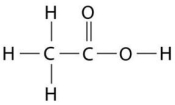 Figure 2.8
-How many grams would be equal to 1 mol of the compound shown in Figure 2.8?
(carbon = 12,oxygen = 16,hydrogen = 1)
Figure 2.8
-How many grams would be equal to 1 mol of the compound shown in Figure 2.8?
(carbon = 12,oxygen = 16,hydrogen = 1) (Multiple Choice)
4.7/5 (68)
(68) How many glucose molecules are contained in one liter of a 0.1 M solution of glucose in water?
(Multiple Choice)
4.8/5 (76)
(76) A beaker contains 100 mL of NaOH solution at pH = 13.A technician carefully pours into the beaker 10 mL of HCl at pH = 1.Which of the following statements correctly describes the results of this mixing?
(Multiple Choice)
4.7/5 (81)
(81) The molar mass of glucose is 180 g/mol.Which of the following procedures should you carry out to make a 1 M solution of glucose?
(Multiple Choice)
4.8/5 (76)
(76) The left-to-right position of an element in the first three rows of the periodic table indicates which of the following properties of the element?
(Multiple Choice)
4.8/5 (82)
(82) The attraction between the slight negative charge of one water molecule to the slight positive charge of another water molecule results in which of the following interactions?
(Multiple Choice)
4.9/5 (78)
(78) Glucose has a molecular mass of 180 g/mol.How many glucose molecules are present in 100 grams of glucose?
(Multiple Choice)
4.7/5 (81)
(81) Which of the following correctly describes any reaction that has reached chemical equilibrium?
(Multiple Choice)
4.9/5 (90)
(90) 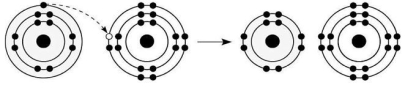 Figure 2.6
-What is the atomic number of the cation formed in the reaction illustrated in Figure 2.6?
Figure 2.6
-What is the atomic number of the cation formed in the reaction illustrated in Figure 2.6? (Multiple Choice)
4.8/5 (72)
(72) If a salamander clings to surfaces through hydrogen bonds,it would have the most difficulty clinging to which of the following surfaces?
(Multiple Choice)
4.9/5 (73)
(73) How many molecules of glycerol (C3H8O3;molecular mass = 92)are present in 0.5 L of a 1 M glycerol solution?
(Multiple Choice)
5.0/5 (84)
(84) How many electron pairs are shared between the two carbon atoms in a molecule that has the formula C2H6?
(Multiple Choice)
4.8/5 (86)
(86) 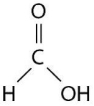 Figure 2.5
 shows a representation of formic acid.A formic acid molecule
Figure 2.5
Figure 2.5 shows a representation of formic acid.A formic acid molecule (Multiple Choice)
4.8/5 (80)
(80) Measurements show that the pH of a particular lake is 4.0.What is the hydrogen ion concentration of the lake?
(Multiple Choice)
4.8/5 (86)
(86) 
Filters
- Essay(0)
- Multiple Choice(0)
- Short Answer(0)
- True False(0)
- Matching(0)