



 Chat with AI
Exam 3: Carbon and the Molecular Diversity of Life

Exam 1: Introduction: Evolution and the Foundations of Biology36 Questions
Exam 2: The Chemical Context of Life135 Questions
Exam 3: Carbon and the Molecular Diversity of Life136 Questions
Exam 4: A Tour of the Cell75 Questions
Exam 5: Membrane Transport and Cell Signaling86 Questions
Exam 6: An Introduction to Metabolism79 Questions
Exam 7: Cellular Respiration and Fermentation99 Questions
Exam 8: Photosynthesis68 Questions
Exam 9: The Cell Cycle57 Questions
Exam 10: Meiosis and Sexual Life Cycles59 Questions
Exam 11: Mendel and the Gene Idea57 Questions
Exam 12: The Chromosomal Basis of Inheritance43 Questions
Exam 13: The Molecular Basis of Inheritance62 Questions
Exam 14: Gene Expression: From Gene to Protein77 Questions
Exam 15: Regulation of Gene Expression48 Questions
Exam 16: Development,stem Cells,and Cancer34 Questions
Exam 17: Viruses35 Questions
Exam 18: Genomes and Their Evolution31 Questions
Exam 19: Descent With Modification61 Questions
Exam 20: Phylogeny72 Questions
Exam 21: The Evolution of Populations81 Questions
Exam 22: The Origin of Species75 Questions
Exam 23: Broad Patterns of Evolution60 Questions
Exam 24: Early Life and the Diversification of Prokaryotes99 Questions
Exam 25: The Origin and Diversification of Eukaryotes80 Questions
Exam 26: The Colonization of Land by Plants and Fungi128 Questions
Exam 27: The Rise of Animal Diversity93 Questions
Exam 28: Plant Structure and Growth67 Questions
Exam 29: Resource Acquisition,nutrition,and Transport in Vascular Plants115 Questions
Exam 30: Reproduction and Domestication of Flowering Plants72 Questions
Exam 31: Plant Responses to Internal and External Signals74 Questions
Exam 32: Homeostasis and Endocrine Signaling116 Questions
Exam 33: Animal Nutrition75 Questions
Exam 34: Circulation and Gas Exchange94 Questions
Exam 35: The Immune System96 Questions
Exam 36: Reproduction and Development123 Questions
Exam 37: Neurons,synapses,and Signaling77 Questions
Exam 38: Nervous and Sensory Systems105 Questions
Exam 39: Motor Mechanisms and Behavior83 Questions
Exam 40: Population Ecology and the Distribution of Organisms93 Questions
Exam 41: Ecological Communities59 Questions
Exam 42: Ecosystems and Energy86 Questions
Exam 43: Conservation Biology and Global Change71 Questions
Select questions type


The side chain (R group)of the amino acid serine is -CH2-OH.The side chain of the amino acid leucine is -CH2-CH-(CH3)2.Where would you expect to find these amino acids in a globular protein in aqueous solution?
(Multiple Choice)
4.7/5  (85)
(85) A double-stranded DNA molecule contains a total of 120 base pairs.This DNA molecule could be composed of
(Multiple Choice)
4.9/5 (73)
(73) Which of the following is an example of a hydrolysis reaction?
(Multiple Choice)
4.8/5 (90)
(90) 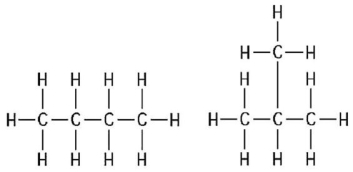 Figure 3.1
The two molecules shown in Figure 3.1 are best described as
Figure 3.1
The two molecules shown in Figure 3.1 are best described as (Multiple Choice)
4.8/5 (81)
(81) Lactose,a sugar in milk,is composed of one glucose molecule joined by a glycosidic linkage to one galactose molecule.How is lactose classified?
(Multiple Choice)
4.9/5 (69)
(69) Which bonds are created during the formation of the primary structure of a protein?
(Multiple Choice)
4.9/5 (81)
(81) Testosterone and estradiol are male and female sex hormones,respectively,in many vertebrates.How do these molecules differ from each other?
(Multiple Choice)
4.8/5 (72)
(72)  Figure 3.5
-Which molecule(s)shown in Figure 3.5 is (are)ionized in a cell?
Figure 3.5
-Which molecule(s)shown in Figure 3.5 is (are)ionized in a cell? (Multiple Choice)
4.9/5 (68)
(68)  Figure 3.12
-Which bond in Figure 3.12 is farthest from an alpha-carbon?
Figure 3.12
-Which bond in Figure 3.12 is farthest from an alpha-carbon? (Multiple Choice)
4.9/5 (73)
(73) Which of the following chemical equations describes a hydrolysis reaction?
(Multiple Choice)
4.9/5 (82)
(82)  Figure 3.3
-Which of the structures illustrated in Figure 3.3 could not be formed by typical covalent bonds?
Figure 3.3
-Which of the structures illustrated in Figure 3.3 could not be formed by typical covalent bonds? (Multiple Choice)
4.9/5 (79)
(79) Choose the term that correctly describes the relationship between these two sugar molecules: 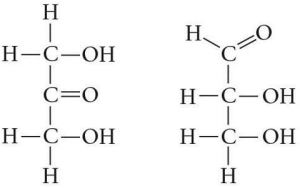
(Multiple Choice)
4.8/5 (76)
(76) Which of the following categories includes all others in the list?
(Multiple Choice)
4.7/5 (69)
(69) Figure 3.5
-Which molecule shown in Figure 3.5 has a carbonyl functional group in the form of a ketone?
Figure 3.5
-Which molecule shown in Figure 3.5 has a carbonyl functional group in the form of a ketone? (Multiple Choice)
4.8/5 (92)
(92) 
Filters
- Essay(0)
- Multiple Choice(0)
- Short Answer(0)
- True False(0)
- Matching(0)