



 Chat with AI
Exam 5: Membrane Transport and Cell Signaling

Exam 1: Introduction: Evolution and the Foundations of Biology36 Questions
Exam 2: The Chemical Context of Life135 Questions
Exam 3: Carbon and the Molecular Diversity of Life136 Questions
Exam 4: A Tour of the Cell75 Questions
Exam 5: Membrane Transport and Cell Signaling86 Questions
Exam 6: An Introduction to Metabolism79 Questions
Exam 7: Cellular Respiration and Fermentation99 Questions
Exam 8: Photosynthesis68 Questions
Exam 9: The Cell Cycle57 Questions
Exam 10: Meiosis and Sexual Life Cycles59 Questions
Exam 11: Mendel and the Gene Idea57 Questions
Exam 12: The Chromosomal Basis of Inheritance43 Questions
Exam 13: The Molecular Basis of Inheritance62 Questions
Exam 14: Gene Expression: From Gene to Protein77 Questions
Exam 15: Regulation of Gene Expression48 Questions
Exam 16: Development,stem Cells,and Cancer34 Questions
Exam 17: Viruses35 Questions
Exam 18: Genomes and Their Evolution31 Questions
Exam 19: Descent With Modification61 Questions
Exam 20: Phylogeny72 Questions
Exam 21: The Evolution of Populations81 Questions
Exam 22: The Origin of Species75 Questions
Exam 23: Broad Patterns of Evolution60 Questions
Exam 24: Early Life and the Diversification of Prokaryotes99 Questions
Exam 25: The Origin and Diversification of Eukaryotes80 Questions
Exam 26: The Colonization of Land by Plants and Fungi128 Questions
Exam 27: The Rise of Animal Diversity93 Questions
Exam 28: Plant Structure and Growth67 Questions
Exam 29: Resource Acquisition,nutrition,and Transport in Vascular Plants115 Questions
Exam 30: Reproduction and Domestication of Flowering Plants72 Questions
Exam 31: Plant Responses to Internal and External Signals74 Questions
Exam 32: Homeostasis and Endocrine Signaling116 Questions
Exam 33: Animal Nutrition75 Questions
Exam 34: Circulation and Gas Exchange94 Questions
Exam 35: The Immune System96 Questions
Exam 36: Reproduction and Development123 Questions
Exam 37: Neurons,synapses,and Signaling77 Questions
Exam 38: Nervous and Sensory Systems105 Questions
Exam 39: Motor Mechanisms and Behavior83 Questions
Exam 40: Population Ecology and the Distribution of Organisms93 Questions
Exam 41: Ecological Communities59 Questions
Exam 42: Ecosystems and Energy86 Questions
Exam 43: Conservation Biology and Global Change71 Questions
Select questions type


The mechanism by which testosterone alters cell function is by
(Multiple Choice)
4.8/5  (88)
(88)  Figure 5.2
-The solutions in the two arms of the U-tube shown in Figure 5.2 are separated by a membrane that is permeable to water and glucose but not to sucrose.Side A is half-filled with a solution of 2 M sucrose and 1 M glucose.Side B is half-filled with 1 M sucrose and 2 M glucose.Initially,the liquid levels are equal,and the solution in side A is
Figure 5.2
-The solutions in the two arms of the U-tube shown in Figure 5.2 are separated by a membrane that is permeable to water and glucose but not to sucrose.Side A is half-filled with a solution of 2 M sucrose and 1 M glucose.Side B is half-filled with 1 M sucrose and 2 M glucose.Initially,the liquid levels are equal,and the solution in side A is (Multiple Choice)
4.9/5 (79)
(79) The movement of the hydrophobic gas nitrous oxide (N2O)(laughing gas)into a cell is an example of
(Multiple Choice)
4.9/5 (78)
(78) A major group of G protein-coupled receptors contains seven transmembrane α helices.The amino end of the protein lies at the exterior of the plasma membrane.Loops of amino acids connect the helices either at the exterior face or on the cytoplasmic face of the membrane.The loop on the cytoplasmic side between helices 5 and 6 is usually substantially longer than the other loops.The G protein activated by this receptor most likely interacts with the receptor
(Multiple Choice)
4.9/5 (67)
(67) The difference between pinocytosis and receptor-mediated endocytosis is that
(Multiple Choice)
4.9/5 (75)
(75) Figure 5.2
-The solutions in the two arms of the U-tube shown in Figure 5.2 are separated by a membrane that is permeable to water and glucose but not to sucrose.Side A is half-filled with a solution of 2 M sucrose and 1 M glucose.Side B is half-filled with 1 M sucrose and 2 M glucose.Initially,the liquid levels are equal.After the system depicted in the figure reaches equilibrium,what changes are observed?
Figure 5.2
-The solutions in the two arms of the U-tube shown in Figure 5.2 are separated by a membrane that is permeable to water and glucose but not to sucrose.Side A is half-filled with a solution of 2 M sucrose and 1 M glucose.Side B is half-filled with 1 M sucrose and 2 M glucose.Initially,the liquid levels are equal.After the system depicted in the figure reaches equilibrium,what changes are observed? (Multiple Choice)
4.9/5 (81)
(81) A protein that spans the phospholipid bilayer one or more times is
(Multiple Choice)
4.8/5 (68)
(68)  Figure 5.4
-Five dialysis bags,constructed from a semipermeable membrane that is impermeable to sucrose,were filled with various concentrations of sucrose and then placed in separate beakers containing an initial concentration of 0.6 M sucrose solution.At 10-minute intervals,the bags were massed (weighed),and the percent change in mass of each bag was graphed.Figure 5.4 illustrates the change in the mass of the bags over time.Which line in the graph represents the bag with the highest initial concentration of sucrose?
Figure 5.4
-Five dialysis bags,constructed from a semipermeable membrane that is impermeable to sucrose,were filled with various concentrations of sucrose and then placed in separate beakers containing an initial concentration of 0.6 M sucrose solution.At 10-minute intervals,the bags were massed (weighed),and the percent change in mass of each bag was graphed.Figure 5.4 illustrates the change in the mass of the bags over time.Which line in the graph represents the bag with the highest initial concentration of sucrose? (Multiple Choice)
4.9/5 (74)
(74) Transcription factors play a major role in regulating which of the following processes?
(Multiple Choice)
4.9/5 (77)
(77) Which of the following molecules would you expect to diffuse through the lipid bilayer of a plasma membrane most slowly,if at all?
(Multiple Choice)
4.7/5 (89)
(89) In receptor-mediated endocytosis,where are the receptors that bind specific molecules located immediately following endocytosis?
(Multiple Choice)
4.8/5 (83)
(83) In what way would the lack of receptors for local paracrine signal molecules affect animal cells?
(Multiple Choice)
4.8/5 (86)
(86) Lipid-soluble signaling molecules,such as aldosterone,cross the membranes of all cells but affect only target cells because
(Multiple Choice)
4.9/5 (87)
(87) Research on aging suggests that as cells age,their rate of cell division decreases until they ultimately no longer divide.Which of the following would provide evidence that the decreased rate of cell division is related to cell signaling?
(Multiple Choice)
4.9/5 (77)
(77) Figure 5.4
-Five dialysis bags,constructed from a semipermeable membrane that is impermeable to sucrose,were filled with various concentrations of sucrose and then placed in separate beakers containing an initial concentration of 0.6 M sucrose solution.At 10-minute intervals,the bags were massed (weighed),and the percent change in mass of each bag was graphed.Figure 5.4 illustrates the change in the mass of the bags over time.Which line in the graph represents the bag that contained a 0.6 M solution at the beginning of the experiment?
Figure 5.4
-Five dialysis bags,constructed from a semipermeable membrane that is impermeable to sucrose,were filled with various concentrations of sucrose and then placed in separate beakers containing an initial concentration of 0.6 M sucrose solution.At 10-minute intervals,the bags were massed (weighed),and the percent change in mass of each bag was graphed.Figure 5.4 illustrates the change in the mass of the bags over time.Which line in the graph represents the bag that contained a 0.6 M solution at the beginning of the experiment? (Multiple Choice)
4.9/5 (79)
(79) Figure 5.2
-The solutions in the two arms of the U-tube shown in Figure 5.2 are separated by a membrane that is permeable to water and glucose but not to sucrose.Side A is half-filled with a solution of 2 M sucrose and 1 M glucose.Side B is half-filled with 1 M sucrose and 2 M glucose.Initially,the liquid levels are equal.After the system depicted in the figure reaches equilibrium,what changes are observed with respect to the concentrations of sugars?
Figure 5.2
-The solutions in the two arms of the U-tube shown in Figure 5.2 are separated by a membrane that is permeable to water and glucose but not to sucrose.Side A is half-filled with a solution of 2 M sucrose and 1 M glucose.Side B is half-filled with 1 M sucrose and 2 M glucose.Initially,the liquid levels are equal.After the system depicted in the figure reaches equilibrium,what changes are observed with respect to the concentrations of sugars? (Multiple Choice)
4.9/5 (91)
(91) A bacterium engulfed by a white blood cell through phagocytosis will be digested by enzymes contained in
(Multiple Choice)
4.9/5 (75)
(75) Based on the figure below,which of these experimental treatments would increase the rate of sucrose transport into a plant cell? 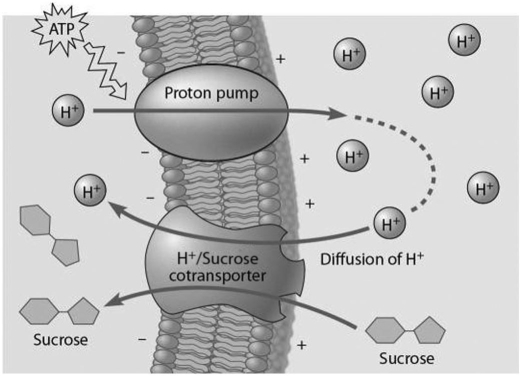
(Multiple Choice)
4.8/5 (83)
(83) Proteins that allow the diffusion of ions across membranes in the direction of their concentration gradients are most likely
(Multiple Choice)
4.9/5 (78)
(78) 
Filters
- Essay(0)
- Multiple Choice(0)
- Short Answer(0)
- True False(0)
- Matching(0)