



 Chat with AI
Exam 15: Regulation of Gene Expression

Exam 1: Introduction: Evolution and the Foundations of Biology36 Questions
Exam 2: The Chemical Context of Life135 Questions
Exam 3: Carbon and the Molecular Diversity of Life136 Questions
Exam 4: A Tour of the Cell75 Questions
Exam 5: Membrane Transport and Cell Signaling86 Questions
Exam 6: An Introduction to Metabolism79 Questions
Exam 7: Cellular Respiration and Fermentation99 Questions
Exam 8: Photosynthesis68 Questions
Exam 9: The Cell Cycle57 Questions
Exam 10: Meiosis and Sexual Life Cycles59 Questions
Exam 11: Mendel and the Gene Idea57 Questions
Exam 12: The Chromosomal Basis of Inheritance43 Questions
Exam 13: The Molecular Basis of Inheritance62 Questions
Exam 14: Gene Expression: From Gene to Protein77 Questions
Exam 15: Regulation of Gene Expression48 Questions
Exam 16: Development,stem Cells,and Cancer34 Questions
Exam 17: Viruses35 Questions
Exam 18: Genomes and Their Evolution31 Questions
Exam 19: Descent With Modification61 Questions
Exam 20: Phylogeny72 Questions
Exam 21: The Evolution of Populations81 Questions
Exam 22: The Origin of Species75 Questions
Exam 23: Broad Patterns of Evolution60 Questions
Exam 24: Early Life and the Diversification of Prokaryotes99 Questions
Exam 25: The Origin and Diversification of Eukaryotes80 Questions
Exam 26: The Colonization of Land by Plants and Fungi128 Questions
Exam 27: The Rise of Animal Diversity93 Questions
Exam 28: Plant Structure and Growth67 Questions
Exam 29: Resource Acquisition,nutrition,and Transport in Vascular Plants115 Questions
Exam 30: Reproduction and Domestication of Flowering Plants72 Questions
Exam 31: Plant Responses to Internal and External Signals74 Questions
Exam 32: Homeostasis and Endocrine Signaling116 Questions
Exam 33: Animal Nutrition75 Questions
Exam 34: Circulation and Gas Exchange94 Questions
Exam 35: The Immune System96 Questions
Exam 36: Reproduction and Development123 Questions
Exam 37: Neurons,synapses,and Signaling77 Questions
Exam 38: Nervous and Sensory Systems105 Questions
Exam 39: Motor Mechanisms and Behavior83 Questions
Exam 40: Population Ecology and the Distribution of Organisms93 Questions
Exam 41: Ecological Communities59 Questions
Exam 42: Ecosystems and Energy86 Questions
Exam 43: Conservation Biology and Global Change71 Questions
Select questions type


A researcher found a method she could use to manipulate and quantify phosphorylation and methylation in embryonic cells in culture.In one set of experiments she succeeded in decreasing methylation of histone tails.Which of the following results would she most likely see?
(Multiple Choice)
4.7/5  (65)
(65) Which of the following statements correctly describes the role of general transcription factors in eukaryotes?
(Multiple Choice)
4.7/5 (75)
(75) Gene expression can be blocked by a process called RNA interference.Which of the following molecules is involved in this process?
(Multiple Choice)
4.9/5 (74)
(74) Gene expression might be altered based on post-transcriptional processing in eukaryotes rather than prokaryotes.Which of the following statements describes this difference?
(Multiple Choice)
4.9/5 (76)
(76) 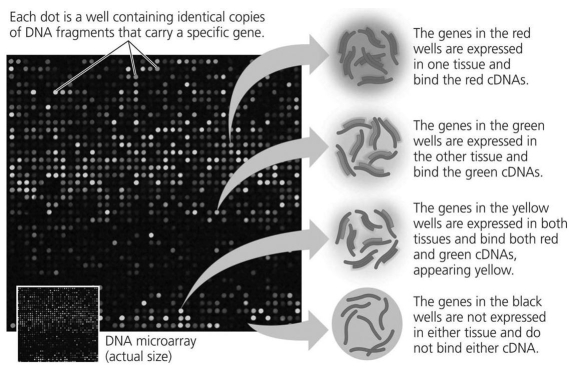 In the microarray shown in the figure above,if you were searching for genes whose expression was inhibited by hormone treatment,you would search for sequences spotted on the array that showed what level of fluorescence?
 (Multiple Choice)
4.9/5 (76)
(76) Which of the following statements describes one of the functions of the protein called ubiquitin?
(Multiple Choice)
4.8/5 (87)
(87) In positive control of several sugar-metabolism-related operons,the cAMP receptor protein (CRP)binds to DNA to stimulate transcription.Which of the following events activates CRP?
(Multiple Choice)
4.9/5 (82)
(82) What would occur if the repressor of an inducible operon were mutated so it could not bind the operator?
(Multiple Choice)
4.8/5 (63)
(63) If a particular operon encodes enzymes for making an essential amino acid and is regulated like the trp operon,then
(Multiple Choice)
4.8/5 (83)
(83) You are given an experimental problem involving control of a gene's expression in the embryo of a particular species.One of your first questions is whether the gene's expression is controlled at the level of transcription or translation.Which of the following experiments might best give you an answer?
(Multiple Choice)
4.9/5 (86)
(86) Suppose an experimenter becomes proficient with a technique that allows her to move DNA sequences within a prokaryotic genome.If she moves the promoter for the lac operon to the region between the beta galactosidase (lacZ)gene and the permease (lacY)gene,which of the following results would be likely?
(Multiple Choice)
4.7/5 (69)
(69) A researcher found a method she could use to manipulate and quantify acetylation in embryonic cells in culture.In one set of experiments using this procedure in Drosophila,she was readily successful in increasing acetylation of amino acids in histone tails.Which of the following results would she most likely see?
(Multiple Choice)
4.7/5 (80)
(80) Which of the following is an example of post-transcriptional control of gene expression?
(Multiple Choice)
4.8/5 (88)
(88) Which of the following molecules,when taken up by the cell,binds to the repressor so that the repressor no longer binds to the operator?
(Multiple Choice)
4.8/5 (76)
(76) Researchers are looking for better treatments for breast cancer.For a particular DNA microarray assay (DNA chip),cDNA has been made from the mRNAs of a dozen patients' breast tumor biopsies.What would the researchers be looking for in this type of assay?
(Multiple Choice)
4.8/5 (77)
(77) Which of the following would not be true of cDNA produced using human brain tissue as the starting material?
(Multiple Choice)
4.9/5 (80)
(80) Which of the following results can a DNA microarray assay detect or identify?
(Multiple Choice)
4.8/5 (91)
(91) Altering patterns of gene expression in prokaryotes would most likely contribute to the organism's survival in which of the following ways?
(Multiple Choice)
4.8/5 (84)
(84) Suppose an experimenter becomes proficient with a technique that allows her to move DNA sequences within a prokaryotic genome.If she moves the operator to the far end of the operon,past the transacetylase (lacA)gene,which of the following results would likely occur when the cell is exposed to lactose?
(Multiple Choice)
4.8/5 (87)
(87) 
Filters
- Essay(0)
- Multiple Choice(0)
- Short Answer(0)
- True False(0)
- Matching(0)