



 Chat with AI
Exam 17: Viruses

Exam 1: Introduction: Evolution and the Foundations of Biology36 Questions
Exam 2: The Chemical Context of Life135 Questions
Exam 3: Carbon and the Molecular Diversity of Life136 Questions
Exam 4: A Tour of the Cell75 Questions
Exam 5: Membrane Transport and Cell Signaling86 Questions
Exam 6: An Introduction to Metabolism79 Questions
Exam 7: Cellular Respiration and Fermentation99 Questions
Exam 8: Photosynthesis68 Questions
Exam 9: The Cell Cycle57 Questions
Exam 10: Meiosis and Sexual Life Cycles59 Questions
Exam 11: Mendel and the Gene Idea57 Questions
Exam 12: The Chromosomal Basis of Inheritance43 Questions
Exam 13: The Molecular Basis of Inheritance62 Questions
Exam 14: Gene Expression: From Gene to Protein77 Questions
Exam 15: Regulation of Gene Expression48 Questions
Exam 16: Development,stem Cells,and Cancer34 Questions
Exam 17: Viruses35 Questions
Exam 18: Genomes and Their Evolution31 Questions
Exam 19: Descent With Modification61 Questions
Exam 20: Phylogeny72 Questions
Exam 21: The Evolution of Populations81 Questions
Exam 22: The Origin of Species75 Questions
Exam 23: Broad Patterns of Evolution60 Questions
Exam 24: Early Life and the Diversification of Prokaryotes99 Questions
Exam 25: The Origin and Diversification of Eukaryotes80 Questions
Exam 26: The Colonization of Land by Plants and Fungi128 Questions
Exam 27: The Rise of Animal Diversity93 Questions
Exam 28: Plant Structure and Growth67 Questions
Exam 29: Resource Acquisition,nutrition,and Transport in Vascular Plants115 Questions
Exam 30: Reproduction and Domestication of Flowering Plants72 Questions
Exam 31: Plant Responses to Internal and External Signals74 Questions
Exam 32: Homeostasis and Endocrine Signaling116 Questions
Exam 33: Animal Nutrition75 Questions
Exam 34: Circulation and Gas Exchange94 Questions
Exam 35: The Immune System96 Questions
Exam 36: Reproduction and Development123 Questions
Exam 37: Neurons,synapses,and Signaling77 Questions
Exam 38: Nervous and Sensory Systems105 Questions
Exam 39: Motor Mechanisms and Behavior83 Questions
Exam 40: Population Ecology and the Distribution of Organisms93 Questions
Exam 41: Ecological Communities59 Questions
Exam 42: Ecosystems and Energy86 Questions
Exam 43: Conservation Biology and Global Change71 Questions
Select questions type


You isolate an infectious substance that is capable of causing disease in plants,but you do not know whether the infectious agent is a bacterium,virus,or prion.You have four methods at your disposal that you can use to analyze the substance in order to determine the nature of the infectious agent.
I.Treat the substance with nucleases that destroy all nucleic acids and then determine whether it is still infectious.
II.Filter the substance to remove all elements smaller than what can be easily seen under a light microscope.
III.Culture the substance by itself on nutritive medium,away from any plant cells.
IV.Treat the sample with proteases that digest all proteins and then determine whether it is still infectious.
If you already knew that the infectious agent was either bacterial or viral,which treatment listed above would allow you to distinguish between these two possibilities?
(Multiple Choice)
4.9/5  (77)
(77) Some people who have had a herpesvirus-mediated cold sore or genital sore may have flare-ups for the rest of their life.Why does this occur?
(Multiple Choice)
5.0/5 (81)
(81) In 1971,David Baltimore described a scheme for classifying viruses based on how the virus produces mRNA,referred to as the Baltimore requirements.The table below shows the results of testing five viruses (A-E)for nuclease sensitivity,the ability of the viral genome to act as an mRNA,and the presence (+)or absence (-)of each virus's own polymerase. 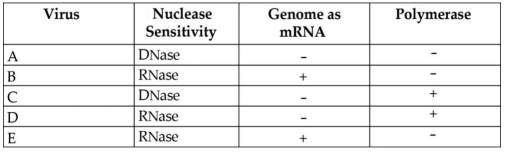 Based on the table above,which virus meets the requirements for a bacteriophage?
 (Multiple Choice)
4.7/5 (81)
(81) Which of the following responses correctly lists the order of events in a generalized viral replicative cycle?
(Multiple Choice)
4.9/5 (83)
(83) Which of the following statements accurately describes plant virus infections?
(Multiple Choice)
4.8/5 (81)
(81) Which of the following characteristics,structures,or processes is common to both bacteria and viruses?
(Multiple Choice)
4.9/5 (80)
(80) A bacterium is infected with an experimentally constructed bacteriophage composed of the T2 phage protein coat and T4 phage DNA.The new phages produced would have
(Multiple Choice)
4.8/5 (91)
(91) Which of the following processes can be effective in preventing the onset of viral infection in humans?
(Multiple Choice)
4.9/5 (71)
(71) Which of the following nucleic acids make(s)up viral genomes?
(Multiple Choice)
4.9/5 (68)
(68)  -Which of the three types of viruses shown in the figure above would you expect to include glycoproteins as part of their overall structure?
 (Multiple Choice)
4.9/5 (78)
(78) Which of the following statements correctly describes adenoviruses?
(Multiple Choice)
4.7/5 (72)
(72) Which of the following characteristics determine a virus's host range?
(Multiple Choice)
4.8/5 (80)
(80) Which of the following statements correctly describes the best predictor of how much damage a virus causes?
(Multiple Choice)
5.0/5 (75)
(75) You isolate an infectious substance that is capable of causing disease in plants,but you do not know whether the infectious agent is a bacterium,virus,or prion.You have four methods at your disposal that you can use to analyze the substance in order to determine the nature of the infectious agent.
I.Treat the substance with nucleases that destroy all nucleic acids and then determine whether it is still infectious.
II.Filter the substance to remove all elements smaller than what can be easily seen under a light microscope.
III.Culture the substance by itself on nutritive medium,away from any plant cells.
IV.Treat the sample with proteases that digest all proteins and then determine whether it is still infectious.
If you already knew that the infectious agent was a prion,which treatment listed above would allow you to distinguish this?
(Multiple Choice)
4.8/5 (73)
(73) 
Filters
- Essay(0)
- Multiple Choice(0)
- Short Answer(0)
- True False(0)
- Matching(0)