



 Chat with AI
Exam 24: Early Life and the Diversification of Prokaryotes

Exam 1: Introduction: Evolution and the Foundations of Biology36 Questions
Exam 2: The Chemical Context of Life135 Questions
Exam 3: Carbon and the Molecular Diversity of Life136 Questions
Exam 4: A Tour of the Cell75 Questions
Exam 5: Membrane Transport and Cell Signaling86 Questions
Exam 6: An Introduction to Metabolism79 Questions
Exam 7: Cellular Respiration and Fermentation99 Questions
Exam 8: Photosynthesis68 Questions
Exam 9: The Cell Cycle57 Questions
Exam 10: Meiosis and Sexual Life Cycles59 Questions
Exam 11: Mendel and the Gene Idea57 Questions
Exam 12: The Chromosomal Basis of Inheritance43 Questions
Exam 13: The Molecular Basis of Inheritance62 Questions
Exam 14: Gene Expression: From Gene to Protein77 Questions
Exam 15: Regulation of Gene Expression48 Questions
Exam 16: Development,stem Cells,and Cancer34 Questions
Exam 17: Viruses35 Questions
Exam 18: Genomes and Their Evolution31 Questions
Exam 19: Descent With Modification61 Questions
Exam 20: Phylogeny72 Questions
Exam 21: The Evolution of Populations81 Questions
Exam 22: The Origin of Species75 Questions
Exam 23: Broad Patterns of Evolution60 Questions
Exam 24: Early Life and the Diversification of Prokaryotes99 Questions
Exam 25: The Origin and Diversification of Eukaryotes80 Questions
Exam 26: The Colonization of Land by Plants and Fungi128 Questions
Exam 27: The Rise of Animal Diversity93 Questions
Exam 28: Plant Structure and Growth67 Questions
Exam 29: Resource Acquisition,nutrition,and Transport in Vascular Plants115 Questions
Exam 30: Reproduction and Domestication of Flowering Plants72 Questions
Exam 31: Plant Responses to Internal and External Signals74 Questions
Exam 32: Homeostasis and Endocrine Signaling116 Questions
Exam 33: Animal Nutrition75 Questions
Exam 34: Circulation and Gas Exchange94 Questions
Exam 35: The Immune System96 Questions
Exam 36: Reproduction and Development123 Questions
Exam 37: Neurons,synapses,and Signaling77 Questions
Exam 38: Nervous and Sensory Systems105 Questions
Exam 39: Motor Mechanisms and Behavior83 Questions
Exam 40: Population Ecology and the Distribution of Organisms93 Questions
Exam 41: Ecological Communities59 Questions
Exam 42: Ecosystems and Energy86 Questions
Exam 43: Conservation Biology and Global Change71 Questions
Select questions type


Please use the following information to answer the question(s)below.
A hypothetical bacterium swims among human intestinal contents until it finds a suitable location on the intestinal lining.It adheres to the intestinal lining using a feature that also protects it from bacteriophages and dehydration.Fecal matter from a human in whose intestine this bacterium lives can spread the bacterium,even after being mixed with water and boiled.The bacterium is not susceptible to the penicillin family of antibiotics.It contains no plasmids and relatively little peptidoglycan.
-What should be true of the cell wall of this bacterium?
(Multiple Choice)
4.9/5  (90)
(90) Certain proteins of the complex motor that drives bacterial flagella are modified versions of proteins that had previously belonged to plasma membrane pumps.This evidence supports the claim that
(Multiple Choice)
4.8/5 (82)
(82) The table depicts characteristics of five prokaryotic species (A-E).Use the information in the table to answer the following question(s).
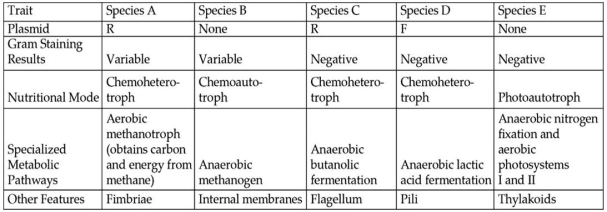 Table 24.1
-Which species in Table 24.1 should be able to respond most readily to taxes (plural of taxis)?
Table 24.1
-Which species in Table 24.1 should be able to respond most readily to taxes (plural of taxis)? (Multiple Choice)
4.8/5 (85)
(85) In general,what is the primary ecological role of prokaryotes?
(Multiple Choice)
4.8/5 (71)
(71) If all prokaryotes on Earth suddenly vanished,which of the following would be the most likely and most direct result?
(Multiple Choice)
4.7/5 (80)
(80) Suppose bacteria are grown on a petri dish that contains nutrient agar and the antibiotic ampicillin.After observing the bacteria growth on the plate for two days,you notice that only some of the bacteria have survived.What is a plausible explanation for your observations?
(Multiple Choice)
4.9/5 (77)
(77) Mycoplasmas are bacteria with the rare structural feature that they do not have cell walls.On the basis of this fact,which statement concerning mycoplasmas should be true?
(Multiple Choice)
5.0/5 (86)
(86) Thiobacillus ferrooxidans is a type of bacteria that oxidizes iron compounds for energy and then uses that energy to build carbohydrates.We might best recognize this bacterium as the rust-colored ring that builds up inside toilet bowls.Thiobacillus ferrooxidans is an example of a
(Multiple Choice)
4.8/5 (80)
(80) Please use the following information to answer the question(s)below.
A hypothetical bacterium swims among human intestinal contents until it finds a suitable location on the intestinal lining.It adheres to the intestinal lining using a feature that also protects it from bacteriophages and dehydration.Fecal matter from a human in whose intestine this bacterium lives can spread the bacterium,even after being mixed with water and boiled.The bacterium is not susceptible to the penicillin family of antibiotics.It contains no plasmids and relatively little peptidoglycan.
-This bacterium's ability to survive in a human who is taking penicillin pills may be due to the presence of which of the following?
1)penicillin-resistance genes
2)a gram-positive cell wall
3)a gram-negative cell wall
4)an endospore
(Multiple Choice)
4.9/5 (76)
(76) The structure of a prokaryotic ribosome is not the same as a ribosome in an animal cell.As a result,which of the following is correct?
(Multiple Choice)
5.0/5 (83)
(83) The table depicts characteristics of five prokaryotic species (A-E).Use the information in the table to answer the following question(s).
Table 24.1
-Which two species in Table 24.1 should have much more phospholipid,in the form of bilayers,in their cytoplasm than most other bacteria?
Table 24.1
-Which two species in Table 24.1 should have much more phospholipid,in the form of bilayers,in their cytoplasm than most other bacteria? (Multiple Choice)
4.9/5 (78)
(78) Figure 24.2 depicts changes to the amount of DNA present in a recipient cell that is engaged in conjugation with an Hfr cell.Hfr cell DNA begins entering the recipient cell at time A.Assume that reciprocal crossing over occurs (in other words,a fragment of the recipient's chromosome is exchanged for a homologous fragment from the Hfr cell's DNA).Use Figure 24.2 to answer the following question(s).
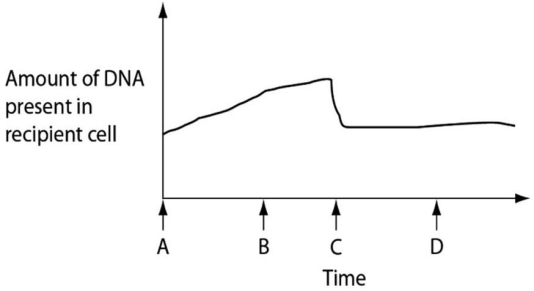 Figure 24.2
-How is the recipient cell different at time D than it was at time A?
Figure 24.2
-How is the recipient cell different at time D than it was at time A? (Multiple Choice)
4.8/5 (73)
(73) The cell also lacks F factors and F plasmids.Which mechanism(s)of genetic recombination can possibly take place?
1)conjugation
2)transduction
3)transformation
(Multiple Choice)
4.8/5 (75)
(75) The table depicts characteristics of five prokaryotic species (A-E).Use the information in the table to answer the following question(s).
Table 24.1
-Which species in Table 24.1 is most self-sustaining in terms of obtaining nutrition in environments containing little fixed nitrogen or carbon?
Table 24.1
-Which species in Table 24.1 is most self-sustaining in terms of obtaining nutrition in environments containing little fixed nitrogen or carbon? (Multiple Choice)
5.0/5 (91)
(91) According to scientists' hypotheses,prokaryotes most likely evolved prior to eukaryotes because
(Multiple Choice)
4.8/5 (84)
(84) Why can prokaryotic population numbers be magnitudes larger than populations of multicellular eukaryotes?
(Multiple Choice)
4.9/5 (73)
(73) 
Filters
- Essay(0)
- Multiple Choice(0)
- Short Answer(0)
- True False(0)
- Matching(0)