



 Chat with AI
Exam 30: Reproduction and Domestication of Flowering Plants

Exam 1: Introduction: Evolution and the Foundations of Biology36 Questions
Exam 2: The Chemical Context of Life135 Questions
Exam 3: Carbon and the Molecular Diversity of Life136 Questions
Exam 4: A Tour of the Cell75 Questions
Exam 5: Membrane Transport and Cell Signaling86 Questions
Exam 6: An Introduction to Metabolism79 Questions
Exam 7: Cellular Respiration and Fermentation99 Questions
Exam 8: Photosynthesis68 Questions
Exam 9: The Cell Cycle57 Questions
Exam 10: Meiosis and Sexual Life Cycles59 Questions
Exam 11: Mendel and the Gene Idea57 Questions
Exam 12: The Chromosomal Basis of Inheritance43 Questions
Exam 13: The Molecular Basis of Inheritance62 Questions
Exam 14: Gene Expression: From Gene to Protein77 Questions
Exam 15: Regulation of Gene Expression48 Questions
Exam 16: Development,stem Cells,and Cancer34 Questions
Exam 17: Viruses35 Questions
Exam 18: Genomes and Their Evolution31 Questions
Exam 19: Descent With Modification61 Questions
Exam 20: Phylogeny72 Questions
Exam 21: The Evolution of Populations81 Questions
Exam 22: The Origin of Species75 Questions
Exam 23: Broad Patterns of Evolution60 Questions
Exam 24: Early Life and the Diversification of Prokaryotes99 Questions
Exam 25: The Origin and Diversification of Eukaryotes80 Questions
Exam 26: The Colonization of Land by Plants and Fungi128 Questions
Exam 27: The Rise of Animal Diversity93 Questions
Exam 28: Plant Structure and Growth67 Questions
Exam 29: Resource Acquisition,nutrition,and Transport in Vascular Plants115 Questions
Exam 30: Reproduction and Domestication of Flowering Plants72 Questions
Exam 31: Plant Responses to Internal and External Signals74 Questions
Exam 32: Homeostasis and Endocrine Signaling116 Questions
Exam 33: Animal Nutrition75 Questions
Exam 34: Circulation and Gas Exchange94 Questions
Exam 35: The Immune System96 Questions
Exam 36: Reproduction and Development123 Questions
Exam 37: Neurons,synapses,and Signaling77 Questions
Exam 38: Nervous and Sensory Systems105 Questions
Exam 39: Motor Mechanisms and Behavior83 Questions
Exam 40: Population Ecology and the Distribution of Organisms93 Questions
Exam 41: Ecological Communities59 Questions
Exam 42: Ecosystems and Energy86 Questions
Exam 43: Conservation Biology and Global Change71 Questions
Select questions type


In which of the following pairs are the two terms equivalent?
(Multiple Choice)
4.7/5  (96)
(96) Which of the following is true about vegetative reproduction?
(Multiple Choice)
4.8/5 (71)
(71) Which of the following is the correct sequence of processes that takes place when a flowering plant reproduces?
(Multiple Choice)
4.9/5 (80)
(80) The embryo of a grass seed is enclosed by two protective sheaths,a ________,which covers the young shoot,and a(n)________,which covers the young root.
(Multiple Choice)
4.9/5 (82)
(82) A fruit that develops from many separate carpels of one flower is referred as
(Multiple Choice)
4.8/5 (77)
(77) The following questions refer to the diagram of an embryo sac of an angiosperm shown in Figure 30.1.
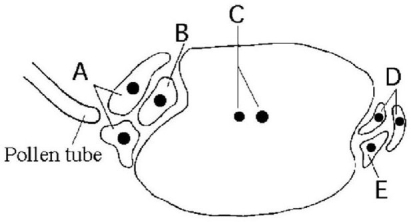 Figure 30.1
-Based on Figure 30.1,which cell(s)become(s)the triploid endosperm?
Figure 30.1
-Based on Figure 30.1,which cell(s)become(s)the triploid endosperm? (Multiple Choice)
4.7/5 (75)
(75) Some dioecious species have the XY genotype for male and XX for female.After double fertilization,what would be the genotypes of the embryos and endosperm nuclei?
(Multiple Choice)
4.9/5 (85)
(85) Which of the following plants is correctly matched with its fruit type?
(Multiple Choice)
4.8/5 (72)
(72) Which of the following best describes the ploidy level of a fertilized embryo sac?
(Multiple Choice)
4.8/5 (85)
(85) The following questions refer to the diagram of an embryo sac of an angiosperm shown in Figure 30.1.
Figure 30.1
-Based on Figure 30.1,which cell(s)guide(s)the pollen tube to the egg cell?
Figure 30.1
-Based on Figure 30.1,which cell(s)guide(s)the pollen tube to the egg cell? (Multiple Choice)
4.8/5 (83)
(83) The floral parts are arranged in concentric whorls.Which of the following sequences of floral parts is correct from the center to periphery of the receptacle?
(Multiple Choice)
4.8/5 (86)
(86) In the process of evolution,________ in the life cycle became reduced in size and completely dependent on ________ for nutrients.
(Multiple Choice)
4.8/5 (84)
(84) In a typical dicot ovule,a surviving megaspore divided by ________ consecutive mitotic divisions without cytokinesis results in ________ nuclei.
(Multiple Choice)
4.9/5 (72)
(72) Cassava is a ________ crop that has been modified by biotechnology experiments.
(Multiple Choice)
4.9/5 (70)
(70) 
Filters
- Essay(0)
- Multiple Choice(0)
- Short Answer(0)
- True False(0)
- Matching(0)