



 Chat with AI
Exam 20: Thermodynamics Entropy, Free Energy, and Reaction Direction

Exam 1: Keys to Studying Chemistry Definitions, Units, and Problem Solving71 Questions
Exam 2: The Components of Matter100 Questions
Exam 3: Stoichiometry of Formulas and Equations70 Questions
Exam 4: Three Major Classes of Chemical Reactions111 Questions
Exam 5: Gases and the Kinetic-Molecular Theory97 Questions
Exam 6: Thermochemistry Energy Flow and Chemical Change72 Questions
Exam 7: Quantum Theory and Atomic Structure69 Questions
Exam 8: Electron Configuration and Chemical Periodicity77 Questions
Exam 9: Models of Chemical Bonding61 Questions
Exam 10: The Shapes of Molecules98 Questions
Exam 11: Theories of Covalent Bonding48 Questions
Exam 12: Intermolecular Forces Liquids, Solids, and Phase Changes90 Questions
Exam 13: The Properties of Mixtures Solutions and Colloids96 Questions
Exam 14: Periodic Patterns in the Main-Group Elements102 Questions
Exam 15: Organic Compounds and the Atomic Properties of Carbon107 Questions
Exam 16: Kinetics Rates and Mechanisms of Chemical Reactions78 Questions
Exam 17: Equilibrium the Extent of Chemical Reactions97 Questions
Exam 18: Acid-Base Equilibria100 Questions
Exam 19: Ionic Equilibria in Aqueous Systems114 Questions
Exam 20: Thermodynamics Entropy, Free Energy, and Reaction Direction84 Questions
Exam 21: Electrochemistry Chemical Change and Electrical Work100 Questions
Exam 22: The Elements in Nature and Industry45 Questions
Exam 23: Transition Elements and Their Coordination Compounds82 Questions
Exam 24: Nuclear Reactions and Their Applications81 Questions
Select questions type


Which of the following is necessary for a process to be spontaneous?
(Multiple Choice)
4.9/5  (86)
(86) Calculate ΔS° for the reaction SiCl4(g) + 2Mg(s) → 2MgCl2(s) + Si(s)
Substance: SiCl4(g) Mg(s) MgCl2(s) Si(s)
S°(J/K·mol): 330.73 32.68 89.62 18.83
(Multiple Choice)
4.8/5 (94)
(94) Nitric oxide reacts with chlorine to form NOCl. The data refer to 298 K. 2NO(g) + Cl2(g) → 2NOCl(g)
Substance: NO(g) Cl2(g) NOCl(g)
ΔH°f (kJ/mol): 90.29 0 51.71
ΔG°f (kJ/mol): 86.60 0 66.07
S°(J/K·mol): 210.65 223.0 261.6
What is the value of ΔG° for this reaction at 550 K?
(Multiple Choice)
5.0/5 (74)
(74) The entropy of one mole of oxygen gas in a 0.5-L container is less than it would be in a 22.4-L container at the same temperature.
(True/False)
4.7/5 (76)
(76) You are given pure samples of ethane, C2H6(g), and toluene, C7H8(l). What prediction would you make concerning their standard molar entropies at 298 K?
(Multiple Choice)
4.9/5 (76)
(76) Which of the following is always true for an exothermic process?
(Multiple Choice)
4.8/5 (69)
(69) Use the given data at 298 K to calculate ΔG° for the reaction 2Cl2(g) + SO2(g) → SOCl2(g) + Cl2O(g)
Substance: Cl2(g) SO2(g) SOCl2 (g) Cl2O(g)
ΔH°f (kJ/mol): 0 -296.8 -212.5 80.3
S°(J/K·mol): 223.0 248.1 309.77 266.1
(Multiple Choice)
4.8/5 (78)
(78) Which of the following is always true for an endothermic process?
(Multiple Choice)
4.7/5 (86)
(86) For a chemical reaction to be non-spontaneous at any temperature, which of the following conditions must be met?
(Multiple Choice)
4.8/5 (86)
(86) A certain process has ΔH° > 0, ΔS° < 0, and ΔG° > 0. The values of ΔH° and ΔS° do not depend on the temperature. Which of the following is a correct conclusion about this process?
(Multiple Choice)
4.9/5 (80)
(80) For a chemical reaction to be spontaneous only at low temperatures, which of the following conditions must be met?
(Multiple Choice)
5.0/5 (66)
(66) When a sky diver free-falls through the air, the process is
(Multiple Choice)
4.7/5 (60)
(60) Which relationship best describes ΔS° for the following reaction? CO(g) + H2O(g) → CO2(g) + H2(g)
(Multiple Choice)
4.7/5 (76)
(76) A certain process has ΔSuniv > 0 at 25°C. What does one know about the process?
(Multiple Choice)
4.9/5 (81)
(81) Use the thermodynamic data at 298 K below to determine the Ksp for barium carbonate, BaCO3 at this temperature. Substance: Ba2+(aq) CO32-(aq) BaCO3(s)
ΔH°f (kJ/mol): -538.36 -676.26 -1219
ΔG°f (kJ/mol): -560.7 -528.1 -1139
S°(J/K·mol): 13 -53.1 112
(Multiple Choice)
4.7/5 (81)
(81) Which relationship or statement best describes ΔS° for the following reaction? KCl(s) → K+(aq) + Cl-(aq)
(Multiple Choice)
4.8/5 (86)
(86) Which of the following conditions will ensure that a chemical reaction will definitely proceed in the forward direction, toward products?
(Multiple Choice)
4.9/5 (74)
(74) Consider the figure that shows ΔG° for a chemical process plotted against absolute temperature. From this plot, it is reasonable to conclude that 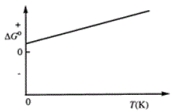
(Multiple Choice)
4.8/5 (68)
(68) Which one of the following changes of state increases the entropy of the system?
(Multiple Choice)
4.9/5 (91)
(91) You are given pure samples of pentane, CH3CH2CH2CH2CH3(l), and 1,3-pentadiene, CH2=CHCH=CHCH3(l). What prediction would you make concerning their standard molar entropies at 298 K?
(Multiple Choice)
5.0/5 (84)
(84) 
Filters
- Essay(0)
- Multiple Choice(0)
- Short Answer(0)
- True False(0)
- Matching(0)