



 Chat with AI
Exam 20: Thermodynamics Entropy, Free Energy, and Reaction Direction

Exam 1: Keys to Studying Chemistry Definitions, Units, and Problem Solving71 Questions
Exam 2: The Components of Matter100 Questions
Exam 3: Stoichiometry of Formulas and Equations70 Questions
Exam 4: Three Major Classes of Chemical Reactions111 Questions
Exam 5: Gases and the Kinetic-Molecular Theory97 Questions
Exam 6: Thermochemistry Energy Flow and Chemical Change72 Questions
Exam 7: Quantum Theory and Atomic Structure69 Questions
Exam 8: Electron Configuration and Chemical Periodicity77 Questions
Exam 9: Models of Chemical Bonding61 Questions
Exam 10: The Shapes of Molecules98 Questions
Exam 11: Theories of Covalent Bonding48 Questions
Exam 12: Intermolecular Forces Liquids, Solids, and Phase Changes90 Questions
Exam 13: The Properties of Mixtures Solutions and Colloids96 Questions
Exam 14: Periodic Patterns in the Main-Group Elements102 Questions
Exam 15: Organic Compounds and the Atomic Properties of Carbon107 Questions
Exam 16: Kinetics Rates and Mechanisms of Chemical Reactions78 Questions
Exam 17: Equilibrium the Extent of Chemical Reactions97 Questions
Exam 18: Acid-Base Equilibria100 Questions
Exam 19: Ionic Equilibria in Aqueous Systems114 Questions
Exam 20: Thermodynamics Entropy, Free Energy, and Reaction Direction84 Questions
Exam 21: Electrochemistry Chemical Change and Electrical Work100 Questions
Exam 22: The Elements in Nature and Industry45 Questions
Exam 23: Transition Elements and Their Coordination Compounds82 Questions
Exam 24: Nuclear Reactions and Their Applications81 Questions
Select questions type


For a chemical reaction to be spontaneous at all temperatures, which of the following conditions must be met?
(Multiple Choice)
4.8/5  (75)
(75) Consider the reaction CuI(s)  Cu+(aq) + I-(aq)
If the concentrations of the Cu+ and I- ions in equilibrium at 298 K are both equal to 1.03 × 10⁻⁶ M, what is the value of ΔG° for the reaction?
Cu+(aq) + I-(aq)
If the concentrations of the Cu+ and I- ions in equilibrium at 298 K are both equal to 1.03 × 10⁻⁶ M, what is the value of ΔG° for the reaction? (Multiple Choice)
4.9/5 (85)
(85) Calculate the equilibrium constant at 25°C for the reaction of methane with water to form carbon dioxide and hydrogen. The data refer to 25°C. CH4(g) + 2H2O(g)  CO2(g) + 4H2(g)

CO2(g) + 4H2(g)
(Multiple Choice)
4.9/5 (81)
(81) In 1774 Joseph Priestley prepared the element oxygen by heating mercury(II) oxide: HgO(s) → Hg(l) + ½O2(g)
For this reaction, ΔH° = 90.84 kJ and ΔS° = 108 J/K. Which of the following statements is true?
(Multiple Choice)
4.9/5 (86)
(86) Which of the following is true for a system at equilibrium?
(Multiple Choice)
4.8/5 (82)
(82) Which, if any, of the following processes is spontaneous under the specified conditions?
(Multiple Choice)
4.7/5 (82)
(82) Which relationship best describes ΔS° for the following reaction? 8H2(g) + S8(s) → 8H2S(g)
(Multiple Choice)
4.9/5 (84)
(84) Elemental boron can be formed by reaction of boron trichloride with hydrogen. BCl3(g) + 1.5H2(g) → B(s) + 3HCl(g)
Calculate ΔG° for the reaction.
Substance: BCl3(g) H2(g) B(s) HCl(g)
ΔG°f (kJ/mol): -388.7 0 0 -95.3
(Multiple Choice)
4.9/5 (88)
(88) Which one of the following phase changes decreases the entropy of the system?
(Multiple Choice)
5.0/5 (81)
(81) Which of the following pairs has the member with the greater molar entropy listed first? All systems are at 25°C.
(Multiple Choice)
4.7/5 (87)
(87) Which relationship or statement best describes ΔS° for the following reaction? HgS(s) + O2(g) → Hg(l) + SO2(g)
(Multiple Choice)
4.9/5 (72)
(72) Which of the following values is based on the Third Law of Thermodynamics?
(Multiple Choice)
4.7/5 (70)
(70) Consider the figure that shows ΔG° for a chemical process plotted against absolute temperature. 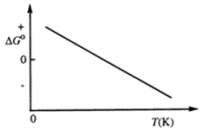 Which one of the following is an incorrect conclusion, based on the information in the diagram?
 (Multiple Choice)
4.8/5 (80)
(80) Calculate ΔG° for the reaction SiCl4(g) + 2Mg(s) → 2MgCl2(s) + Si(s)
Substance: SiCl4(g) Mg(s) MgCl2(s) Si(s)
ΔG°f (kJ/mol): -616.98 0 -591.79 0
(Multiple Choice)
4.8/5 (76)
(76) Which relationship or statement best describes ΔS° for the following reaction? 2H2S(g) + 3O2(g) → 2H2O(g) + 2SO2(g)
(Multiple Choice)
4.8/5 (89)
(89) The temperature at which the following process reaches equilibrium at 1.0 atm is the normal boiling point of hydrogen peroxide. H2O2(l)  H2O2(g)
Use the following thermodynamic information at 298 K to determine this temperature.
Substance: H2O2(l) H2O2(g)
ΔH°f (kJ/mol): -187.7 -136.3
ΔG°f (kJ/mol): -120.4 -105.6
S°(J/K·mol): 109.6 232.7
H2O2(g)
Use the following thermodynamic information at 298 K to determine this temperature.
Substance: H2O2(l) H2O2(g)
ΔH°f (kJ/mol): -187.7 -136.3
ΔG°f (kJ/mol): -120.4 -105.6
S°(J/K·mol): 109.6 232.7 (Multiple Choice)
4.9/5 (84)
(84) Which of the following results in a decrease in the entropy of the system?
(Multiple Choice)
4.9/5 (79)
(79) Hydrogen sulfide decomposes according to the following reaction 2H2S(g) → 2H2(g) + S2(g)
For this reaction at 298K ΔS° = 78.1 J/K, ΔH° = 169.4 kJ, and ΔG° = 146.1 kJ. What is the value of ΔG° at 900 K?
(Multiple Choice)
4.9/5 (80)
(80) 
Filters
- Essay(0)
- Multiple Choice(0)
- Short Answer(0)
- True False(0)
- Matching(0)