



 Chat with AI
Exam 10: Financial Markets and the Economy

Exam 1: Economics: the Study of Choice145 Questions
Exam 3: Demand and Supply251 Questions
Exam 4: Applications of Supply and Demand113 Questions
Exam 5: Macroeconomics: the Big Picture145 Questions
Exam 6: Measuring Total Output and Income161 Questions
Exam 7: Aggregate Demand and Aggregate Supply166 Questions
Exam 8: Economic Growth136 Questions
Exam 9: The Nature and Creation of Money224 Questions
Exam 10: Financial Markets and the Economy175 Questions
Exam 11: Monetary Policy and the Fed178 Questions
Exam 12: Government and Fiscal Policy177 Questions
Exam 13: Consumption and the Aggregate Expenditures Model219 Questions
Exam 14: Investment and Economic Activity138 Questions
Exam 15: Net Exports and International Finance199 Questions
Exam 16: Inflation and Unemployment132 Questions
Exam 17: A Brief History of Macroeconomic Thought and Policy123 Questions
Exam 18: Inequality, Poverty, and Discrimination140 Questions
Select questions type


An increase in the supply of bonds leads to an increase in aggregate demand.
(True/False)
4.7/5  (95)
(95) Use the following to answer questions .
Exhibit: A Shift in Money Demand 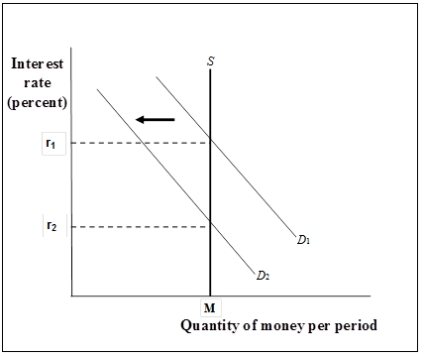 -(Exhibit: A Shift in Money Demand) Which of the following could cause the demand curve to shift from D2 to D1?
 (Multiple Choice)
4.9/5 (82)
(82) If the supply of bonds in the United States decreases, bond prices will rise. When bond prices rise interest rates will
(Multiple Choice)
4.9/5 (77)
(77) Consider Scenario 1 below:
Scenario 1
Consider two money management strategies. The first strategy is called the cash strategy in which an individual deposits her monthly earnings in a checking account and draws down equal amounts each day to finance her daily expenditures. Assume that she earns no interest on her checking accounts and funds are exhausted at the end of the month. The second strategy is called the bond fund strategy. Here the individual deposits one-quarter of her earnings in a checking account and the remaining three-quarters in a bond fund. The bond fund pays 1% interest per month. At the end of the week when the money in the checking account is exhausted, the individual replenishes it by withdrawing another one-quarter of her earnings from the bond fund for the next week. This process is repeated at the end of the second week and third week until the bond fund is exhausted.
In which strategy will the quantity of money demanded be greater?
(Multiple Choice)
4.8/5 (83)
(83) Use the following to answer questions .
Exhibit: A Shift in Money Demand
-(Exhibit: A Shift in Money Demand) What happens in the bond market as a result of the shift in the money demand curve from D1 to D2?
-(Exhibit: A Shift in Money Demand) What happens in the bond market as a result of the shift in the money demand curve from D1 to D2? (Multiple Choice)
4.9/5 (84)
(84) Use the following to answer questions .
Exhibit: Changes in the Money Supply  -(Exhibit: Changes in the Money Supply) Following the increase in money supply, at the original interest rate of 6%, there is
 (Multiple Choice)
4.8/5 (88)
(88) Suppose the U.S. dollar price of the Euro falls. This means that
(Multiple Choice)
4.8/5 (86)
(86) A $100 bond, which matures in one year, has a price of $75. The interest rate on this bond is
(Multiple Choice)
4.9/5 (86)
(86) If a British student pays her way to attend Harvard University, her action will:
(Multiple Choice)
4.8/5 (83)
(83) Use the following to answer questions .
Exhibit: The Bond Market  -(Exhibit: The Bond Market) Given a face value of $1,000, a price of $900, and quantity of Q1, the interest rate on the bond is
 (Multiple Choice)
5.0/5 (79)
(79) What happens in the money market when there is a decrease in the supply of money?
(Multiple Choice)
4.8/5 (83)
(83) The supply curve of money shows, all other things unchanged, the
(Multiple Choice)
4.9/5 (80)
(80) An increase in the money supply will shift the aggregate demand curve to the left, resulting in a lower equilibrium price level and a lower equilibrium real GDP.
(True/False)
4.8/5 (89)
(89) 
Filters
- Essay(0)
- Multiple Choice(0)
- Short Answer(0)
- True False(0)
- Matching(0)