



 Chat with AI
Exam 10: Financial Markets and the Economy

Exam 1: Economics: the Study of Choice145 Questions
Exam 3: Demand and Supply251 Questions
Exam 4: Applications of Supply and Demand113 Questions
Exam 5: Macroeconomics: the Big Picture145 Questions
Exam 6: Measuring Total Output and Income161 Questions
Exam 7: Aggregate Demand and Aggregate Supply166 Questions
Exam 8: Economic Growth136 Questions
Exam 9: The Nature and Creation of Money224 Questions
Exam 10: Financial Markets and the Economy175 Questions
Exam 11: Monetary Policy and the Fed178 Questions
Exam 12: Government and Fiscal Policy177 Questions
Exam 13: Consumption and the Aggregate Expenditures Model219 Questions
Exam 14: Investment and Economic Activity138 Questions
Exam 15: Net Exports and International Finance199 Questions
Exam 16: Inflation and Unemployment132 Questions
Exam 17: A Brief History of Macroeconomic Thought and Policy123 Questions
Exam 18: Inequality, Poverty, and Discrimination140 Questions
Select questions type


In the textbook model, wealth is held in two forms: money and in bond funds. Which of the following statements are true?
I. Money and bond funds earn the same interest rates in a well functioning money market.
II. Money is a more liquid asset compared to bond funds.
III. Bond funds are interest earning assets while money generally is not.
IV. The difference between the interest rates paid on money deposits and the interest return available from bonds is the cost of holding money.
(Multiple Choice)
4.8/5  (75)
(75) An increase in bond prices accompanies a decrease in interest rates.
(True/False)
4.8/5 (78)
(78) Use the following to answer questions .
Exhibit: A Shift in Money Supply 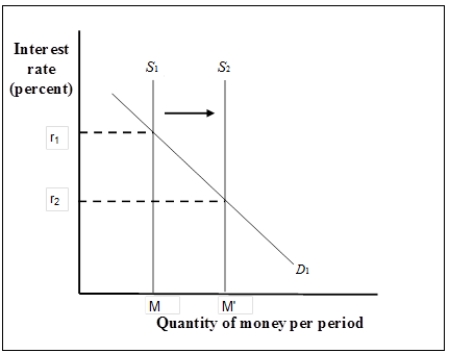 -(Exhibit: A Shift in Money Supply) What happens in the product market as a result of the increase in money supply?
 (Multiple Choice)
4.9/5 (78)
(78) An increase in financial innovations such as increased network of ATM machines and the widespread acceptance of debit cards
(Multiple Choice)
4.8/5 (79)
(79) Suppose the Fed announces that it expects interest rates to fall in the next quarter. What happens to the demand for money today?
(Multiple Choice)
4.8/5 (82)
(82) The transactions demand for money is the money households and firms hold in order to pay for goods and services they buy.
(True/False)
4.8/5 (67)
(67) When people hold money to make anticipated purchases of goods and services, they are exercising the _______ demand for money.
(Multiple Choice)
5.0/5 (71)
(71) Use the following to answer questions .
Exhibit: Economic Adjustments 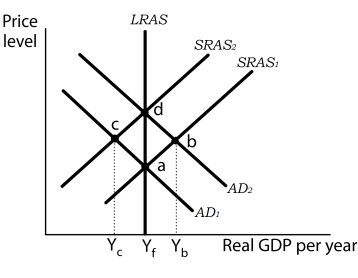 -(Exhibit: Economic Adjustments) If the economy is at point b, the Federal Reserve can close the output gap by selling bonds. In the bond market,
 (Multiple Choice)
4.8/5 (67)
(67) Use the following to answer questions .
Exhibit: A Shift in Money Supply
-(Exhibit: A Shift in Money Supply) What could have caused the money supply curve to shift from S1 to S2?
-(Exhibit: A Shift in Money Supply) What could have caused the money supply curve to shift from S1 to S2? (Multiple Choice)
4.9/5 (70)
(70) When the Fed sells government bonds in the open market, interest rates will rise.
(True/False)
4.9/5 (72)
(72) Money held for contingencies reflects the _______ demand for money.
(Multiple Choice)
4.9/5 (85)
(85) If the demand for U.S. dollars goes up, the exchange rate will.
(Multiple Choice)
4.8/5 (78)
(78) An increase in the money supply by the Federal Reserve is likely to increase
I. consumption expenditures
II. investment expenditures
III. interest rates
IV. the exchange rate
(Multiple Choice)
4.9/5 (79)
(79) Explain what happens in the bond market when the Fed conducts an open market purchase. A complete answer should explain what happens to bond prices, the quantity of bonds traded and the interest rate. Illustrate your answer with a demand-supply graph of the bond market.
(Essay)
4.7/5 (82)
(82) Action taken by the Fed to reduce the money supply will tend, all other things unchanged,
(Multiple Choice)
4.8/5 (70)
(70) 
Filters
- Essay(0)
- Multiple Choice(0)
- Short Answer(0)
- True False(0)
- Matching(0)