



 Chat with AI
Exam 10: Financial Markets and the Economy

Exam 1: Economics: the Study of Choice145 Questions
Exam 3: Demand and Supply251 Questions
Exam 4: Applications of Supply and Demand113 Questions
Exam 5: Macroeconomics: the Big Picture145 Questions
Exam 6: Measuring Total Output and Income161 Questions
Exam 7: Aggregate Demand and Aggregate Supply166 Questions
Exam 8: Economic Growth136 Questions
Exam 9: The Nature and Creation of Money224 Questions
Exam 10: Financial Markets and the Economy175 Questions
Exam 11: Monetary Policy and the Fed178 Questions
Exam 12: Government and Fiscal Policy177 Questions
Exam 13: Consumption and the Aggregate Expenditures Model219 Questions
Exam 14: Investment and Economic Activity138 Questions
Exam 15: Net Exports and International Finance199 Questions
Exam 16: Inflation and Unemployment132 Questions
Exam 17: A Brief History of Macroeconomic Thought and Policy123 Questions
Exam 18: Inequality, Poverty, and Discrimination140 Questions
Select questions type


An investor who felt that the U.S. and world economies were about to improve, would be likely to
(Multiple Choice)
4.8/5  (89)
(89) The demand for money curve is negatively sloped because people tend to hold less money at lower interest rates.
(True/False)
4.8/5 (93)
(93) An increase in interest rates due to a decrease in the money supply will
(Multiple Choice)
4.8/5 (84)
(84) Expectations that bond prices will be rising in the near future are likely to decrease the demand for money.
(True/False)
4.9/5 (84)
(84) Use the following to answer questions .
Exhibit: Changes in the Money Supply 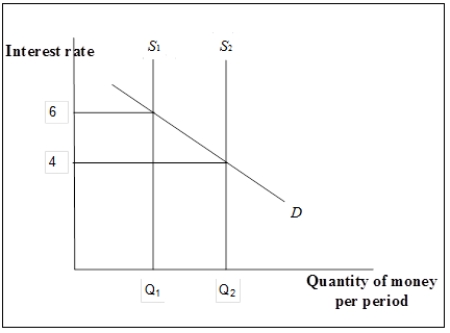 -(Exhibit: Changes in the Money Supply) The increase in money supply and the resulting decrease in the interest rate from 6% to 4%, is accomplished by action that also
 (Multiple Choice)
4.9/5 (83)
(83) Use the following to answer questions .
Exhibit: Foreign Exchange Market 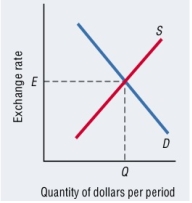 -(Exhibit: Foreign Exchange Market) The demand for dollars curve slopes downwards because
 (Multiple Choice)
4.8/5 (65)
(65) Use the following to answer questions .
Exhibit: Economic Adjustments 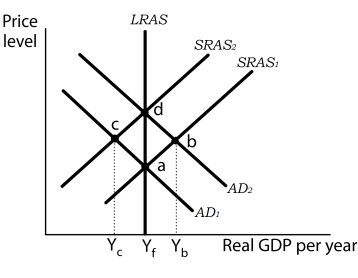 -(Exhibit: Economic Adjustments) If the economy is at point c, the Federal Reserve can close the output gap by buying bonds. In the bond market,
 (Multiple Choice)
4.8/5 (97)
(97) All else constant, a decrease in the supply of money will lead to
(Multiple Choice)
4.8/5 (87)
(87) Use the following to answer questions .
Exhibit: Economic Adjustments
-(Exhibit: Economic Adjustments) Short-run but not long-run equilibrium positions occur at points
-(Exhibit: Economic Adjustments) Short-run but not long-run equilibrium positions occur at points (Multiple Choice)
4.9/5 (88)
(88) Use the following to answer questions .
Exhibit: Foreign Exchange Market
-(Exhibit: Foreign Exchange Market) Who generates a supply of dollars in the foreign exchange market?
-(Exhibit: Foreign Exchange Market) Who generates a supply of dollars in the foreign exchange market? (Multiple Choice)
4.8/5 (71)
(71) When the Fed sells government bonds in the open market, the money supply will increase.
(True/False)
4.8/5 (79)
(79) Which of the following events is likely to generate a supply of U.S. dollars in the foreign exchange market?
(Multiple Choice)
4.7/5 (65)
(65) The supply curve of money is horizontal at the market interest rate.
(True/False)
4.8/5 (88)
(88) Use the following to answer questions .
Exhibit: The Money Supply and Aggregate Demand 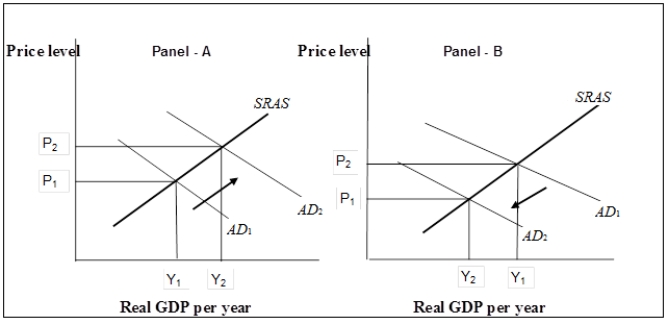 -(Exhibit: The Money Supply and Aggregate Demand) Panel (a) illustrates what happens when the Fed
 (Multiple Choice)
4.8/5 (74)
(74) Use the following to answer questions .
Exhibit: The Money Supply and Aggregate Demand
-(Exhibit: The Money Supply and Aggregate Demand) Panel (b) illustrates what happens when the Fed
-(Exhibit: The Money Supply and Aggregate Demand) Panel (b) illustrates what happens when the Fed (Multiple Choice)
4.7/5 (82)
(82) 
Filters
- Essay(0)
- Multiple Choice(0)
- Short Answer(0)
- True False(0)
- Matching(0)