



 Chat with AI
Exam 5: Membranes

Exam 1: The Science of Biology58 Questions
Exam 2: The Nature of Molecules and the Properties of Water76 Questions
Exam 3: The Chemical Building Blocks of Life74 Questions
Exam 4: Cell Structure63 Questions
Exam 5: Membranes76 Questions
Exam 6: Energy and Metabolism53 Questions
Exam 7: How Cells Harvest Energy59 Questions
Exam 8: Photosynthesis67 Questions
Exam 9: Cell Communication45 Questions
Exam 10: How Cells Divide62 Questions
Exam 11: Sexual Reproduction and Meiosis53 Questions
Exam 12: Patterns of Inheritance64 Questions
Exam 13: Chromosomes, mapping, and the Meiosisinheritance Connection58 Questions
Exam 14: Dna: the Genetic Material68 Questions
Exam 15: Genes and How They Work79 Questions
Exam 16: Control of Gene Expression62 Questions
Exam 17: Biotechnology48 Questions
Exam 18: Genomics52 Questions
Exam 19: Cellular Mechanisms of Development56 Questions
Exam 20: Genes Within Populations78 Questions
Exam 21: The Evidence for Evolution65 Questions
Exam 22: The Origin of Species67 Questions
Exam 23: Systematics,phylogenies,and Comparative Biology67 Questions
Exam 24: Genome Evolution54 Questions
Exam 25: The Origin and Diversity of Life35 Questions
Exam 26: Viruses62 Questions
Exam 27: Prokaryotes61 Questions
Exam 28: Protists55 Questions
Exam 29: Seedless Plants44 Questions
Exam 30: Seed Plants36 Questions
Exam 31: Fungi63 Questions
Exam 32: Animal Diversity and the Evolution of Body Plans42 Questions
Exam 33: Protostomes79 Questions
Exam 34: Deuterostomes83 Questions
Exam 35: Plant Form55 Questions
Exam 36: Transport in Plants51 Questions
Exam 37: Plant Nutrition and Soils47 Questions
Exam 38: Plant Defense Responses42 Questions
Exam 39: Sensory Systems in Plants50 Questions
Exam 40: Plant Reproduction86 Questions
Exam 41: The Animal Body and Principles of Regulation75 Questions
Exam 42: The Nervous System78 Questions
Exam 43: Sensory Systems88 Questions
Exam 44: The Endocrine System87 Questions
Exam 45: The Musculoskeletal System57 Questions
Exam 46: The Digestive System59 Questions
Exam 47: The Respiratory System54 Questions
Exam 48: The Circulatory System53 Questions
Exam 49: Osmotic Regulation and the Urinary System46 Questions
Exam 50: The Immune System49 Questions
Exam 51: The Reproductive System79 Questions
Exam 52: Animal Development69 Questions
Exam 53: Behavioral Biology91 Questions
Exam 54: Ecology of Individuals and Populations69 Questions
Exam 55: Community Ecology59 Questions
Exam 56: Dynamics of Ecosystems48 Questions
Exam 57: The Biosphere and Human Impacts41 Questions
Exam 58: Conservation Biology49 Questions
Select questions type


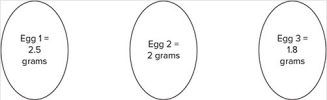
Three (3)eggs are boiled and all weigh 2g.The eggs are placed in a 15% solution of NaCl and reweighed after 30 minutes.
 McGraw-Hill Education
-The solution in the container is hypertonic to which egg?
McGraw-Hill Education
-The solution in the container is hypertonic to which egg? (Multiple Choice)
4.9/5  (75)
(75) Osmosis is the diffusion of water across a membrane in response to the concentration of one or more of the ________.
(Multiple Choice)
4.7/5 (84)
(84) A type of transport of a solute across a membrane,up its concentration gradient,using protein carriers driven by the expenditure of chemical energy is known as
(Multiple Choice)
4.9/5 (78)
(78) If two solutions have unequal concentrations of a solute,the solution with the lower concentration is called
(Multiple Choice)
5.0/5 (86)
(86) What describes the movement of substances down their concentration gradients?
(Multiple Choice)
4.8/5 (65)
(65) Osmosis occurs as water can cross the lipid bilayer through specialized channels for water movement called ________.
(Multiple Choice)
5.0/5 (73)
(73) While water continually orients phospholipids into a lipid bilayer,it does not fix the lipids permanently into position.Thus,the bilayer is considered to be ________.
(Multiple Choice)
4.9/5 (79)
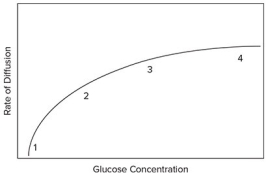
(79) The diagram shows the rate of diffusion into a cell using carrier proteins.
 McGraw-Hill Education
-Carrier proteins are saturated at which point?
McGraw-Hill Education
-Carrier proteins are saturated at which point? (Multiple Choice)
4.8/5 (82)
(82) Receptor-mediated endocytosis brings in specific material by engulfing it in vesicles.What factors,either directly or indirectly,are related to this process? Choose all that apply.
(Multiple Choice)
4.8/5 (87)
(87) Tetrodotoxin is a potent poison,produced by some newts,pufferfish,and blue-ringed octopus that affects sodium transport involved with the voltage gates in neurons.A friend swimming in the Caribbean is pricked by a pufferfish and gets very sick.The most likely action the poison takes is
(Multiple Choice)
4.9/5 (87)
(87) Diapedesis is the movement of white blood cells through intact blood vessel walls into surrounding body tissue.It typically happens when an area of the body is injured or damaged,and an inflammation response is required.What role would you expect cell adhesion molecules to play in this process?
(Multiple Choice)
4.9/5 (88)
(88) Three (3)eggs are boiled and all weigh 2g.The eggs are placed in a 15% solution of NaCl and reweighed after 30 minutes.
McGraw-Hill Education
-Which egg is isotonic to the solution?
McGraw-Hill Education
-Which egg is isotonic to the solution? (Multiple Choice)
4.9/5 (79)
(79) Which of the following protein classes are not found as membrane proteins?
(Multiple Choice)
4.9/5 (79)
(79) 
Filters
- Essay(0)
- Multiple Choice(0)
- Short Answer(0)
- True False(0)
- Matching(0)