



 Chat with AI
Exam 9: Cell Communication

Exam 1: The Science of Biology58 Questions
Exam 2: The Nature of Molecules and the Properties of Water76 Questions
Exam 3: The Chemical Building Blocks of Life74 Questions
Exam 4: Cell Structure63 Questions
Exam 5: Membranes76 Questions
Exam 6: Energy and Metabolism53 Questions
Exam 7: How Cells Harvest Energy59 Questions
Exam 8: Photosynthesis67 Questions
Exam 9: Cell Communication45 Questions
Exam 10: How Cells Divide62 Questions
Exam 11: Sexual Reproduction and Meiosis53 Questions
Exam 12: Patterns of Inheritance64 Questions
Exam 13: Chromosomes, mapping, and the Meiosisinheritance Connection58 Questions
Exam 14: Dna: the Genetic Material68 Questions
Exam 15: Genes and How They Work79 Questions
Exam 16: Control of Gene Expression62 Questions
Exam 17: Biotechnology48 Questions
Exam 18: Genomics52 Questions
Exam 19: Cellular Mechanisms of Development56 Questions
Exam 20: Genes Within Populations78 Questions
Exam 21: The Evidence for Evolution65 Questions
Exam 22: The Origin of Species67 Questions
Exam 23: Systematics,phylogenies,and Comparative Biology67 Questions
Exam 24: Genome Evolution54 Questions
Exam 25: The Origin and Diversity of Life35 Questions
Exam 26: Viruses62 Questions
Exam 27: Prokaryotes61 Questions
Exam 28: Protists55 Questions
Exam 29: Seedless Plants44 Questions
Exam 30: Seed Plants36 Questions
Exam 31: Fungi63 Questions
Exam 32: Animal Diversity and the Evolution of Body Plans42 Questions
Exam 33: Protostomes79 Questions
Exam 34: Deuterostomes83 Questions
Exam 35: Plant Form55 Questions
Exam 36: Transport in Plants51 Questions
Exam 37: Plant Nutrition and Soils47 Questions
Exam 38: Plant Defense Responses42 Questions
Exam 39: Sensory Systems in Plants50 Questions
Exam 40: Plant Reproduction86 Questions
Exam 41: The Animal Body and Principles of Regulation75 Questions
Exam 42: The Nervous System78 Questions
Exam 43: Sensory Systems88 Questions
Exam 44: The Endocrine System87 Questions
Exam 45: The Musculoskeletal System57 Questions
Exam 46: The Digestive System59 Questions
Exam 47: The Respiratory System54 Questions
Exam 48: The Circulatory System53 Questions
Exam 49: Osmotic Regulation and the Urinary System46 Questions
Exam 50: The Immune System49 Questions
Exam 51: The Reproductive System79 Questions
Exam 52: Animal Development69 Questions
Exam 53: Behavioral Biology91 Questions
Exam 54: Ecology of Individuals and Populations69 Questions
Exam 55: Community Ecology59 Questions
Exam 56: Dynamics of Ecosystems48 Questions
Exam 57: The Biosphere and Human Impacts41 Questions
Exam 58: Conservation Biology49 Questions
Select questions type


Tamoxifen is a drug that is used to treat breast cancer.It inhibits the activities of the estrogen receptor in breast epithelial cells,which are the cells that are relevant to breast cancer.One of the concerns that scientists had during the development of Tamoxifen as a therapy for breast cancer was that other cell types require estrogen signaling for their function.For example,it is known that cells in bone tissue require estrogen signaling.As a result,there was a concern that use of Tamoxifen would lead to bone loss in patients.In reality,however,researchers were surprised to find that Tamoxifen actually led to an increase in bone density in breast cancer patients.At the same time,Tamoxifen did inhibit the activity of the estrogen receptor in breast epithelial cells in these patients.What is the best explanation for this finding?
(Multiple Choice)
4.8/5  (80)
(80) What is the difference between Ras and the G proteins bound to G protein coupled receptors (GPCRs)?
(Multiple Choice)
4.9/5 (85)
(85) What second messenger is directly involved in activating protein kinase C (PKC)?
(Multiple Choice)
4.9/5 (69)
(69) In synaptic signaling,neurotransmitters are released into a space that is referred to as a:
(Multiple Choice)
4.9/5 (97)
(97) You are having lunch with an elderly friend when suddenly he begins to experience chest pain and tightness.He reaches into his pocket,gets out one of his nitroglycerin tablets and quickly takes it.After the episode passes,your friend asks you how the nitroglycerin helps his angina.You explain that nitroglycerin gets converted by cells to nitric oxide (NO)causing the smooth muscle cells of the blood vessel to relax and increase blood flow to the heart.He pushes you for a more detailed explanation,so you explain further that:
(Multiple Choice)
4.8/5 (64)
(64) The protein SOS is a guanine nucleotide exchange factor for Ras.SOS helps facilitate the exchange of GDP for GTP.What would be the effect of a mutation that inhibits the interaction between SOS and Ras?
(Multiple Choice)
5.0/5 (74)
(74) A small number of cell surface receptors can ultimately generate a large intracellular response due to activation of kinase cascades.This is referred to as:
(Multiple Choice)
4.8/5 (81)
(81) One cell sends second messengers to another cell through gap junctions.What type of signaling would this be considered?
(Multiple Choice)
4.9/5 (84)
(84) You are planning to perform some protein-protein interaction studies to identify a receptor for a steroid hormone you have been working on.You start by fractionating the cell.What cell fraction would you want to work with to identify the steroid hormone receptor of interest?
(Multiple Choice)
4.8/5 (77)
(77) When bound to ligand,this type of receptor changes conformation to allow ions to move down their concentration gradient across the membrane:
(Multiple Choice)
4.9/5 (71)
(71) You have identified a novel cytoplasmic protein.Through sequence analysis you are able to identify the presence of a number of serine/threonine phosphorylation motifs.Based on these data,you hypothesize that this protein may be a substrate for what kind of enzyme?
(Multiple Choice)
4.9/5 (87)
(87) The protein Sonic Hedgehog (SHH)plays a role in specifying the identity of digits (such as fingers and toes)in mammals.Several digits arise directly from cells that both express and respond to secreted SHH.What type of signaling would this be considered?
(Multiple Choice)
4.9/5 (79)
(79) Some enzymatic receptors and most G protein-coupled receptors transmit the signal into the cytoplasm by utilizing other substances within the cytoplasm that are referred to as:
(Multiple Choice)
4.9/5 (75)
(75) Why are phosphorylation and dephosphorylation reactions commonly used to regulate signal transduction pathways?
(Multiple Choice)
4.8/5 (79)
(79) You have identified a molecule,molecule X,that can bind to the ATP binding site of a specific protein kinase,and prevent ATP binding.You are conducting a kinase assay using this protein kinase and a known substrate of this kinase,and have set up the reaction using the proper conditions and cofactors to allow for optimal protein kinase activity.If you add molecule X to the reaction,what do you predict will be the outcome?
(Multiple Choice)
4.8/5 (92)
(92) You are performing an experiment to assay phosphorylation of a substrate by a protein kinase.Based on the data in the table below,what do these experimental results suggest? 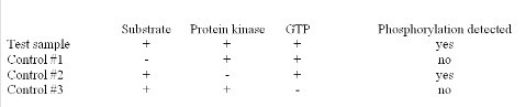
(Multiple Choice)
4.8/5 (81)
(81) Many receptor tyrosine kinase pathways have MAPK as a downstream signaling component.MAPK can phosphorylate target proteins.What type of signaling molecule is MAPK?
(Multiple Choice)
4.9/5 (83)
(83) Growth of new blood vessels is stimulated by vascular endothelial growth factor (VEGF).This ligand binds to the VEGF receptor,which leads to the dimerization and autophosphorylation of this receptor on cytoplasmic tyrosines.What type of receptor is the VEGF receptor?
(Multiple Choice)
4.9/5 (65)
(65) 
Filters
- Essay(0)
- Multiple Choice(0)
- Short Answer(0)
- True False(0)
- Matching(0)