



 Chat with AI
Exam 55: Community Ecology

Exam 1: The Science of Biology58 Questions
Exam 2: The Nature of Molecules and the Properties of Water76 Questions
Exam 3: The Chemical Building Blocks of Life74 Questions
Exam 4: Cell Structure63 Questions
Exam 5: Membranes76 Questions
Exam 6: Energy and Metabolism53 Questions
Exam 7: How Cells Harvest Energy59 Questions
Exam 8: Photosynthesis67 Questions
Exam 9: Cell Communication45 Questions
Exam 10: How Cells Divide62 Questions
Exam 11: Sexual Reproduction and Meiosis53 Questions
Exam 12: Patterns of Inheritance64 Questions
Exam 13: Chromosomes, mapping, and the Meiosisinheritance Connection58 Questions
Exam 14: Dna: the Genetic Material68 Questions
Exam 15: Genes and How They Work79 Questions
Exam 16: Control of Gene Expression62 Questions
Exam 17: Biotechnology48 Questions
Exam 18: Genomics52 Questions
Exam 19: Cellular Mechanisms of Development56 Questions
Exam 20: Genes Within Populations78 Questions
Exam 21: The Evidence for Evolution65 Questions
Exam 22: The Origin of Species67 Questions
Exam 23: Systematics,phylogenies,and Comparative Biology67 Questions
Exam 24: Genome Evolution54 Questions
Exam 25: The Origin and Diversity of Life35 Questions
Exam 26: Viruses62 Questions
Exam 27: Prokaryotes61 Questions
Exam 28: Protists55 Questions
Exam 29: Seedless Plants44 Questions
Exam 30: Seed Plants36 Questions
Exam 31: Fungi63 Questions
Exam 32: Animal Diversity and the Evolution of Body Plans42 Questions
Exam 33: Protostomes79 Questions
Exam 34: Deuterostomes83 Questions
Exam 35: Plant Form55 Questions
Exam 36: Transport in Plants51 Questions
Exam 37: Plant Nutrition and Soils47 Questions
Exam 38: Plant Defense Responses42 Questions
Exam 39: Sensory Systems in Plants50 Questions
Exam 40: Plant Reproduction86 Questions
Exam 41: The Animal Body and Principles of Regulation75 Questions
Exam 42: The Nervous System78 Questions
Exam 43: Sensory Systems88 Questions
Exam 44: The Endocrine System87 Questions
Exam 45: The Musculoskeletal System57 Questions
Exam 46: The Digestive System59 Questions
Exam 47: The Respiratory System54 Questions
Exam 48: The Circulatory System53 Questions
Exam 49: Osmotic Regulation and the Urinary System46 Questions
Exam 50: The Immune System49 Questions
Exam 51: The Reproductive System79 Questions
Exam 52: Animal Development69 Questions
Exam 53: Behavioral Biology91 Questions
Exam 54: Ecology of Individuals and Populations69 Questions
Exam 55: Community Ecology59 Questions
Exam 56: Dynamics of Ecosystems48 Questions
Exam 57: The Biosphere and Human Impacts41 Questions
Exam 58: Conservation Biology49 Questions
Select questions type


Succession happens because species in the habitat alter that habitat in ways that assist other species.There are three dynamic concepts that are of critical importance for succession to take place.They are
(Multiple Choice)
4.8/5  (79)
(79) It is a situation in which a palatable organism resembles another kind of organism that is distasteful or toxic.
(Short Answer)
4.9/5 (71)
(71) In ________ mimicry,two or more unrelated but protected species resemble one another,thus achieving a kind of group defense.
(Multiple Choice)
4.8/5 (86)
(86) Communities evolve to have greater biomass and species richness in a process called
(Multiple Choice)
4.9/5 (83)
(83) Which of the following statements about mimicry are true? Check all that apply.
(Multiple Choice)
4.9/5 (74)
(74) Interspecific competition can affect the phenotypic characteristics of organisms.
(True/False)
4.7/5 (73)
(73) In ________ mimicry,unprotected species resemble others that are distasteful.
(Multiple Choice)
4.8/5 (72)
(72) Chemicals that play the dominant role in protecting plants from being eaten by herbivores or predators are called
(Multiple Choice)
4.9/5 (77)
(77) Following their respective breeding seasons,several species of hummingbirds occur at the same locations in North America and several hummingbird flowers bloom simultaneously in these habitats.These flowers seem to have converged to a common morphology and color.Birds have the most visual sensitivity to the color red.Following their breeding season,these species of hummingbirds are
(Multiple Choice)
4.9/5 (86)
(86) Two of Darwin's finches display a character displacement when they occur as sympatric species.Which of the statements correctly interprets the graph? 
(Multiple Choice)
4.9/5 (65)
(65) Which of the following examples would be undergoing secondary succession? Check all that apply.
(Multiple Choice)
4.9/5 (78)
(78) In general,communities in early succession will be dominated by fast-growing species with r-selected life histories.
(True/False)
4.7/5 (72)
(72) Paleontological studies indicate that,over millions of years,
(Multiple Choice)
4.9/5 (73)
(73) The difference in the fundamental niche and the realized niche is
(Multiple Choice)
4.9/5 (77)
(77) Alligators excavate holes in the bottom of bodies of water.During times of severe drought these holes act as refugia for various aquatic organisms that might perish if there were no water available.Thus,alligators in this system can be classified as a(n)
(Multiple Choice)
4.8/5 (90)
(90) In studies of two species of barnacles in the marine intertidal zone it was observed that Chthamalus can live in the upper intertidal zone and the lower intertidal zone if Semibalanus is absent,and Semibalanus can only live in the lower zone because it is more subject to dehydration.Based on this,which of the following statements are true? Check all that apply.
(Multiple Choice)
5.0/5 (72)
(72) Based on the following graph,what is the most likely relationship between Paramecium and Didinium? 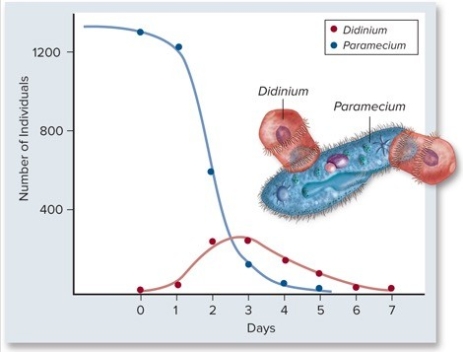
(Multiple Choice)
4.8/5 (79)
(79) Geographical allopatry between species is definitive evidence of interspecific competition.
(True/False)
4.7/5 (86)
(86) 
Filters
- Essay(0)
- Multiple Choice(0)
- Short Answer(0)
- True False(0)
- Matching(0)