



 Chat with AI
Exam 58: Conservation Biology

Exam 1: The Science of Biology58 Questions
Exam 2: The Nature of Molecules and the Properties of Water76 Questions
Exam 3: The Chemical Building Blocks of Life74 Questions
Exam 4: Cell Structure63 Questions
Exam 5: Membranes76 Questions
Exam 6: Energy and Metabolism53 Questions
Exam 7: How Cells Harvest Energy59 Questions
Exam 8: Photosynthesis67 Questions
Exam 9: Cell Communication45 Questions
Exam 10: How Cells Divide62 Questions
Exam 11: Sexual Reproduction and Meiosis53 Questions
Exam 12: Patterns of Inheritance64 Questions
Exam 13: Chromosomes, mapping, and the Meiosisinheritance Connection58 Questions
Exam 14: Dna: the Genetic Material68 Questions
Exam 15: Genes and How They Work79 Questions
Exam 16: Control of Gene Expression62 Questions
Exam 17: Biotechnology48 Questions
Exam 18: Genomics52 Questions
Exam 19: Cellular Mechanisms of Development56 Questions
Exam 20: Genes Within Populations78 Questions
Exam 21: The Evidence for Evolution65 Questions
Exam 22: The Origin of Species67 Questions
Exam 23: Systematics,phylogenies,and Comparative Biology67 Questions
Exam 24: Genome Evolution54 Questions
Exam 25: The Origin and Diversity of Life35 Questions
Exam 26: Viruses62 Questions
Exam 27: Prokaryotes61 Questions
Exam 28: Protists55 Questions
Exam 29: Seedless Plants44 Questions
Exam 30: Seed Plants36 Questions
Exam 31: Fungi63 Questions
Exam 32: Animal Diversity and the Evolution of Body Plans42 Questions
Exam 33: Protostomes79 Questions
Exam 34: Deuterostomes83 Questions
Exam 35: Plant Form55 Questions
Exam 36: Transport in Plants51 Questions
Exam 37: Plant Nutrition and Soils47 Questions
Exam 38: Plant Defense Responses42 Questions
Exam 39: Sensory Systems in Plants50 Questions
Exam 40: Plant Reproduction86 Questions
Exam 41: The Animal Body and Principles of Regulation75 Questions
Exam 42: The Nervous System78 Questions
Exam 43: Sensory Systems88 Questions
Exam 44: The Endocrine System87 Questions
Exam 45: The Musculoskeletal System57 Questions
Exam 46: The Digestive System59 Questions
Exam 47: The Respiratory System54 Questions
Exam 48: The Circulatory System53 Questions
Exam 49: Osmotic Regulation and the Urinary System46 Questions
Exam 50: The Immune System49 Questions
Exam 51: The Reproductive System79 Questions
Exam 52: Animal Development69 Questions
Exam 53: Behavioral Biology91 Questions
Exam 54: Ecology of Individuals and Populations69 Questions
Exam 55: Community Ecology59 Questions
Exam 56: Dynamics of Ecosystems48 Questions
Exam 57: The Biosphere and Human Impacts41 Questions
Exam 58: Conservation Biology49 Questions
Select questions type


As habitats are fragmented and consequently shrinking in size,a major problem is
(Multiple Choice)
4.9/5  (76)
(76) The degree of allelic diversity of a population is independent of its size.
(True/False)
4.8/5 (82)
(82) The following graph shows the relationship between extinction and habitat area.Which statements help explain the trend shown on the graph? Check all that apply. 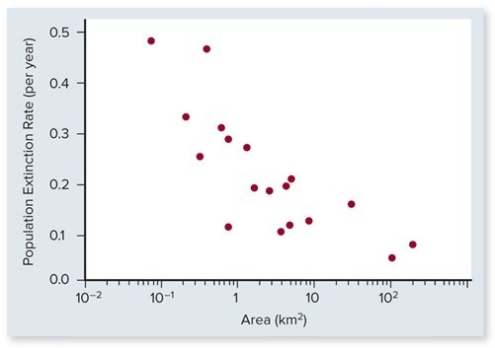
(Multiple Choice)
4.8/5 (84)
(84) Ecologists are concerned about amphibian populations because
(Multiple Choice)
4.8/5 (80)
(80) Match the correct case study in conservation biology with its animal.
(Multiple Choice)
4.8/5 (69)
(69) As we study the past 50,000 years worth of information about species' decline and extinctions around the world
(Multiple Choice)
4.9/5 (76)
(76) Economists have been comparing the monetary value of intact habitats with the value of using (destroying)those habitats (such as for logging or farming).They find
(Multiple Choice)
4.9/5 (88)
(88) Which of the statements given below supports the idea that frog populations can demonstrate the phenomenon of evolutionary rescue?
(Multiple Choice)
4.8/5 (84)
(84) Which of the following statements about the causes of extinction are true? Check all that apply.
(Multiple Choice)
4.9/5 (67)
(67) Which of the following is a reason that conservation biologists have begun to use phylogenetic trees to assist in determining where to direct the limited resources that support conservation efforts?
(Multiple Choice)
4.7/5 (78)
(78) Modern restoration biologists recognize that it may not be prudent to restore the same species to an ecosystem that has been disturbed.Which of the following statements and or explanations supports this?
(Multiple Choice)
4.7/5 (77)
(77) In western Sweden,coastal marine ecosystems have been exposed to discharge of nutrients over several decades.As a result,algal blooms are more common.Algal mats on the sea bottom limit sunlight and alter the amount of dissolved oxygen in the water.Additionally,some algae produce toxic compounds that can enter shellfish.Furthermore,the decomposing algae produces a strong odor.Which statements below correctly match the outcomes to their effects on value of the ecosystem? Check all that apply.
(Multiple Choice)
4.7/5 (75)
(75) Conservationists have identified 25 areas worldwide as hotspots.This means these areas
(Multiple Choice)
4.8/5 (82)
(82) A scientist studied peregrine falcons to determine why the numbers of birds was declining.She determined that
(Multiple Choice)
4.9/5 (72)
(72) The various endemic cichlid species of Lake Victoria have suffered losses in their population numbers and species due to the introduction of
(Multiple Choice)
4.8/5 (77)
(77) The West African black rhino,one of four subspecies of rhinoceros,was declared extinct in 2006.Their horns were believed by many to hold medicinal value.What is the most likely reason for the extinction of the West African black rhino?
(Multiple Choice)
4.8/5 (75)
(75) A friend asks you for a definition of endemic because she is writing a history paper and this word keeps occurring in the literature in reference to bison on the Great Plains of the United States.Your response is that the word endemic means
(Multiple Choice)
4.7/5 (80)
(80) 
Filters
- Essay(0)
- Multiple Choice(0)
- Short Answer(0)
- True False(0)
- Matching(0)