



 Chat with AI
Exam 7: Alkyl Halides and Nucleophilic Substitution

Exam 1: Structure and Bonding77 Questions
Exam 2: Acids and Bases59 Questions
Exam 3: Introduction to Organic Molecules and Functional Groups56 Questions
Exam 4: Alkanes64 Questions
Exam 5: Stereochemistry76 Questions
Exam 6: Understanding Organic Reactions53 Questions
Exam 7: Alkyl Halides and Nucleophilic Substitution73 Questions
Exam 8: Alkyl Halides and Elimination Reactions52 Questions
Exam 9: Alcohols,ethers,and Related Compounds60 Questions
Exam 10: Alkenes and Addition Reactions54 Questions
Exam 11: Alkynes and Synthesis51 Questions
Exam 12: Oxidation and Reduction51 Questions
Exam 13: Radical Reactions51 Questions
Exam 14: Conjugation,resonance,and Dienes53 Questions
Exam 15: Benzene and Aromatic Compounds47 Questions
Exam 16: Reactions of Aromatic Compounds60 Questions
Exam 17: Introduction to Carbonyl Chemistry; Organometallic Reagents; Oxidation and Reduction59 Questions
Exam 18: Aldehydes and Ketones - Nucleophilic Addition52 Questions
Exam 19: Carboxylic Acids and the Acidity of the O-H Bond53 Questions
Exam 20: Carboxylic Acids and Their Derivatives Nucleophilic Acyl Substitution50 Questions
Exam 21: Substitution Reactions of Carbonyl Compounds at the a Carbon47 Questions
Exam 22: Carbonyl Condensation Reactions51 Questions
Exam 23: Amines65 Questions
Exam 24: Carbon-Carbon Bond-Forming Reactions in Organic Synthesis47 Questions
Exam 25: Pericyclic Reactions62 Questions
Exam 26: Carbohydrates50 Questions
Exam 27: Amino Acids and Proteins46 Questions
Exam 28: Synthetic Polymers45 Questions
Exam 29: Lipids45 Questions
Exam 30: Spectroscopy A: Mass Spectrometry19 Questions
Exam 31: Spectroscopy B: Infrared Spectroscopy39 Questions
Exam 32: Spectroscopy C: Nuclear Magnetic Resonance Spectroscopy51 Questions
Select questions type



Rank the following carbocations in order of decreasing stability,putting the most stable first. 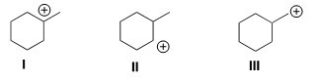
(Multiple Choice)
4.8/5  (85)
(85) Rank the following in order of increasing nucleophilicity,putting the least nucleophilic first. 
(Multiple Choice)
4.7/5 (89)
(89) What is the product of the nucleophilic substitution reaction shown below? 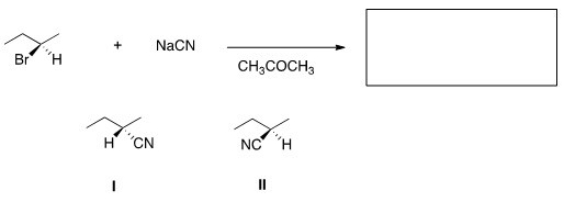
(Multiple Choice)
4.7/5 (88)
(88) Which of the following alkyl halides is a primary alkyl halide? 
(Multiple Choice)
4.9/5 (71)
(71) Which of the following solvents is not a polar protic solvent? 
(Multiple Choice)
4.9/5 (78)
(78) Which of the following is not a characteristic of an SN1 reaction?
(Multiple Choice)
4.9/5 (96)
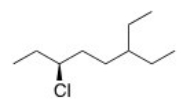
(96) 
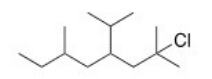
The reaction of bromoethane with sodium acetate affords the substitution product methyl acetate.What is the effect of doubling the concentration of sodium acetate on the rate of the reaction?
(Multiple Choice)
4.9/5 (82)
(82) Which of the following statements about the SN2 mechanism for nucleophilic substitution reactions is true?
(Multiple Choice)
4.8/5 (90)
(90) Pick the solvent that gives the fastest SN2 reaction between CH2CH2Br and -OCH3.
(Multiple Choice)
4.9/5 (88)
(88) Which of the following statements explain why aryl halides and vinyl halides do not undergo nucleophilic substitution by either the SN1 or SN2 mechanism?
(Multiple Choice)
4.9/5 (77)
(77) Rank the following halides in order of decreasing polarity,putting the most polar first. 
(Multiple Choice)
4.7/5 (86)
(86) Which of the following statements about the reactions of alkyl halides is true?
(Multiple Choice)
5.0/5 (86)
(86) Which of the following alkyl halides is a secondary alkyl halide? 
(Multiple Choice)
4.8/5 (79)
(79) For the following reaction,use the identity of the alkyl halide and nucleophile to determine which substitution mechanism occurs.Then determine which solvent affords the faster reaction. 
(Multiple Choice)
4.9/5 (91)
(91) 
Filters
- Essay(0)
- Multiple Choice(0)
- Short Answer(0)
- True False(0)
- Matching(0)