



 Chat with AI
Exam 13: Radical Reactions

Exam 1: Structure and Bonding77 Questions
Exam 2: Acids and Bases59 Questions
Exam 3: Introduction to Organic Molecules and Functional Groups56 Questions
Exam 4: Alkanes64 Questions
Exam 5: Stereochemistry76 Questions
Exam 6: Understanding Organic Reactions53 Questions
Exam 7: Alkyl Halides and Nucleophilic Substitution73 Questions
Exam 8: Alkyl Halides and Elimination Reactions52 Questions
Exam 9: Alcohols,ethers,and Related Compounds60 Questions
Exam 10: Alkenes and Addition Reactions54 Questions
Exam 11: Alkynes and Synthesis51 Questions
Exam 12: Oxidation and Reduction51 Questions
Exam 13: Radical Reactions51 Questions
Exam 14: Conjugation,resonance,and Dienes53 Questions
Exam 15: Benzene and Aromatic Compounds47 Questions
Exam 16: Reactions of Aromatic Compounds60 Questions
Exam 17: Introduction to Carbonyl Chemistry; Organometallic Reagents; Oxidation and Reduction59 Questions
Exam 18: Aldehydes and Ketones - Nucleophilic Addition52 Questions
Exam 19: Carboxylic Acids and the Acidity of the O-H Bond53 Questions
Exam 20: Carboxylic Acids and Their Derivatives Nucleophilic Acyl Substitution50 Questions
Exam 21: Substitution Reactions of Carbonyl Compounds at the a Carbon47 Questions
Exam 22: Carbonyl Condensation Reactions51 Questions
Exam 23: Amines65 Questions
Exam 24: Carbon-Carbon Bond-Forming Reactions in Organic Synthesis47 Questions
Exam 25: Pericyclic Reactions62 Questions
Exam 26: Carbohydrates50 Questions
Exam 27: Amino Acids and Proteins46 Questions
Exam 28: Synthetic Polymers45 Questions
Exam 29: Lipids45 Questions
Exam 30: Spectroscopy A: Mass Spectrometry19 Questions
Exam 31: Spectroscopy B: Infrared Spectroscopy39 Questions
Exam 32: Spectroscopy C: Nuclear Magnetic Resonance Spectroscopy51 Questions
Select questions type


Which of the labeled hydrogens is most easily abstracted in a free radical bromination reaction? 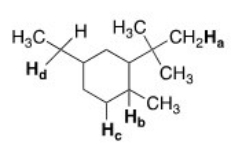

Free
(Multiple Choice)
4.9/5  (85)
(85) Correct Answer: Verified
B
Select the route that would most likely produce the desired results from the given starting material.  I.(1)H2SO4 and heat; (2)HBr II.(1)KOH in ethanol; (2)HBr
III)(1)H2SO4 and heat; (2)HBr + peroxides
IV)(1)potassium tert-butoxide in tert-butanol; (2)HBr + peroxides
I.(1)H2SO4 and heat; (2)HBr II.(1)KOH in ethanol; (2)HBr
III)(1)H2SO4 and heat; (2)HBr + peroxides
IV)(1)potassium tert-butoxide in tert-butanol; (2)HBr + peroxidesFree
(Multiple Choice)
4.9/5 (76)
(76) Correct Answer:Verified
VerifiedD
Which steps are the rate-determining step in the mechanism of radical halogenation?
Free
(Multiple Choice)
4.8/5 (78)
(78) Correct Answer:Verified
VerifiedB
How many monochlorination products (constitutional isomers and stereoisomers)are formed from the reaction of pentane with Cl2 and hn?
(Multiple Choice)
4.9/5 (79)
(79) How many monochlorination products can be formed (constitutional isomers only)from the reaction of CH3CH2CH2CH2CH2CH3 with Cl2 and hn?
(Multiple Choice)
4.8/5 (75)
(75) Which of the following would be the fastest to form a radical? 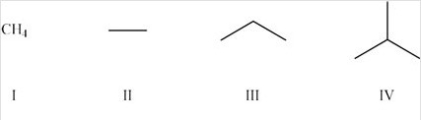
(Multiple Choice)
4.8/5 (90)
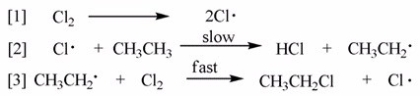
(90) A possible reaction of ethane with chlorine is shown below.  This reaction could conceivably occur by the following chain mechanisms [1],[2],and [3].Determine DH for step [2].
 Bond dissociation energies (kcal/mol):
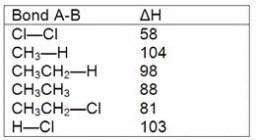
This reaction could conceivably occur by the following chain mechanisms [1],[2],and [3].Determine DH for step [2]. Bond dissociation energies (kcal/mol): (Multiple Choice)
4.8/5 (63)
(63) A possible reaction of ethane with chlorine is shown below.  This reaction could conceivably occur by the following chain mechanisms [1],[2],and [3].The chain propagating step(s)is (are)________.
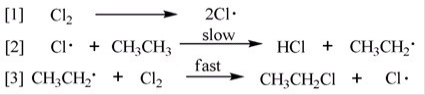
This reaction could conceivably occur by the following chain mechanisms [1],[2],and [3].The chain propagating step(s)is (are)________. (Multiple Choice)
4.7/5 (76)
(76) Rank the following radicals in order of increasing stability,putting the least stable first. 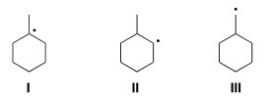
(Multiple Choice)
4.9/5 (97)
(97) Which of the following compounds contain primary (1°)radical carbons? 
(Multiple Choice)
4.8/5 (79)
(79) Which of the following compounds contain secondary (2°)radical carbons? 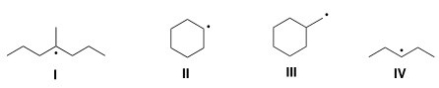
(Multiple Choice)
4.7/5 (72)
(72) Which of the following statements about the stereochemistry of halogenation reactions is true?
(Multiple Choice)
4.8/5 (77)
(77) How many monochlorination products,including stereoisomers,are formed from (S,S)-1,2-dimethylcyclopropane? 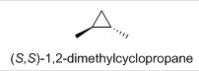
(Multiple Choice)
4.8/5 (81)
(81) What is the product in the following sequence of reactions? 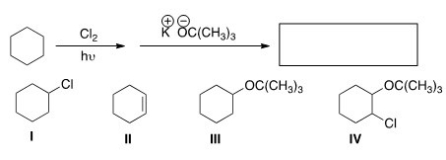
(Multiple Choice)
4.9/5 (77)
(77) Which of the following compounds contain tertiary (3°)radical carbons? 
(Multiple Choice)
4.9/5 (89)
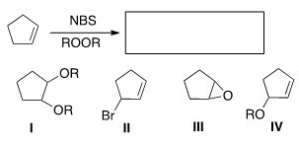
(89) 
How many monochlorination products (constitutional isomers and stereoisomers)are formed from the reaction of butane with Cl2 and hn?
(Multiple Choice)
4.9/5 (83)
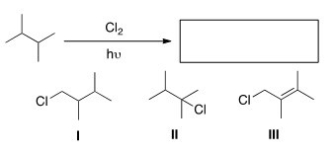
(83) 
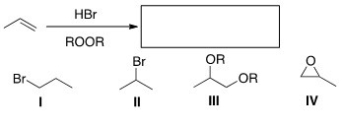

Filters
- Essay(0)
- Multiple Choice(0)
- Short Answer(0)
- True False(0)
- Matching(0)