



 Chat with AI
Exam 32: Spectroscopy C: Nuclear Magnetic Resonance Spectroscopy

Exam 1: Structure and Bonding77 Questions
Exam 2: Acids and Bases59 Questions
Exam 3: Introduction to Organic Molecules and Functional Groups56 Questions
Exam 4: Alkanes64 Questions
Exam 5: Stereochemistry76 Questions
Exam 6: Understanding Organic Reactions53 Questions
Exam 7: Alkyl Halides and Nucleophilic Substitution73 Questions
Exam 8: Alkyl Halides and Elimination Reactions52 Questions
Exam 9: Alcohols,ethers,and Related Compounds60 Questions
Exam 10: Alkenes and Addition Reactions54 Questions
Exam 11: Alkynes and Synthesis51 Questions
Exam 12: Oxidation and Reduction51 Questions
Exam 13: Radical Reactions51 Questions
Exam 14: Conjugation,resonance,and Dienes53 Questions
Exam 15: Benzene and Aromatic Compounds47 Questions
Exam 16: Reactions of Aromatic Compounds60 Questions
Exam 17: Introduction to Carbonyl Chemistry; Organometallic Reagents; Oxidation and Reduction59 Questions
Exam 18: Aldehydes and Ketones - Nucleophilic Addition52 Questions
Exam 19: Carboxylic Acids and the Acidity of the O-H Bond53 Questions
Exam 20: Carboxylic Acids and Their Derivatives Nucleophilic Acyl Substitution50 Questions
Exam 21: Substitution Reactions of Carbonyl Compounds at the a Carbon47 Questions
Exam 22: Carbonyl Condensation Reactions51 Questions
Exam 23: Amines65 Questions
Exam 24: Carbon-Carbon Bond-Forming Reactions in Organic Synthesis47 Questions
Exam 25: Pericyclic Reactions62 Questions
Exam 26: Carbohydrates50 Questions
Exam 27: Amino Acids and Proteins46 Questions
Exam 28: Synthetic Polymers45 Questions
Exam 29: Lipids45 Questions
Exam 30: Spectroscopy A: Mass Spectrometry19 Questions
Exam 31: Spectroscopy B: Infrared Spectroscopy39 Questions
Exam 32: Spectroscopy C: Nuclear Magnetic Resonance Spectroscopy51 Questions
Select questions type


How many different kinds of protons are present in each of the following molecules? 
(Multiple Choice)
4.8/5  (87)
(87) What is the relationship between Ha and Hb in the following compound? 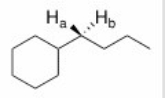
(Multiple Choice)
4.9/5 (73)
(73) For each of the following compounds,indicate how many 13C NMR signals will be observed. 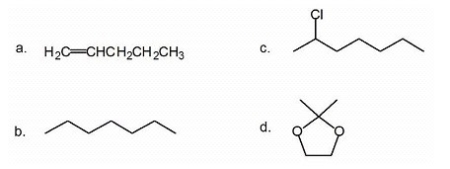
(Multiple Choice)
4.9/5 (82)
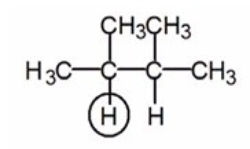
(82) 
An unknown compound X has the molecular formula C6H14O.Compound X shows a strong peak in its IR spectrum at 3000 cm-1.The 1H NMR spectral data of compound X is given below.What is the structure of compound X? 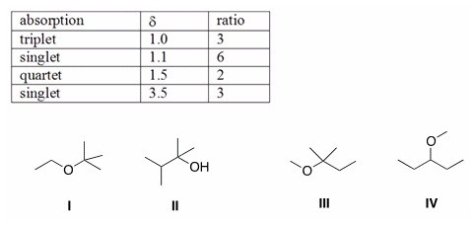
(Multiple Choice)
4.9/5 (72)
(72) How many different kinds of protons are present in each of the following compounds? 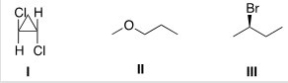
(Multiple Choice)
4.7/5 (81)
(81) What is the relationship between Ha and Hb in the following compound? 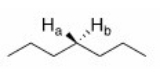
(Multiple Choice)
4.8/5 (76)
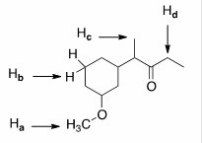
(76) 
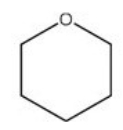
How many different kinds of protons are present in the following molecule? 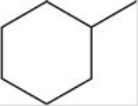
(Multiple Choice)
4.9/5 (85)
(85) 
Into how many peaks will each of the circled protons be split? (Assume complete resolution of all NMR peaks is possible) 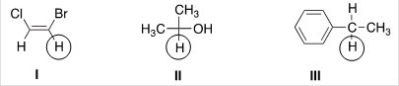
(Multiple Choice)
4.9/5 (72)
(72) An unknown compound X has the molecular formula C6H14O.Compound X shows a peak in its IR spectrum at 3200-3600 cm-1.The 1H NMR spectral data for compound X is given below.What is the structure of compound X? 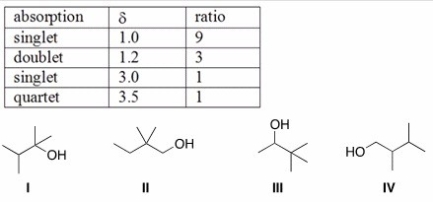
(Multiple Choice)
4.7/5 (83)
(83) Which compound does not give four sets of absorptions in its 1H NMR spectrum (i.e.,which compound does not have four unique hydrogens)? 
(Multiple Choice)
4.8/5 (63)
(63) Which of the indicated protons in the molecules below would absorb furthest downfield in a 1H NMR spectrum? 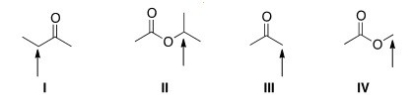
(Multiple Choice)
4.8/5 (93)
(93) How many different kinds of protons are present in each of the following compounds? 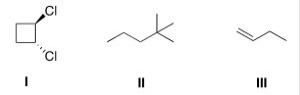
(Multiple Choice)
4.9/5 (87)
(87) For each of the following compounds,indicate how many 13C NMR signals will be seen. 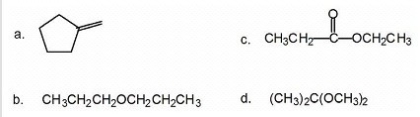
(Multiple Choice)
4.9/5 (87)
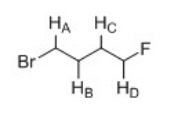
(87) 
How many different kinds of protons are present in each of the following compounds? 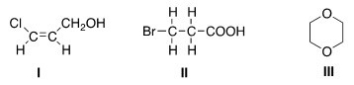
(Multiple Choice)
4.8/5 (72)
(72) An unknown compound X has the molecular formula C6H12O2.Compound X shows a strong peak in its IR spectrum at 1700 cm-1.The 1H NMR spectral data of compound X is given below.What is the structure of compound X? 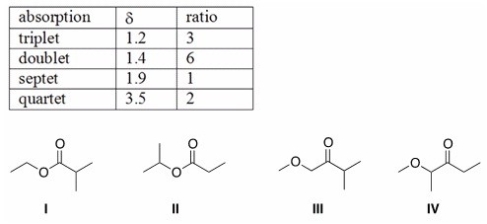
(Multiple Choice)
4.8/5 (85)
(85) An unknown compound X has the empirical formula C3H6O and a molecular ion in its mass spectrum at 116.Compound X shows no IR absorption at 3200-3600 cm-1 but shows a peak at 1700 cm-1.The 1H NMR spectral data of X is shown below.What is the structure of compound X? 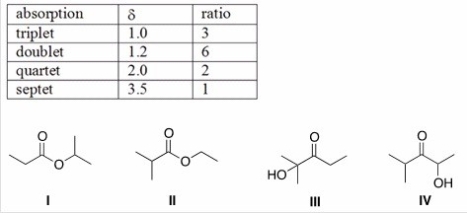
(Multiple Choice)
5.0/5 (75)
(75) 
Filters
- Essay(0)
- Multiple Choice(0)
- Short Answer(0)
- True False(0)
- Matching(0)