



 Chat with AI
Exam 7: The Muscular System

Exam 1: An Introduction to Anatomy and Physiology90 Questions
Exam 2: The Chemical Level of Organization105 Questions
Exam 3: Cell Structure and Function126 Questions
Exam 4: The Tissue Level of Organization88 Questions
Exam 5: The Integumentary System103 Questions
Exam 6: The Skeletal System218 Questions
Exam 7: The Muscular System115 Questions
Exam 8: The Nervous System149 Questions
Exam 9: The General and Special Senses118 Questions
Exam 10: The Endocrine System100 Questions
Exam 11: The Cardiovascular System: Blood84 Questions
Exam 12: The Cardiovascular System: the Heart115 Questions
Exam 13: The Cardiovascular System: Blood Vessels and Circulation121 Questions
Exam 14: The Lymphatic System and Immunity105 Questions
Exam 15: The Respiratory System101 Questions
Exam 16: The Digestive System129 Questions
Exam 17: Metabolism and Energetics77 Questions
Exam 18: The Urinary System114 Questions
Exam 19: The Reproductive System118 Questions
Exam 20: Development and Inheritance97 Questions
Select questions type


Regarding lactic acid regulation, which cells in the body consume extra oxygen and produce ATP for the conversion of excess lactate absorbed from the blood back to glucose?
(Multiple Choice)
4.8/5  (76)
(76) Exhaustion of energy reserves or decline in pH due to production and dissociation of lactic acid causes
(Multiple Choice)
4.9/5 (64)
(64) In infants, which muscle allows for the mouth to form a tight fit around the nipple during suckling at the breast?
(Multiple Choice)
4.8/5 (85)
(85) The difference in the action when comparing the biceps brachii to the flexor carpi radialis, is
(Multiple Choice)
4.9/5 (73)
(73) You are lying on the floor with your feet flat and your knees up practicing your abdominal crunches. You raise your upper body to the ceiling, up and down. What muscles are you using to the greatest extent?
(Multiple Choice)
4.9/5 (79)
(79) The muscle that inserts on the iliotibial tract and gluteal tuberosity of the femur is the
(Multiple Choice)
4.8/5 (96)
(96) 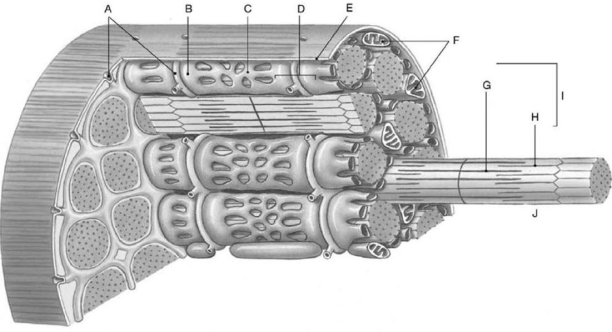 Figure 7-1 Structural Components of a Skeletal Muscle Fiber
Use Figure 7-1 to identify the labeled part.
-Structure C is the
Figure 7-1 Structural Components of a Skeletal Muscle Fiber
Use Figure 7-1 to identify the labeled part.
-Structure C is the (Multiple Choice)
4.8/5 (75)
(75) Figure 7-1 Structural Components of a Skeletal Muscle Fiber
Use Figure 7-1 to identify the labeled part.
-Structure G is composed of
Figure 7-1 Structural Components of a Skeletal Muscle Fiber
Use Figure 7-1 to identify the labeled part.
-Structure G is composed of (Multiple Choice)
4.9/5 (73)
(73) Figure 7-1 Structural Components of a Skeletal Muscle Fiber
Use Figure 7-1 to identify the labeled part.
-Structure B
Figure 7-1 Structural Components of a Skeletal Muscle Fiber
Use Figure 7-1 to identify the labeled part.
-Structure B (Multiple Choice)
4.8/5 (89)
(89) Figure 7-1 Structural Components of a Skeletal Muscle Fiber
Use Figure 7-1 to identify the labeled part.
-Structure H is the
Figure 7-1 Structural Components of a Skeletal Muscle Fiber
Use Figure 7-1 to identify the labeled part.
-Structure H is the (Multiple Choice)
4.9/5 (88)
(88) The muscle that inserts on the coronoid process of the mandible is the
(Multiple Choice)
4.8/5 (70)
(70) During which phase is the stimulus frequency so high that the relaxation phase is eliminated?
(Multiple Choice)
4.8/5 (92)
(92) 
Filters
- Essay(0)
- Multiple Choice(0)
- Short Answer(0)
- True False(0)
- Matching(0)