



 Chat with AI
Exam 19: The Heart

Exam 1: The Human Body: an Orientation110 Questions
Exam 2: Cells: the Living Units108 Questions
Exam 3: Basic Embryology112 Questions
Exam 4: Tissues110 Questions
Exam 5: The Integumentary System109 Questions
Exam 6: Bones and Skeletal Tissues108 Questions
Exam 7: Bones, Part 1: the Axial Skeleton110 Questions
Exam 8: Bones, Part 2: the Appendicular Skeleton113 Questions
Exam 9: Joints110 Questions
Exam 10: Skeletal Muscle Tissue110 Questions
Exam 11: Muscles of the Body160 Questions
Exam 12: Fundamentals of the Nervous System and Nervous Tissue112 Questions
Exam 13: The Central Nervous System109 Questions
Exam 14: The Peripheral Nervous System114 Questions
Exam 15: The Autonomic Nervous System and Visceral Sensory Neurons110 Questions
Exam 16: The Special Senses114 Questions
Exam 17: The Endocrine System115 Questions
Exam 18: Blood110 Questions
Exam 19: The Heart114 Questions
Exam 20: Blood Vessels113 Questions
Exam 21: The Lymphatic and Immune Systems115 Questions
Exam 22: The Respiratory System110 Questions
Exam 23: The Digestive System113 Questions
Exam 24: The Urinary System112 Questions
Exam 25: The Reproductive System116 Questions
Select questions type


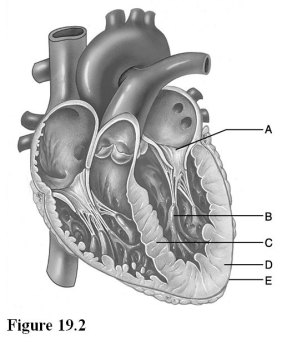 Use the diagram above to answer the following questions.
-Identify the letter that indicates the tissue layer of the heart known as the epicardium.
Use the diagram above to answer the following questions.
-Identify the letter that indicates the tissue layer of the heart known as the epicardium. (Multiple Choice)
4.9/5  (72)
(72) Heart block interferes with the ability of the ventricles to receive the pacing impulses of the conducting system.
(True/False)
4.8/5 (76)
(76) The correct sequence of heart wall layers from superficial to deep is epicardium, endocardium, and myocardium.
(True/False)
4.8/5 (72)
(72) Of the three layers of the heart wall, the layer that contains cardiac muscle is the
(Multiple Choice)
4.8/5 (85)
(85) The accumulation of pericardial fluid due to inflammation, or the accumulation of blood in the pericardial cavity, can lead to
(Multiple Choice)
4.8/5 (70)
(70) Compare the difference between incompetent and stenotic heart valves.
(Essay)
4.9/5 (70)
(70) The ________ develops from the embryological chamber called the sinus venosus.
(Multiple Choice)
4.8/5 (88)
(88) The right atrium receives blood from the superior vena cava, inferior vena cava, and ________.
(Short Answer)
4.8/5 (79)
(79) The atrioventricular valves cannot be inverted because of the attachment of ________.
(Short Answer)
4.8/5 (73)
(73) Identify the change in blood flow through the heart in the condition of a ventricular septal defect.
(Essay)
4.8/5 (75)
(75) 
Filters
- Essay(0)
- Multiple Choice(0)
- Short Answer(0)
- True False(0)
- Matching(0)