



 Chat with AI
Exam 19: The Heart

Exam 1: The Human Body: an Orientation110 Questions
Exam 2: Cells: the Living Units108 Questions
Exam 3: Basic Embryology112 Questions
Exam 4: Tissues110 Questions
Exam 5: The Integumentary System109 Questions
Exam 6: Bones and Skeletal Tissues108 Questions
Exam 7: Bones, Part 1: the Axial Skeleton110 Questions
Exam 8: Bones, Part 2: the Appendicular Skeleton113 Questions
Exam 9: Joints110 Questions
Exam 10: Skeletal Muscle Tissue110 Questions
Exam 11: Muscles of the Body160 Questions
Exam 12: Fundamentals of the Nervous System and Nervous Tissue112 Questions
Exam 13: The Central Nervous System109 Questions
Exam 14: The Peripheral Nervous System114 Questions
Exam 15: The Autonomic Nervous System and Visceral Sensory Neurons110 Questions
Exam 16: The Special Senses114 Questions
Exam 17: The Endocrine System115 Questions
Exam 18: Blood110 Questions
Exam 19: The Heart114 Questions
Exam 20: Blood Vessels113 Questions
Exam 21: The Lymphatic and Immune Systems115 Questions
Exam 22: The Respiratory System110 Questions
Exam 23: The Digestive System113 Questions
Exam 24: The Urinary System112 Questions
Exam 25: The Reproductive System116 Questions
Select questions type


The ________ of the heart prevents overdilation of the valve openings.
(Short Answer)
5.0/5  (74)
(74) The cardiac centers that control heart rate are located in the
(Multiple Choice)
5.0/5 (88)
(88) Atherosclerosis in the marginal artery may cause ischemia in the left side of the heart.
(True/False)
4.9/5 (73)
(73) 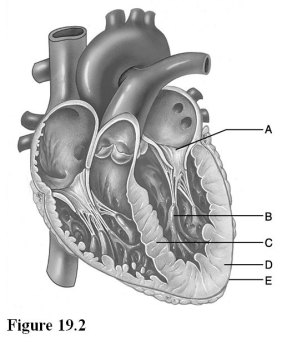 Use the diagram above to answer the following questions.
-Identify the letter that indicates anchor points for chordae tendineae, composed of cells from the myocardium.
Use the diagram above to answer the following questions.
-Identify the letter that indicates anchor points for chordae tendineae, composed of cells from the myocardium. (Multiple Choice)
4.8/5 (87)
(87) Cardiac muscle cells are bound by connective tissue into long circular and spiral networks called
(Multiple Choice)
4.8/5 (64)
(64) Insertion of a stent to treat coronary artery disease (CAD)
(Multiple Choice)
4.9/5 (87)
(87) Intercalated discs contain ________ which allow ions to pass between cells, allowing the direct transmission of impulses.
(Short Answer)
4.8/5 (91)
(91) Stenosis of the mitral valve may cause blood to back up into the
(Multiple Choice)
4.9/5 (93)
(93) Papillary muscles are horizontal ridges in the walls of the atrium.
(True/False)
4.9/5 (74)
(74) Which of these blood vessels is located in the anterior interventricular sulcus?
(Multiple Choice)
4.8/5 (75)
(75) Threadlike structures of the endocardium that prevent prolapse of the atrioventricular valves.
(Multiple Choice)
4.9/5 (91)
(91) Enlargement of the heart with progressive decline in pumping efficiency.
(Multiple Choice)
4.8/5 (67)
(67) A specific coronary vessel that lies in the coronary sulcus is the
(Multiple Choice)
4.9/5 (76)
(76) 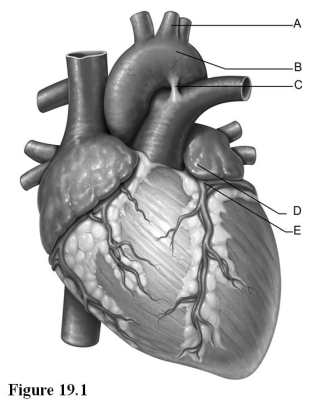 Use the diagram above to answer the following questions.
-Identify the letter that indicates the aortic arch.
Use the diagram above to answer the following questions.
-Identify the letter that indicates the aortic arch. (Multiple Choice)
4.7/5 (59)
(59) Which of the following vessels does not carry oxygen-poor blood to the heart?
(Multiple Choice)
4.8/5 (86)
(86) The desmosome-like structures that attach adjacent cardiac muscle cells are called
(Multiple Choice)
4.9/5 (79)
(79) Internal C-shaped crest of the right atrium, which indicates the openings for the superior and inferior vena cavae.
(Multiple Choice)
4.9/5 (72)
(72) The ________ lies directly deep to the fibrous pericardium.
(Multiple Choice)
4.7/5 (83)
(83) 
Filters
- Essay(0)
- Multiple Choice(0)
- Short Answer(0)
- True False(0)
- Matching(0)