



 Chat with AI
Exam 20: Blood Vessels

Exam 1: The Human Body: an Orientation110 Questions
Exam 2: Cells: the Living Units108 Questions
Exam 3: Basic Embryology112 Questions
Exam 4: Tissues110 Questions
Exam 5: The Integumentary System109 Questions
Exam 6: Bones and Skeletal Tissues108 Questions
Exam 7: Bones, Part 1: the Axial Skeleton110 Questions
Exam 8: Bones, Part 2: the Appendicular Skeleton113 Questions
Exam 9: Joints110 Questions
Exam 10: Skeletal Muscle Tissue110 Questions
Exam 11: Muscles of the Body160 Questions
Exam 12: Fundamentals of the Nervous System and Nervous Tissue112 Questions
Exam 13: The Central Nervous System109 Questions
Exam 14: The Peripheral Nervous System114 Questions
Exam 15: The Autonomic Nervous System and Visceral Sensory Neurons110 Questions
Exam 16: The Special Senses114 Questions
Exam 17: The Endocrine System115 Questions
Exam 18: Blood110 Questions
Exam 19: The Heart114 Questions
Exam 20: Blood Vessels113 Questions
Exam 21: The Lymphatic and Immune Systems115 Questions
Exam 22: The Respiratory System110 Questions
Exam 23: The Digestive System113 Questions
Exam 24: The Urinary System112 Questions
Exam 25: The Reproductive System116 Questions
Select questions type


Systemic blood pressure is regulated by adjusting the diameter of arterioles.
(True/False)
4.9/5  (85)
(85) 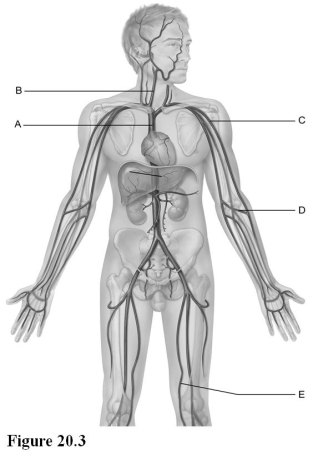 Use the diagram above to answer the following questions.
-Identify the letter that indicates the internal jugular vein.
Use the diagram above to answer the following questions.
-Identify the letter that indicates the internal jugular vein. (Multiple Choice)
4.7/5 (76)
(76) Venous blood from the right posterior intercostal veins (except the first intercostal space) flows to the unpaired ________ vein and on to the superior vena cava.
(Short Answer)
4.9/5 (83)
(83) What artery enters the skull through the foramen spinosum and supplies the inner surface of the parietal bone, dura mater, and parts of the temporal bone?
(Multiple Choice)
4.7/5 (74)
(74) Varicose veins can occur when ________ are no longer functioning, allowing blood to flow backwards and pool in the veins of the limbs.
(Short Answer)
4.7/5 (80)
(80) In the adult, the hepatic portal system carries nutrients absorbed from the digestive tract to the liver. In the fetus, nutrients are absorbed at the placenta, and the vessel that carries these nutrients to the liver is the
(Multiple Choice)
4.8/5 (73)
(73) 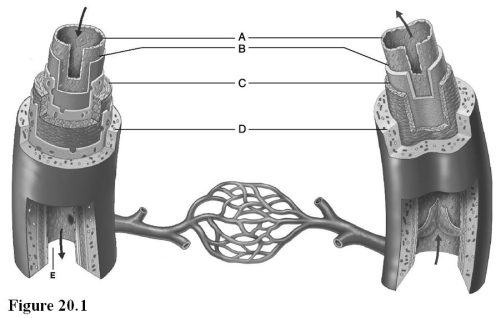 Use the diagram above to answer the following questions.
-Identify the letter that is indicating the lumen.
Use the diagram above to answer the following questions.
-Identify the letter that is indicating the lumen. (Multiple Choice)
5.0/5 (83)
(83) The main arteries of the sole of the foot-the medial and lateral plantar arteries-arise behind the ankle from which artery?
(Multiple Choice)
4.8/5 (85)
(85) Paired fetal umbilical veins carry blood from the fetus to the placenta, whereas the unpaired umbilical artery returns blood from the placenta to the fetus.
(True/False)
4.8/5 (78)
(78) In a capillary bed, blood enters by a terminal arteriole, continues through a metarteriole, and exits to a venule by means of a(n) ________.
(Short Answer)
4.8/5 (73)
(73) The ________ branches to form the right subclavian and right common carotid arteries.
(Short Answer)
4.9/5 (70)
(70) Two large arteries that have relatively superficial locations and are, therefore, vulnerable to injury the
(Multiple Choice)
4.7/5 (74)
(74) Functionally, there are no valves in arteries (as opposed to in veins) because
(Multiple Choice)
4.9/5 (88)
(88) The ________ artery descends along the arcuate line of the ilium and passes below the inguinal ligament.
(Short Answer)
4.7/5 (79)
(79) 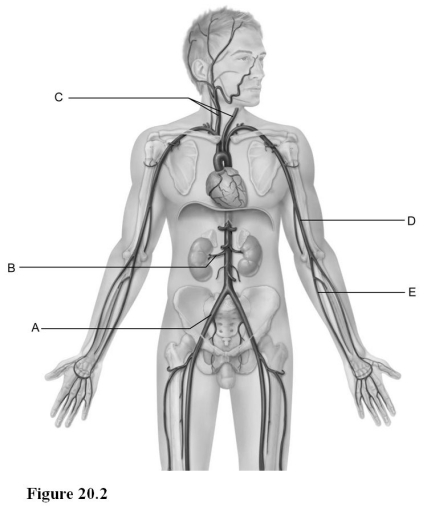 Use the diagram above to answer the following questions.
-Identify the letter that indicates the common carotid arteries.
Use the diagram above to answer the following questions.
-Identify the letter that indicates the common carotid arteries. (Multiple Choice)
4.8/5 (85)
(85) Blood passing through the fetal ductus arteriosus bypasses the
(Multiple Choice)
4.9/5 (79)
(79) 
Filters
- Essay(0)
- Multiple Choice(0)
- Short Answer(0)
- True False(0)
- Matching(0)