



 Chat with AI
Exam 20: Blood Vessels

Exam 1: The Human Body: an Orientation110 Questions
Exam 2: Cells: the Living Units108 Questions
Exam 3: Basic Embryology112 Questions
Exam 4: Tissues110 Questions
Exam 5: The Integumentary System109 Questions
Exam 6: Bones and Skeletal Tissues108 Questions
Exam 7: Bones, Part 1: the Axial Skeleton110 Questions
Exam 8: Bones, Part 2: the Appendicular Skeleton113 Questions
Exam 9: Joints110 Questions
Exam 10: Skeletal Muscle Tissue110 Questions
Exam 11: Muscles of the Body160 Questions
Exam 12: Fundamentals of the Nervous System and Nervous Tissue112 Questions
Exam 13: The Central Nervous System109 Questions
Exam 14: The Peripheral Nervous System114 Questions
Exam 15: The Autonomic Nervous System and Visceral Sensory Neurons110 Questions
Exam 16: The Special Senses114 Questions
Exam 17: The Endocrine System115 Questions
Exam 18: Blood110 Questions
Exam 19: The Heart114 Questions
Exam 20: Blood Vessels113 Questions
Exam 21: The Lymphatic and Immune Systems115 Questions
Exam 22: The Respiratory System110 Questions
Exam 23: The Digestive System113 Questions
Exam 24: The Urinary System112 Questions
Exam 25: The Reproductive System116 Questions
Select questions type


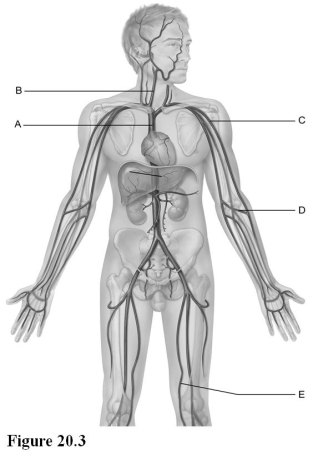 Use the diagram above to answer the following questions.
-Identify the letter that indicates the vessel that is easy to find in most people and is used to obtain blood.
Use the diagram above to answer the following questions.
-Identify the letter that indicates the vessel that is easy to find in most people and is used to obtain blood. (Multiple Choice)
4.9/5  (86)
(86) Most systemic venous blood is both oxygen-poor and nutrient-poor. However, systemic venous blood that is nutrient-rich occurs in
(Multiple Choice)
4.9/5 (70)
(70) The internal iliac arteries supply blood both to the pelvic organs and to the lower limbs.
(True/False)
4.9/5 (80)
(80) Which branch (or branches) of the abdominal aorta supplies the stomach?
(Multiple Choice)
4.9/5 (79)
(79) A dural sinus that contains a major artery and some cranial nerves within it is the
(Multiple Choice)
4.8/5 (76)
(76) 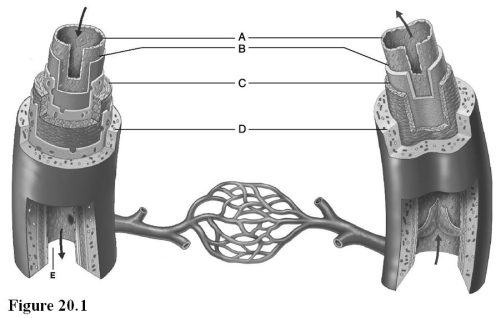 Use the diagram above to answer the following questions.
-Identify the letter that indicates the layer common to all blood vessels regardless of their size.
Use the diagram above to answer the following questions.
-Identify the letter that indicates the layer common to all blood vessels regardless of their size. (Multiple Choice)
4.9/5 (75)
(75) 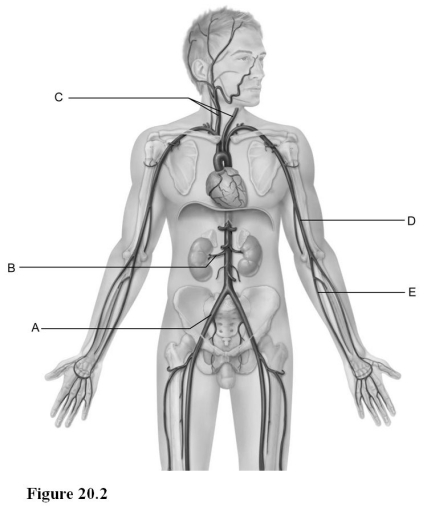 Use the diagram above to answer the following questions.
-Identify the letter that indicates the renal artery.
Use the diagram above to answer the following questions.
-Identify the letter that indicates the renal artery. (Multiple Choice)
4.8/5 (82)
(82) A blood vessel that ranges from 0.3 mm to about 1 cm in diameter and has a large tunica media relative to the size of the lumen is
(Multiple Choice)
4.7/5 (75)
(75) Use the diagram above to answer the following questions.
-Identify the letter that indicates the vessel that arises from the union of the left and right brachiocephalic veins.
Use the diagram above to answer the following questions.
-Identify the letter that indicates the vessel that arises from the union of the left and right brachiocephalic veins. (Multiple Choice)
4.9/5 (62)
(62) Describe the function of the fetal shunts from the pulmonary circuit.
(Essay)
4.9/5 (69)
(69) Use the diagram above to answer the following questions.
-Identify the letter that indicates the longest vein in the body.
Use the diagram above to answer the following questions.
-Identify the letter that indicates the longest vein in the body. (Multiple Choice)
4.9/5 (75)
(75) The inferior vena cava ascends on the left side of the vertebral bodies and to the left of the abdominal aorta.
(True/False)
5.0/5 (78)
(78) ________ channels, also known as arterial anastomoses, provide alternative pathways of blood to joints.
(Short Answer)
4.9/5 (95)
(95) The layer of blood vessels innervated by sympathetic vasomotor fibers is called the
(Multiple Choice)
4.9/5 (71)
(71) The saphenous vein is not paired with an artery with the same name.
(True/False)
4.9/5 (73)
(73) Why do the arteries and veins of the pulmonary circuit have thinner walls than arteries and veins of the systemic circuit?
(Multiple Choice)
4.9/5 (84)
(84) 
Filters
- Essay(0)
- Multiple Choice(0)
- Short Answer(0)
- True False(0)
- Matching(0)