



 Chat with AI
Exam 11: Industry and Manufacturing

Exam 1: Basic Concepts112 Questions
Exam 2: Population and Health102 Questions
Exam 3: Migration104 Questions
Exam 4: Folk and Popular Culture111 Questions
Exam 5: Languages123 Questions
Exam 6: Religions118 Questions
Exam 7: Ethnicities113 Questions
Exam 8: Political Geography128 Questions
Exam 9: Development99 Questions
Exam 10: Food and Agriculture132 Questions
Exam 11: Industry and Manufacturing118 Questions
Exam 12: Services and Settlements117 Questions
Exam 13: Urban Patterns113 Questions
Select questions type


About three-fourths of world industrial production is clustered in three regions.
(True/False)
4.9/5  (69)
(69) If the cost of transporting the inputs exceeds the cost of transporting the product, then the optimal plant location is as close as possible to the customer.
(True/False)
4.8/5 (86)
(86) In Western Europe, ________ has experienced the most rapid manufacturing growth since the late twentieth century, especially after joining the European Union.
(Multiple Choice)
4.9/5 (87)
(87) 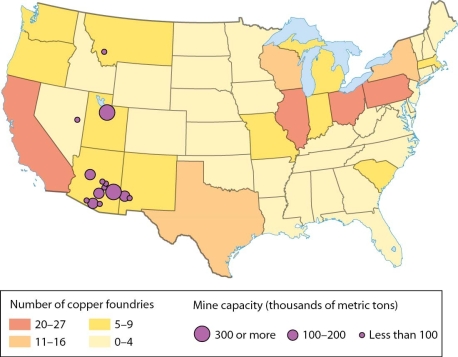 -An analysis of this map of the copper industry in the United States indicates that
 (Multiple Choice)
4.8/5 (84)
(84) What two location factors influence more industries to remain in the northeastern United States and northwestern Europe?
(Multiple Choice)
4.8/5 (96)
(96) What economic advantages would break-of-bulk points offer to local populations?
(Short Answer)
5.0/5 (80)
(80) Maintaining control over all phases of a highly complex production process, as opposed to outsourcing, is known as
(Multiple Choice)
4.8/5 (84)
(84) Discuss an example of a bulk-reducing (or weight-reducing) industry that you believe will face severe economic or environmental difficulties in the near future. What could be done to improve the outlook for that industry? How and why?
(Essay)
4.8/5 (85)
(85) 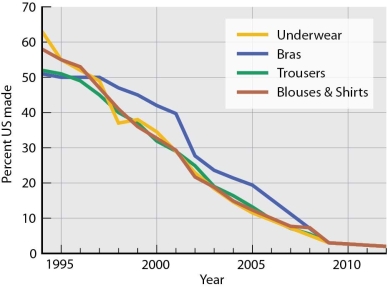 -This chart regarding U.S.-made clothing indicates that the percentage of U.S.-made blouses and skirts being sold
 (Multiple Choice)
4.9/5 (63)
(63) Compared to other industries, aluminum manufacturers are more likely to locate near sources of
(Multiple Choice)
5.0/5 (80)
(80) The optimal location for a factory manufacturing a bulk-gaining product is likely to be one that minimizes the cost of transporting the product to the market.
(True/False)
4.8/5 (80)
(80) 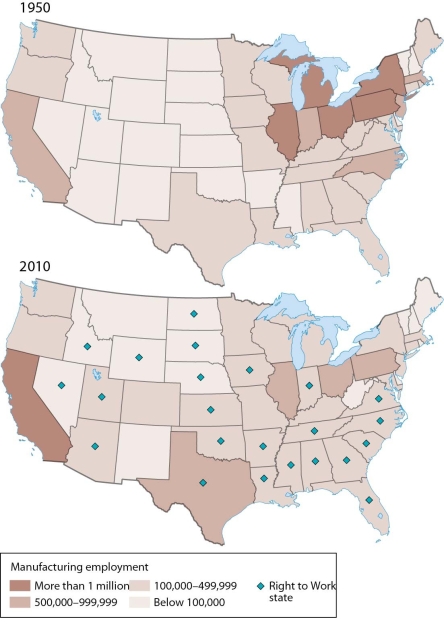 -An analysis of these maps showing changes in U.S. manufacturing from 1950 to 2010 indicates that
 (Multiple Choice)
4.9/5 (71)
(71) How are just-in-time delivery methods more subject to disruptions?
(Short Answer)
4.8/5 (75)
(75) The shift in steel production locations in the United States from the mid-nineteenth century until the mid-twentieth century can best be described as
(Multiple Choice)
4.8/5 (88)
(88) 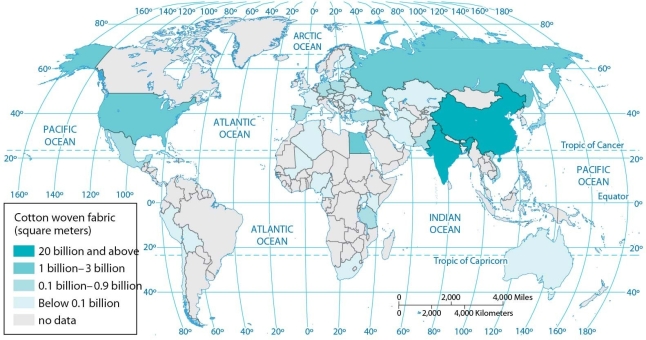 -According to this map of cotton weaving distribution, between 1 billion and 3 billion square meters of fabric are produced annually in both
 (Multiple Choice)
4.9/5 (69)
(69) The dominant industrial power in the nineteenth century was Great Britain.
(True/False)
4.8/5 (87)
(87) If transportation costs were almost nonexistent-that is, if industries did not have to pay money to transport inputs and finished goods over long distances-what are the major changes that could occur in the automobile manufacturing industry?
(Short Answer)
4.8/5 (81)
(81) New U.S. automobile assembly plants have been built primarily in the
(Multiple Choice)
4.9/5 (82)
(82) 
Filters
- Essay(0)
- Multiple Choice(0)
- Short Answer(0)
- True False(0)
- Matching(0)