



 Chat with AI
Exam 14: Ocean Water and Ocean Life

Exam 1: Introduction to Earth Science108 Questions
Exam 2: Matter and Minerals115 Questions
Exam 3: Rocks: Materials of the Solid Earth120 Questions
Exam 4: Plate Tectonics: a Scientific Revolution Unfolds89 Questions
Exam 5: Earthquakes and Earths Interior90 Questions
Exam 6: Volcanoes and Other Igneous Activity106 Questions
Exam 7: Crustal Deformation and Mountain Building97 Questions
Exam 8: Weathering, Soil, and Mass Movement124 Questions
Exam 9: Running Water and Groundwater134 Questions
Exam 10: Glaciers, Deserts, and Wind100 Questions
Exam 11: Geologic Time102 Questions
Exam 12: Earths Evolution Through Geologic Time129 Questions
Exam 13: The Ocean Floor92 Questions
Exam 14: Ocean Water and Ocean Life74 Questions
Exam 15: The Dynamic Ocean101 Questions
Exam 16: The Atmosphere: Composition, Structure, and Temperature85 Questions
Exam 17: Moisture, Clouds, and Precipitation101 Questions
Exam 18: Air Pressure and Wind97 Questions
Exam 19: Weather Patterns and Severe Storms96 Questions
Exam 20: World Climates and Global Climate Change105 Questions
Exam 21: Origins of Modern Astronomy101 Questions
Exam 22: Touring Our Solar System93 Questions
Exam 23: Light, Telescopes, and the Sun93 Questions
Exam 24: Beyond Our Solar System83 Questions
Select questions type


The pycnocline is a rapid change in _______ with depth in the ocean.
(Multiple Choice)
4.9/5  (83)
(83) Consider the below image of a bather easily floating in the Dead Sea, exerting no effort to do so. 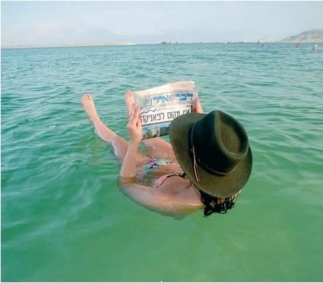 Why is it so easy for the sunbather to stay afloat?
 (Multiple Choice)
4.8/5 (80)
(80) The open ocean, regardless of depth, where animals swim or float freely is called the_______ zone.
(Multiple Choice)
4.9/5 (78)
(78) Large Blue whales that are up to 30 meters long live primarily on _______ that is/are only about 6 cm long.
(Multiple Choice)
4.8/5 (69)
(69) Examine the words and/or phrases below and determine the relationship among the majority of words/phrases. Choose the option that does not fit the pattern.
(Multiple Choice)
4.9/5 (88)
(88) _______ refers to the mass of all living organisms on Earth.
(Multiple Choice)
4.8/5 (77)
(77) _______ include all organisms that drift with ocean currents.
(Multiple Choice)
4.8/5 (86)
(86) Organisms, such as algae and bacteria, that drift with ocean currents are known as_______ .
(Multiple Choice)
4.9/5 (85)
(85) Feeding stages in the food chain are known as _______ levels.
(Multiple Choice)
4.9/5 (81)
(81) 
Filters
- Essay(0)
- Multiple Choice(0)
- Short Answer(0)
- True False(0)
- Matching(0)