



 Chat with AI
Exam 14: Reconstruction: an Unfinished Revolution

Exam 1: Three Old Worlds Create a New108 Questions
Exam 2: Europeans Colonize North America108 Questions
Exam 3: North America in the Atlantic World101 Questions
Exam 4: Becoming America112 Questions
Exam 5: The Ends of Empire133 Questions
Exam 6: American Revolutions109 Questions
Exam 7: Forging a Nation161 Questions
Exam 8: Defining the Nation170 Questions
Exam 9: The Rise of the South111 Questions
Exam 10: The Restless North177 Questions
Exam 11: The Contested West100 Questions
Exam 12: Politics and the Fate of the Union178 Questions
Exam 13: Transforming Fire: the Civil War160 Questions
Exam 14: Reconstruction: an Unfinished Revolution122 Questions
Select questions type


After the Civil War, the main purpose of the Ku Klux Klan in the South was to
(Multiple Choice)
4.9/5  (76)
(76) Instructions:
∙ Identify each item. Give an explanation or description of the item. Answer the questions who, what, where, and when.
Explain the historical significance of each item. Establish the historical context in which the
∙ item exists. Establish the item as the result of or as the cause of other factors existing in the society under study. Answer this question: What were the political, social, economic,
and/or cultural consequences of this item?
-the congressional elections of 1866
(Essay)
4.8/5 (86)
(86) In an attempt to limit President Johnson's powers and safeguard its own Reconstruction plan, Congress
(Multiple Choice)
4.9/5 (83)
(83) Soon after proposing his initial plan for Reconstruction, Andrew Johnson surprisingly helped subvert his own plan by
(Multiple Choice)
4.8/5 (86)
(86) From the African American perspective it appears that the North won the Civil War and lost the peace, for, despite temporary gains, they secured no permanent political or economic rights in the postwar period.
a. Discuss the effectiveness of at least three laws or institutions meant to secure African American rights after the Civil War.
b. What tactics did southern whites use to undermine African American gains?
c. Why did Reconstruction fail to improve the condition of African Americans significantly?
(Essay)
5.0/5 (75)
(75) Explain the conflict between the executive and legislative branches of government over Reconstruction, and discuss the consequences of this conflict.
(Essay)
4.7/5 (77)
(77) Map Exercise 16-1
You will need one colored pen to complete this exercise. On the outline map of the South that follows and using the map in Chapter 16 of the text entitled "The Reconstruction" as a guide:
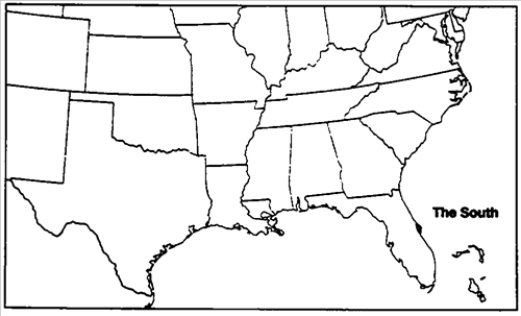 -Refer to Map Exercise 16-1. Label the map: THE RECONSTRUCTION.
 (Essay)
4.8/5 (98)
(98) Instructions:
∙ Identify each item. Give an explanation or description of the item. Answer the questions who, what, where, and when.
Explain the historical significance of each item. Establish the historical context in which the
∙ item exists. Establish the item as the result of or as the cause of other factors existing in the society under study. Answer this question: What were the political, social, economic,
and/or cultural consequences of this item?
-the Civil Rights Act of 1875
(Essay)
4.7/5 (66)
(66) Instructions:
∙ Identify each item. Give an explanation or description of the item. Answer the questions who, what, where, and when.
Explain the historical significance of each item. Establish the historical context in which the
∙ item exists. Establish the item as the result of or as the cause of other factors existing in the society under study. Answer this question: What were the political, social, economic,
and/or cultural consequences of this item?
-scalawag
(Essay)
4.9/5 (75)
(75) Instructions:
∙ Identify each item. Give an explanation or description of the item. Answer the questions who, what, where, and when.
Explain the historical significance of each item. Establish the historical context in which the
∙ item exists. Establish the item as the result of or as the cause of other factors existing in the society under study. Answer this question: What were the political, social, economic,
and/or cultural consequences of this item?
-Johnson's impeachment trial
(Essay)
4.9/5 (85)
(85) Instructions:
∙ Identify each item. Give an explanation or description of the item. Answer the questions who, what, where, and when.
Explain the historical significance of each item. Establish the historical context in which the
∙ item exists. Establish the item as the result of or as the cause of other factors existing in the society under study. Answer this question: What were the political, social, economic,
and/or cultural consequences of this item?
-the Wade-Davis Bill
(Essay)
4.7/5 (78)
(78) Instructions:
∙ Identify each item. Give an explanation or description of the item. Answer the questions who, what, where, and when.
Explain the historical significance of each item. Establish the historical context in which the
∙ item exists. Establish the item as the result of or as the cause of other factors existing in the society under study. Answer this question: What were the political, social, economic,
and/or cultural consequences of this item?
-the Tenure of Office Act
(Essay)
5.0/5 (83)
(83) The 1868 indictment handed down by the House Judiciary Committee against President Johnson concentrated on his
(Multiple Choice)
4.7/5 (77)
(77) Map Exercise 16-1
You will need one colored pen to complete this exercise. On the outline map of the South that follows and using the map in Chapter 16 of the text entitled "The Reconstruction" as a guide:
-Refer to Map Exercise 16-1. Label the following states: Alabama
Arkansas Delaware Georgia Florida Illinois Indiana Kentucky Louisiana Maryland Mississippi Missouri New Jersey
North Carolina Ohio Pennsylvania South Carolina Tennessee Texas
Virginia
West Virginia
-Refer to Map Exercise 16-1. Label the following states: Alabama
Arkansas Delaware Georgia Florida Illinois Indiana Kentucky Louisiana Maryland Mississippi Missouri New Jersey
North Carolina Ohio Pennsylvania South Carolina Tennessee Texas
Virginia
West Virginia (Short Answer)
4.8/5 (86)
(86) Instructions:
∙ Identify each item. Give an explanation or description of the item. Answer the questions who, what, where, and when.
Explain the historical significance of each item. Establish the historical context in which the
∙ item exists. Establish the item as the result of or as the cause of other factors existing in the society under study. Answer this question: What were the political, social, economic,
and/or cultural consequences of this item?
-William H. Seward
(Short Answer)
4.9/5 (85)
(85) Instructions:
∙ Identify each item. Give an explanation or description of the item. Answer the questions who, what, where, and when.
Explain the historical significance of each item. Establish the historical context in which the
∙ item exists. Establish the item as the result of or as the cause of other factors existing in the society under study. Answer this question: What were the political, social, economic,
and/or cultural consequences of this item?
-the Fifteenth Amendment
(Essay)
5.0/5 (72)
(72) Instructions:
∙ Identify each item. Give an explanation or description of the item. Answer the questions who, what, where, and when.
Explain the historical significance of each item. Establish the historical context in which the
∙ item exists. Establish the item as the result of or as the cause of other factors existing in the society under study. Answer this question: What were the political, social, economic,
and/or cultural consequences of this item?
-the constitutional conventions in the former Confederate states
(Essay)
4.9/5 (79)
(79) When Congress, in 1866, decided to base its Reconstruction plan on the ratification of the Fourteenth Amendment by the former Confederate states, the amendment was
(Multiple Choice)
4.9/5 (76)
(76) Instructions:
∙ Identify each item. Give an explanation or description of the item. Answer the questions who, what, where, and when.
Explain the historical significance of each item. Establish the historical context in which the
∙ item exists. Establish the item as the result of or as the cause of other factors existing in the society under study. Answer this question: What were the political, social, economic,
and/or cultural consequences of this item?
-the Civil Rights Act of 1866
(Essay)
5.0/5 (84)
(84) 
Filters
- Essay(0)
- Multiple Choice(0)
- Short Answer(0)
- True False(0)
- Matching(0)