



 Chat with AI
Exam 14: Reconstruction: an Unfinished Revolution

Exam 1: Three Old Worlds Create a New108 Questions
Exam 2: Europeans Colonize North America108 Questions
Exam 3: North America in the Atlantic World101 Questions
Exam 4: Becoming America112 Questions
Exam 5: The Ends of Empire133 Questions
Exam 6: American Revolutions109 Questions
Exam 7: Forging a Nation161 Questions
Exam 8: Defining the Nation170 Questions
Exam 9: The Rise of the South111 Questions
Exam 10: The Restless North177 Questions
Exam 11: The Contested West100 Questions
Exam 12: Politics and the Fate of the Union178 Questions
Exam 13: Transforming Fire: the Civil War160 Questions
Exam 14: Reconstruction: an Unfinished Revolution122 Questions
Select questions type


Map Exercise 16-1
You will need one colored pen to complete this exercise. On the outline map of the South that follows and using the map in Chapter 16 of the text entitled "The Reconstruction" as a guide:
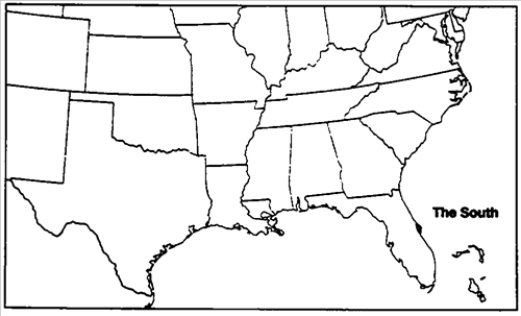 -Refer to Map Exercise 16-1.
Part 1
Create a legend on which you indicate the color chosen to designate the South after reconstruction.
Part 2
Color the former Confederate states with the pen color you have chosen.
-Refer to Map Exercise 16-1.
Part 1
Create a legend on which you indicate the color chosen to designate the South after reconstruction.
Part 2
Color the former Confederate states with the pen color you have chosen. (Short Answer)
4.9/5  (75)
(75) Which of the following is viewed by modern scholars as President Johnson's most serious and indictable offense?
(Multiple Choice)
5.0/5 (81)
(81) Instructions:
∙ Identify each item. Give an explanation or description of the item. Answer the questions who, what, where, and when.
Explain the historical significance of each item. Establish the historical context in which the
∙ item exists. Establish the item as the result of or as the cause of other factors existing in the society under study. Answer this question: What were the political, social, economic,
and/or cultural consequences of this item?
-Sherman's special Field Order Number 15
(Essay)
4.8/5 (83)
(83) Map Exercise 16-1
You will need one colored pen to complete this exercise. On the outline map of the South that follows and using the map in Chapter 16 of the text entitled "The Reconstruction" as a guide:
-Refer to Map Exercise 16-1. Draw the boundaries of the five military districts into which the former Confederate states were divided, and label each of the five districts.
-Refer to Map Exercise 16-1. Draw the boundaries of the five military districts into which the former Confederate states were divided, and label each of the five districts. (Essay)
5.0/5 (82)
(82) After the Civil War, most African American farmers eventually worked
(Multiple Choice)
4.7/5 (85)
(85) Instructions:
∙ Identify each item. Give an explanation or description of the item. Answer the questions who, what, where, and when.
Explain the historical significance of each item. Establish the historical context in which the
∙ item exists. Establish the item as the result of or as the cause of other factors existing in the society under study. Answer this question: What were the political, social, economic,
and/or cultural consequences of this item?
-Thaddeus Stevens' plan for land redistribution in the South
(Essay)
4.9/5 (77)
(77) Explain the impeachment of President Johnson by the House of Representatives and his subsequent acquittal in the Senate. What implications did Johnson's acquittal have for the future?
(Essay)
4.9/5 (83)
(83) Contrast the Reconstruction plan advocated by Radical Republicans such as Thaddeus Stevens with the Reconstruction Act of 1867. Why were key elements of the Radical plan not adopted? How might the Radical plan have changed southern society?
(Essay)
4.9/5 (82)
(82) With respect to the question of black suffrage in the South, Andrew Johnson believed that
(Multiple Choice)
4.9/5 (78)
(78) Instructions:
∙ Identify each item. Give an explanation or description of the item. Answer the questions who, what, where, and when.
Explain the historical significance of each item. Establish the historical context in which the
∙ item exists. Establish the item as the result of or as the cause of other factors existing in the society under study. Answer this question: What were the political, social, economic,
and/or cultural consequences of this item?
-public schools in the former Confederate states
(Essay)
4.8/5 (80)
(80) Instructions:
∙ Identify each item. Give an explanation or description of the item. Answer the questions who, what, where, and when.
Explain the historical significance of each item. Establish the historical context in which the
∙ item exists. Establish the item as the result of or as the cause of other factors existing in the society under study. Answer this question: What were the political, social, economic,
and/or cultural consequences of this item?
-the Enforcement Acts and the anti-Klan law
(Essay)
4.7/5 (84)
(84) Instructions:
∙ Identify each item. Give an explanation or description of the item. Answer the questions who, what, where, and when.
Explain the historical significance of each item. Establish the historical context in which the
∙ item exists. Establish the item as the result of or as the cause of other factors existing in the society under study. Answer this question: What were the political, social, economic,
and/or cultural consequences of this item?
-the Memphis and New Orleans riots of 1866
(Essay)
4.7/5 (82)
(82) Which of the following is true of Johnson's impeachment trial?
(Multiple Choice)
4.9/5 (73)
(73) In the Slaughter-House cases, the Supreme Court held that the Fourteenth Amendment
(Multiple Choice)
4.7/5 (92)
(92) Instructions:
∙ Identify each item. Give an explanation or description of the item. Answer the questions who, what, where, and when.
Explain the historical significance of each item. Establish the historical context in which the
∙ item exists. Establish the item as the result of or as the cause of other factors existing in the society under study. Answer this question: What were the political, social, economic,
and/or cultural consequences of this item?
-Francis Cardozo and P.B.S. Pinchback
(Essay)
4.9/5 (71)
(71) Instructions:
∙ Identify each item. Give an explanation or description of the item. Answer the questions who, what, where, and when.
Explain the historical significance of each item. Establish the historical context in which the
∙ item exists. Establish the item as the result of or as the cause of other factors existing in the society under study. Answer this question: What were the political, social, economic,
and/or cultural consequences of this item?
-"Decoration Day"
(Essay)
4.9/5 (76)
(76) Trace the evolution of the congressional Reconstruction plan, and examine the factors that affected the development of this plan.
(Essay)
4.9/5 (80)
(80) Discuss the aspirations and goals of African American southerners as they entered upon life after slavery, and explain the ways in which they attempted to achieve their goals. To what extent were they successful? Why?
(Not Answered)
This question doesn't have any answer yet
Instructions:
∙ Identify each item. Give an explanation or description of the item. Answer the questions who, what, where, and when.
Explain the historical significance of each item. Establish the historical context in which the
∙ item exists. Establish the item as the result of or as the cause of other factors existing in the society under study. Answer this question: What were the political, social, economic,
and/or cultural consequences of this item?
-President Ulysses S. Grant
(Essay)
4.9/5 (75)
(75) Instructions:
∙ Identify each item. Give an explanation or description of the item. Answer the questions who, what, where, and when.
Explain the historical significance of each item. Establish the historical context in which the
∙ item exists. Establish the item as the result of or as the cause of other factors existing in the society under study. Answer this question: What were the political, social, economic,
and/or cultural consequences of this item?
-the Liberal Republican revolt
(Essay)
4.8/5 (90)
(90) 
Filters
- Essay(0)
- Multiple Choice(0)
- Short Answer(0)
- True False(0)
- Matching(0)