



 Chat with AI
Exam 4: Employee Compensation

Exam 1: Introduction to Taxation109 Questions
Exam 2: The Tax Practice Environment111 Questions
Exam 3: Determining Gross Income132 Questions
Exam 4: Employee Compensation101 Questions
Exam 5: Deductions for Individuals and Tax Determination120 Questions
Exam 6: Business Expenses116 Questions
Exam 7: Property Acquisitions and Cost Recovery Deductions114 Questions
Exam 8: Property Dispositions116 Questions
Exam 9: Tax-Deferred Exchanges112 Questions
Exam 10: Taxation of Corporations111 Questions
Exam 11: Sole Proprietorships and Flow-Through Entities133 Questions
Exam 12: Estates, Gifts, and Trusts116 Questions
Select questions type


A taxpayer must work out of the country for a complete tax year, or he or she will not be eligible for the foreign earned income exclusion.
(True/False)
4.7/5  (88)
(88) A taxpayer who is a bona fide resident of a foreign country for an entire tax year may:
(Multiple Choice)
4.9/5 (85)
(85) Howard is a cash-basis, calendar-year taxpayer. He works for Clyde Corporation, an accrual-basis, calendar-year corporation. Clyde authorizes a $10,000 bonus for Howard on December 20, year 1. It pays the bonus on March 31 of year 2. Which of the following is correct?
(Multiple Choice)
4.8/5 (82)
(82) Tom works two part-time jobs while going to school. He works at a clothing store because he is allowed a 30 percent discount on his clothes purchases and a cellular phone store that allows him a 50 percent discount on his cell phone service. During the year, he purchases clothes valued at $1,000 for $700. The store marks up its clothing 100 percent. He pays $240 ($20 per month) for his discounted cell phone service. How much income in addition to his salaries must he report for these fringe benefits?
(Essay)
4.8/5 (83)
(83) James owns a sole proprietorship. James pays his son Albert, age 17, $8,000 and his daughter Chloe, age 19, $11,000 for their work in the business. Both wages are reasonable for the work they perform. How much FICA tax must the sole proprietorship pay on the wages?
(Multiple Choice)
4.9/5 (73)
(73) Brianna received 600 shares of her employer's stock as a bonus. She must return the stock to the company if she leaves before the 4-year vesting period ends. The fair market value of the stock at the time it was issued was $15,000. After 4 years, the stock vests when its fair market value is $32,000. Two years after vesting, Brianna sells the stock for $44,000. If Brianna makes no special election, how much income or gain does she recognize when she sells the stock?
(Multiple Choice)
5.0/5 (74)
(74) Contrast a qualified defined contribution plan with a qualified defined benefit plan for the employee.
(Essay)
4.8/5 (76)
(76) An employee who receives an incentive stock option normally recognizes no income until the stock acquired with the option is sold.
(True/False)
4.9/5 (77)
(77) Maureen is a cash-basis, calendar-year taxpayer and works as a sales manager for Teton Corporation, an accrual basis, calendar-year corporation. Teton's president and 100 percent owner, Tom, (also a cash-basis taxpayer) authorizes a $25,000 bonus for Maureen and a $100,000 bonus for himself on December 22, year 1. The company pays his bonus on February 2, but fails to pay Maureen's bonus until March 30, year 2.
(Multiple Choice)
4.8/5 (85)
(85) A single employee who is not covered by an employer's retirement plan may always contribute at least $5,000 of earned income to his or her IRA.
(True/False)
4.9/5 (93)
(93) Which of the following is a characteristic of an incentive stock option?
(Multiple Choice)
4.9/5 (87)
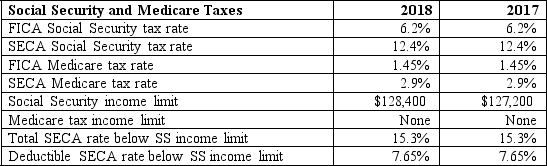
(87) Warren has $62,400 of net income from his sole proprietorship. How much is his self-employment tax on this income in 2018?
(Essay)
4.8/5 (72)
(72) ABC Corporation awarded John 1,000 options in 2014; each option allows him to purchase one share of ABC Corporation stock for $20. The ABC stock is selling for $18 per share at the grant date. In 2016, John exercises the options when the stock's selling price was $40 per share. In 2018, John sells the stock for $50 per share. What is ABC Corporation's deduction if they are nonqualified stock options?
(Multiple Choice)
4.8/5 (77)
(77) Elizabeth received the following benefits from her employer this year: -$5,000 year-end bonus for exceeding sales expectations
-$400 cash as a length-of-service award
-$2,400 for insurance premiums paid by her employer for a disability income policy
-$5,100 for tuition paid by her employer for courses not related to her job under an educational assistance plan
How much must Elizabeth include in gross income?
(Multiple Choice)
4.7/5 (79)
(79) Explain a flexible spending arrangement for uninsured health costs and why it is beneficial to a taxpayer.
(Essay)
4.8/5 (76)
(76) Barry's firm purchases a $31,000 automobile for his business and personal use. Barry uses the auto 80 percent for business and 20 percent for personal use in 2018. Assume that the IRS tables show that the annual lease-value of a $31,000 automobile is $8,250. If the company takes full depreciation deductions for the auto, how much income must Barry recognize?
(Short Answer)
4.7/5 (77)
(77) If an employer insists that an employee move from New York to California, all direct and indirect costs incurred by the taxpayer and paid by the employer would result in no income to the employee.
(True/False)
4.9/5 (71)
(71) In 2013, Hu Corporation granted incentive stock options to Trevor to buy 5,000 shares of Hu stock at $20 per share exercisable for six years. At the date of grant, the stock was selling for $19 per share. In 2016, Trevor exercises the options when the market price was $38 per share. Trevor sells the stock in 2018 for $42 per share. How much income or gain does Trevor recognize and in which year?
(Multiple Choice)
4.8/5 (79)
(79) 
Filters
- Essay(0)
- Multiple Choice(0)
- Short Answer(0)
- True False(0)
- Matching(0)