



 Chat with AI
Exam 11: Biological Membranes and Transport

Exam 1: The Foundations of Biochemistry56 Questions
Exam 2: Water41 Questions
Exam 3: Amino Acids, peptides, and Proteins72 Questions
Exam 4: The Three-Dimensional Structure of Proteins61 Questions
Exam 5: Protein Function45 Questions
Exam 6: Enzymes67 Questions
Exam 7: Carbohydrates and Glycobiology53 Questions
Exam 8: Nucleotides and Nucleic Acids60 Questions
Exam 9: Recombinant Dna Technology46 Questions
Exam 10: Lipids46 Questions
Exam 11: Biological Membranes and Transport60 Questions
Exam 12: Biosignaling70 Questions
Exam 13: Principles of Bioenergetics53 Questions
Exam 14: Glycolysis, gluconeogenesis, and the Pentose Phosphate Pathway79 Questions
Exam 15: Principles of Metabolic Regulation48 Questions
Exam 16: The Citric Acid Cycle58 Questions
Exam 17: Fatty Acid Catabolism50 Questions
Exam 18: Amino Acid Oxidation and the Production of Urea48 Questions
Exam 19: Oxidative Phosphorylation and Photophosphorylation78 Questions
Exam 20: Carbohydrate Biosynthesis in Plants and Bacteria47 Questions
Exam 21: Lipid Biosynthesis58 Questions
Exam 22: Biosynthesis of Amino Acids, nucleotides, and Related Molecules64 Questions
Exam 23: Integration and Hormonal Regulation of Mammalian Metabolism55 Questions
Exam 24: Genes and Chromosomes46 Questions
Exam 25: Dna Metabolism60 Questions
Exam 26: Rna Metabolism58 Questions
Exam 27: Protein Metabolism59 Questions
Exam 28: Regulation of Gene Expression57 Questions
Select questions type


Movement of water across membranes is facilitated by proteins called:
(Multiple Choice)
4.8/5  (75)
(75) Which of these statements about the composition of membranes is true?
(Multiple Choice)
5.0/5 (90)
(90) You are trying to isolate an enzyme that catalyzes the conversion of A B,and you have a sensitive assay for this enzyme.After lysing open the cells,you find that the activity is associated with the membrane fraction,not the soluble fraction (which you throw away).You then follow the procedure shown below.Explain the sudden re-occurrence of activity at the end of your protocol. 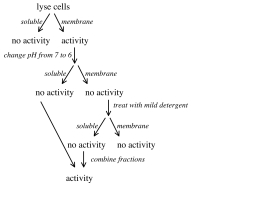
(Essay)
4.8/5 (89)
(89) Which one of the following statements about membranes is true?
(Multiple Choice)
4.9/5 (69)
(69) Compare and contrast symport and antiport.Which term best describes the transport system mediated by the Na+K+ ATPase?
(Essay)
4.9/5 (84)
(84) Describe two different ways a plant can adjust the components of its cell membranes to keep them as fluid as possible on a cold winter morning.
(Essay)
4.8/5 (76)
(76) Draw the structure of a biological membrane as proposed by the fluid mosaic model.Indicate the positions and orientations of phospholipids,cholesterol,integral and peripheral membrane proteins,and the carbohydrate moieties of glycoproteins and glycolipids.
(Essay)
4.9/5 (76)
(76) When a bacterium such as E.coli is shifted from a warmer growth temperature to a cooler growth temperature,it compensates by:
(Multiple Choice)
4.8/5 (75)
(75) What is the major difference between gated and non-gated ion channels? Give an example of two different gating signals.
(Essay)
4.8/5 (82)
(82) Which of the following statements is not true about the chloride-bicarbonate exchanger (AE)?
(Multiple Choice)
5.0/5 (88)
(88) Membrane fusion leading to neurotransmitter release requires the action of:
(Multiple Choice)
4.9/5 (96)
(96) Consider the transport of glucose into an erythrocyte by facilitated diffusion.When the glucose concentrations are 5 mM on the outside and 0.1 mM on the inside,the free-energy change for glucose uptake into the cell is: (These values may be of use to you: R = 8.315 J/mol·K;T = 298 K;9 (Faraday constant)= 96,480 J/V;N = 6.022 *1023/mol. )
(Multiple Choice)
4.9/5 (65)
(65) Explain the differences between integral and peripheral membrane proteins.
(Essay)
4.9/5 (70)
(70) A process not involving the fusion of two membranes or two regions of the same membrane is:
(Multiple Choice)
4.8/5 (77)
(77) The shortest helix segment in a protein that will span a membrane bilayer has about _____ amino acid residues.
(Multiple Choice)
4.7/5 (71)
(71) Reagents A and B both react covalently with primary amino groups such as those of phosphatidylethanolamine.Reagent A permeates erythrocytes,but reagent B is impermeant.Both A and B are available in radioisotopically labeled form.Describe a simple experiment by which you might determine whether the phosphatidylethanolamine of erythrocyte membranes is located in the outside face of the lipid bilayer,the inside face,or in both.
(Essay)
4.9/5 (83)
(83) The specificity of the potassium channel for K+ over Na+ is mainly the result of the:
(Multiple Choice)
4.8/5 (79)
(79) 
Filters
- Essay(0)
- Multiple Choice(0)
- Short Answer(0)
- True False(0)
- Matching(0)