



 Chat with AI
Exam 14: Glycolysis, gluconeogenesis, and the Pentose Phosphate Pathway

Exam 1: The Foundations of Biochemistry56 Questions
Exam 2: Water41 Questions
Exam 3: Amino Acids, peptides, and Proteins72 Questions
Exam 4: The Three-Dimensional Structure of Proteins61 Questions
Exam 5: Protein Function45 Questions
Exam 6: Enzymes67 Questions
Exam 7: Carbohydrates and Glycobiology53 Questions
Exam 8: Nucleotides and Nucleic Acids60 Questions
Exam 9: Recombinant Dna Technology46 Questions
Exam 10: Lipids46 Questions
Exam 11: Biological Membranes and Transport60 Questions
Exam 12: Biosignaling70 Questions
Exam 13: Principles of Bioenergetics53 Questions
Exam 14: Glycolysis, gluconeogenesis, and the Pentose Phosphate Pathway79 Questions
Exam 15: Principles of Metabolic Regulation48 Questions
Exam 16: The Citric Acid Cycle58 Questions
Exam 17: Fatty Acid Catabolism50 Questions
Exam 18: Amino Acid Oxidation and the Production of Urea48 Questions
Exam 19: Oxidative Phosphorylation and Photophosphorylation78 Questions
Exam 20: Carbohydrate Biosynthesis in Plants and Bacteria47 Questions
Exam 21: Lipid Biosynthesis58 Questions
Exam 22: Biosynthesis of Amino Acids, nucleotides, and Related Molecules64 Questions
Exam 23: Integration and Hormonal Regulation of Mammalian Metabolism55 Questions
Exam 24: Genes and Chromosomes46 Questions
Exam 25: Dna Metabolism60 Questions
Exam 26: Rna Metabolism58 Questions
Exam 27: Protein Metabolism59 Questions
Exam 28: Regulation of Gene Expression57 Questions
Select questions type


Which of the following is a cofactor in the reaction catalyzed by glyceraldehyde 3-phosphate dehydrogenase?
(Multiple Choice)
4.8/5  (76)
(76) An extract of adipose (fat)tissue can metabolize glucose to CO2.When glucose labeled with 14C in either C-1 or C-6 was added to the extract,14CO2 was released with the time courses shown below.What is the major path of glucose oxidation in this extract? Explain how you reached this conclusion. 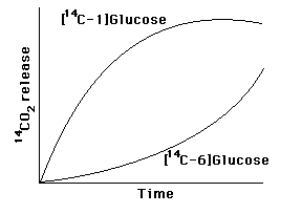
(Essay)
4.9/5 (84)
(84) The first reaction in glycolysis that results in the formation of an energy-rich compound is catalyzed by:
(Multiple Choice)
4.9/5 (80)
(80) There are a variety of fairly common human genetic diseases in which enzymes required for the breakdown of fructose,lactose,or sucrose are defective.However,there are very few cases of people having a genetic disease in which one of the enzymes of glycolysis is severely affected.Why do you suppose such mutations are seen so rarely?
(Essay)
4.8/5 (71)
(71) In comparison with the resting state,actively contracting human muscle tissue has a:
(Multiple Choice)
4.9/5 (79)
(79) Which of the following reactions in glycolysis utilizes a covalent enzyme intermediate?
(Multiple Choice)
4.8/5 (88)
(88) The steps of glycolysis between glyceraldehyde 3-phosphate and 3-phosphoglycerate involve all of the following except:
(Multiple Choice)
4.9/5 (85)
(85) When a mixture of glucose 6-phosphate and fructose 6-phosphate is incubated with the enzyme phosphohexose isomerase,the final mixture contains twice as much glucose 6-phosphate as fructose 6-phosphate.Which one of the following statements is most nearly correct,when applied to the reaction below (R = 8.315 J/mol·K and T = 298 K)?
Glucose 6-phosphate ↔ fructose 6-phosphate
(Multiple Choice)
4.8/5 (81)
(81) The conversion of glucose into glucose 6-phosphate,which must occur in the breakdown of glucose,is thermodynamically unfavorable (endergonic).How do cells overcome this problem?
(Essay)
4.8/5 (90)
(90) If you incubate 14C-CO2 with liver extracts capable of performing gluconeogenesis,where does the radioactive label end up?
(Essay)
4.9/5 (87)
(87) The metabolic function of the pentose phosphate pathway is to:
(Multiple Choice)
4.8/5 (93)
(93) Inorganic fluoride inhibits enolase.In an anaerobic system that is metabolizing glucose as a substrate,which of the following compounds would you expect to increase in concentration following the addition of fluoride?
(Multiple Choice)
4.7/5 (68)
(68) Describe the glycolytic pathway from glucose to glyceraldehyde 3-phosphate.Show structures of intermediates,enzyme names,and indicate where any cofactors participate.
(Essay)
4.9/5 (81)
(81) In glycolysis there are two reactions that require one ATP each and two reactions that produce one ATP each.This being the case,how can fermentation of glucose to lactate lead to the net production of two ATP molecules per glucose?
(Essay)
4.8/5 (69)
(69) What are the two reactions in glycolysis in which aldose to ketose isomerization is catalyzed by an enzyme? For both reactions the G'° is positive.Briefly explain how the reactions are able to proceed without the input of additional energy.
(Essay)
4.9/5 (89)
(89) The conversion of 1 mol of fructose 1,6-bisphosphate to 2 mol of pyruvate by the glycolytic pathway results in a net formation of:
(Multiple Choice)
4.8/5 (86)
(86) Which of these cofactors participates directly in most of the oxidation-reduction reactions in the fermentation of glucose to lactate?
(Multiple Choice)
4.9/5 (86)
(86) Which one of the following statements about gluconeogenesis is false?
(Multiple Choice)
4.8/5 (77)
(77) 
Filters
- Essay(0)
- Multiple Choice(0)
- Short Answer(0)
- True False(0)
- Matching(0)