



 Chat with AI
Exam 2: Water

Exam 1: The Foundations of Biochemistry56 Questions
Exam 2: Water41 Questions
Exam 3: Amino Acids, peptides, and Proteins72 Questions
Exam 4: The Three-Dimensional Structure of Proteins61 Questions
Exam 5: Protein Function45 Questions
Exam 6: Enzymes67 Questions
Exam 7: Carbohydrates and Glycobiology53 Questions
Exam 8: Nucleotides and Nucleic Acids60 Questions
Exam 9: Recombinant Dna Technology46 Questions
Exam 10: Lipids46 Questions
Exam 11: Biological Membranes and Transport60 Questions
Exam 12: Biosignaling70 Questions
Exam 13: Principles of Bioenergetics53 Questions
Exam 14: Glycolysis, gluconeogenesis, and the Pentose Phosphate Pathway79 Questions
Exam 15: Principles of Metabolic Regulation48 Questions
Exam 16: The Citric Acid Cycle58 Questions
Exam 17: Fatty Acid Catabolism50 Questions
Exam 18: Amino Acid Oxidation and the Production of Urea48 Questions
Exam 19: Oxidative Phosphorylation and Photophosphorylation78 Questions
Exam 20: Carbohydrate Biosynthesis in Plants and Bacteria47 Questions
Exam 21: Lipid Biosynthesis58 Questions
Exam 22: Biosynthesis of Amino Acids, nucleotides, and Related Molecules64 Questions
Exam 23: Integration and Hormonal Regulation of Mammalian Metabolism55 Questions
Exam 24: Genes and Chromosomes46 Questions
Exam 25: Dna Metabolism60 Questions
Exam 26: Rna Metabolism58 Questions
Exam 27: Protein Metabolism59 Questions
Exam 28: Regulation of Gene Expression57 Questions
Select questions type


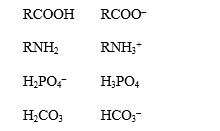

Which of these statements about hydrogen bonds is not true?
(Multiple Choice)
4.9/5  (74)
(74) Phosphoric acid is tribasic,with pKa's of 2.14,6.86,and 12.4.The ionic form that predominates at pH 3.2 is:
(Multiple Choice)
4.8/5 (70)
(70) A compound has a pKa of 7.4.To 100 mL of a 1.0 M solution of this compound at pH 8.0 is added 30 mL of 1.0 M hydrochloric acid.The resulting solution is pH:
(Multiple Choice)
4.8/5 (76)
(76) You want to maintain pH = 7.0 for an enzyme-catalyzed reaction that will produce hydrogen ions along with the desired product.At equal concentrations,which weak acid,if any,will serve as the better buffer for the reaction: Acid A,with pKa = 6.5 or Acid B,with pKa = 7.5?
(Multiple Choice)
5.0/5 (74)
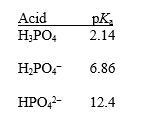
(74) Phosphoric acid (H3PO4)has three dissociable protons,with the pKa's shown below.Which form of phosphoric acid predominates in a solution at pH 4? Explain your answer.
(Essay)
4.7/5 (74)
(74) A true statement about hydrophobic interactions is that they:
(Multiple Choice)
4.7/5 (84)
(84) Define pKa for a weak acid in the following two ways: (1)in relation to its acid dissociation constant,Ka,and (2)by reference to a titration curve for the weak acid.
(Essay)
4.9/5 (78)
(78) Three buffers are made by combining a 1 M solution of acetic acid with a 1 M solution of sodium acetate in the ratios shown below.
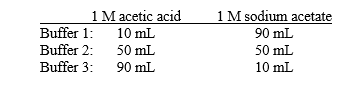 Which of these statements is true of the resulting buffers?
 (Multiple Choice)
4.8/5 (76)
(76) Explain the fact that triethylammonium chloride ((CH3CH2)3N•HCl)is more soluble in water than is triethylamine ((CH3CH2)3N).
(Essay)
4.8/5 (82)
(82) Consider an acetate buffer,initially at the same pH as its pKa (4.76).When sodium hydroxide (NaOH)is mixed with this buffer,the:
(Multiple Choice)
4.9/5 (73)
(73) A 1.0 M solution of a compound with 2 ionizable groups (pKa's = 6.2 and 9.5;100 mL total)has a pH of 6.8.If a biochemist adds 60 mL of 1.0 M HCl to this solution,the solution will change to pH:
(Multiple Choice)
4.7/5 (81)
(81) In which reaction below does water not participate as a reactant (rather than as a product)?
(Multiple Choice)
4.7/5 (91)
(91) Dissolved solutes alter some physical (colligative)properties of the solvent water because they change the:
(Multiple Choice)
4.8/5 (89)
(89) Name and briefly define five types of noncovalent interactions that occur between biological molecules.
(Essay)
4.9/5 (71)
(71) A weak acid HA,has a pKa of 5.0.If 1.0 mol of this acid and 0.1 mol of NaOH were dissolved in one liter of water,what would the final pH be?
(Essay)
4.8/5 (78)
(78) 
Filters
- Essay(0)
- Multiple Choice(0)
- Short Answer(0)
- True False(0)
- Matching(0)