



 Chat with AI
Exam 4: Interpretation and Management of Basic Dysrhythmias

Exam 1: What Is Critical Care37 Questions
Exam 2: Care of the Critically Ill Patient36 Questions
Exam 3: Care of the Patient With Respiratory Failure36 Questions
Exam 4: Interpretation and Management of Basic Dysrhythmias39 Questions
Exam 5: Cardiodynamics and Hemodynamic Regulation36 Questions
Exam 6: Care of the Patient Experiencing Shock36 Questions
Exam 7: Care of the Patient Experiencing Heart Failure36 Questions
Exam 8: Care of the Patient Experiencing Acute Coronary Syndrome37 Questions
Exam 9: Care of the Patient Following Traumatic Injury39 Questions
Exam 10: Care of the Patient Experiencing an Intracranial Dysfunction38 Questions
Exam 11: Care of the Patient With a Cerebral or Cerbrovascular Disorder39 Questions
Exam 12: Care of the Critically Ill Patient Experiencing Alcohol Withdrawal Andor Liver Failure36 Questions
Exam 13: Care of the Patient With an Acute Gastrointestinal Bleed or Pancreatitis37 Questions
Exam 14: Care of the Patient With Problems in Glucose Metabolism37 Questions
Exam 15: Care of the Patient With Acute Kidney Injury38 Questions
Exam 16: Care of the Organ Donor and Transplant Recipient37 Questions
Exam 17: Care of the Acutely Ill Burn Patient38 Questions
Exam 18: Care of the Patient With Sepsis36 Questions
Exam 19: Care of the Icu Patient at the End of Life39 Questions
Select questions type


When evaluating the health history of a patient with complete heart block, what should the nurse identify as potential causes for this health problem? Select all that apply.
(Multiple Choice)
4.8/5  (85)
(85) The nurse is interpreting an ECG strip. What would describe paroxysmal supraventricular tachycardia (PSVT)? Select all that apply.
(Multiple Choice)
4.9/5 (91)
(91) The nurse reviews the characteristics of a normal QRS complex on a patient's cardiac rhythm strip. What should the nurse identify as characteristics of this complex? Select all that apply.
(Multiple Choice)
4.9/5 (73)
(73) A patient with sick sinus syndrome loses consciousness for 15 seconds during periods of asystole. What should the nurse expect to be prescribed for this patient?
(Multiple Choice)
4.9/5 (70)
(70) A patient is experiencing chest pain, shortness of breath, and lethargy. The patient's vital signs are BP 88/58, HR 40, RR 20. Which nursing action is a priority for this patient?
(Multiple Choice)
4.8/5 (77)
(77) A patient in the emergency department is in supraventricular tachycardia. Which actions should be taken for this patient? Select all that apply.
(Multiple Choice)
4.8/5 (76)
(76) The nurse reviews a patient's prescribed scheduled and PRN medications. Which medication affects cardiac contractility? Select all that apply.
(Multiple Choice)
4.8/5 (79)
(79) A patient is placed on continuous cardiac monitoring. What should the nurse realize is occurring when the rhythm displays a flat, isoelectric line?
(Multiple Choice)
4.9/5 (79)
(79) A patient with atrial fibrillation is scheduled for elective cardioversion. What teaching should the nurse prepare for this patient?
(Multiple Choice)
4.8/5 (87)
(87) A patient is scheduled for surgery to implant a cardioverter-defibrillator (ICD). What should the nurse expect to see documented in the patient's medical record?
(Multiple Choice)
4.9/5 (75)
(75) In order to correctly manage ventricular dysrhythmias, the nurse should expect to implement which treatment?
(Multiple Choice)
4.8/5 (98)
(98) A patient has the following rhythm on the monitor. The patient is alert and oriented and denies any complaints at present. What should the nurse do first? 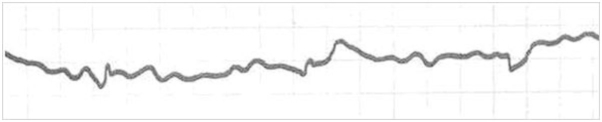
(Multiple Choice)
4.9/5 (90)
(90) A patient is experiencing a new onset of the following rhythm. With complications related to this rhythm in mind, which intervention is a priority? 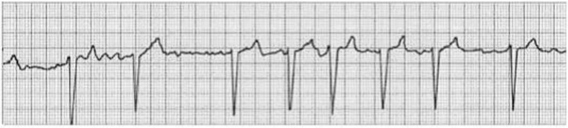
(Multiple Choice)
4.8/5 (80)
(80) The nurse reviews synchronized cardioversion with a new graduate. What should the nurse include when reviewing this procedure? Select all that apply.
(Multiple Choice)
4.9/5 (85)
(85) The ECG strip of a patient with a transvenous ventricular demand pacemaker shows QRS complexes without pacer spikes. What should the nurse do?
(Multiple Choice)
4.7/5 (65)
(65) A patient is demonstrating second-degree heart block (Wenckebach [type I]). What characteristic of this rhythm should the nurse recognize?
(Multiple Choice)
4.7/5 (81)
(81) A patient receiving procainamide develops pulseless ventricular tachycardia. What should the nurse expect to be done for this patient?
(Multiple Choice)
4.8/5 (73)
(73) CPR is started on a patient who has developed ventricular fibrillation. The patient is defibrillated once with the resulting rhythm. Which intervention should the nurse implement next? 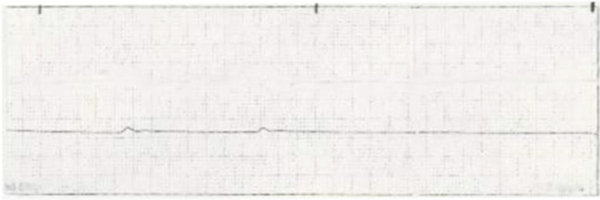
(Multiple Choice)
4.9/5 (72)
(72) 
Filters
- Essay(0)
- Multiple Choice(0)
- Short Answer(0)
- True False(0)
- Matching(0)