



 Chat with AI
Exam 4: Interpretation and Management of Basic Dysrhythmias

Exam 1: What Is Critical Care37 Questions
Exam 2: Care of the Critically Ill Patient36 Questions
Exam 3: Care of the Patient With Respiratory Failure36 Questions
Exam 4: Interpretation and Management of Basic Dysrhythmias39 Questions
Exam 5: Cardiodynamics and Hemodynamic Regulation36 Questions
Exam 6: Care of the Patient Experiencing Shock36 Questions
Exam 7: Care of the Patient Experiencing Heart Failure36 Questions
Exam 8: Care of the Patient Experiencing Acute Coronary Syndrome37 Questions
Exam 9: Care of the Patient Following Traumatic Injury39 Questions
Exam 10: Care of the Patient Experiencing an Intracranial Dysfunction38 Questions
Exam 11: Care of the Patient With a Cerebral or Cerbrovascular Disorder39 Questions
Exam 12: Care of the Critically Ill Patient Experiencing Alcohol Withdrawal Andor Liver Failure36 Questions
Exam 13: Care of the Patient With an Acute Gastrointestinal Bleed or Pancreatitis37 Questions
Exam 14: Care of the Patient With Problems in Glucose Metabolism37 Questions
Exam 15: Care of the Patient With Acute Kidney Injury38 Questions
Exam 16: Care of the Organ Donor and Transplant Recipient37 Questions
Exam 17: Care of the Acutely Ill Burn Patient38 Questions
Exam 18: Care of the Patient With Sepsis36 Questions
Exam 19: Care of the Icu Patient at the End of Life39 Questions
Select questions type


A patient's monitor strip shows an irregular rhythm. Which count and approach should the nurse use to estimate this patient's heart rate?

Free
(Multiple Choice)
4.8/5  (71)
(71) Correct Answer: Verified
C
The nurse is analyzing a 6-second ECG rhythm strip with the following findings: P to QRS ratio is 1:1; four regular R waves were present; QRS width was 0.10 second; PR interval was 0.18 second. How should the nurse document this rhythm?
Free
(Multiple Choice)
4.8/5 (81)
(81) Correct Answer:Verified
VerifiedD
Which assessment finding indicates that a patient has had a favorable response to atropine?
Free
(Multiple Choice)
4.9/5 (70)
(70) Correct Answer:Verified
VerifiedA
What should the nurse include in the plan of care for a patient with atrial fibrillation? Select all that apply.
(Multiple Choice)
4.8/5 (74)
(74) A patient's heart rhythm shows a regular rate of 50 bpm. The P wave looks like an inverted notch and appears after the QRS complex. What should the nurse suspect as the reason for this patient's rhythm? Select all that apply.
(Multiple Choice)
4.9/5 (83)
(83) The nurse suspects that a patient's pacemaker is malfunctioning. What should the nurse assess when analyzing this patient's rhythm strip? Select all that apply.
(Multiple Choice)
4.8/5 (66)
(66) Which assessment finding indicates that a patient has had a favorable response to adenosine (Adenocard)?
(Multiple Choice)
5.0/5 (69)
(69) A patient's cardiac monitor shows a rate of 89 with a PR interval of 0.2 second and a QRS of 0.10 second. What is the most important nursing action?
(Multiple Choice)
4.8/5 (73)
(73) The nurse prepares to analyze a patient's ECG rhythm strip. Place in order the steps the nurse should use to interpret this strip.
(Multiple Choice)
4.9/5 (67)
(67) The nurse identifies that a patient is experiencing ventricular tachycardia. What did the nurse assess on the patient's ECG rhythm strip? Select all that apply.
(Multiple Choice)
4.8/5 (88)
(88) A patient complaining of "feeling tired" has the following cardiac rhythm. The patient has a history of an irregular heartbeat and current vital signs are BP 134/78; RR 17; SaO2 97% on room air. What should be done first for this patient? 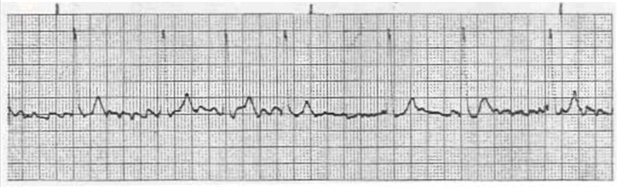
(Multiple Choice)
4.8/5 (77)
(77) The nurse is reviewing normal cardiac conduction with a new graduate nurse. What should the nurse explain when the impulse reaches the bundle of His? Select all that apply.
(Multiple Choice)
5.0/5 (92)
(92) Which criteria should the nurse use when assessing an ECG strip for atrial fibrillation?
(Multiple Choice)
4.8/5 (82)
(82) The nurse notes that a patient on continuous cardiac monitoring has PR intervals that last 0.08 seconds. What should the nurse suspect as the reason for this finding?
(Multiple Choice)
4.9/5 (69)
(69) The nurse receives the following ECG strip at shift report. Which action is most appropriate for this patient? 
(Multiple Choice)
4.7/5 (73)
(73) A patient is admitted to the telemetry unit with new onset of weakness and fatigue. The following rhythm is now seen on the monitor, and the patient is now complaining of shortness of breath and mild chest discomfort. Which medication would be appropriate for this patient? 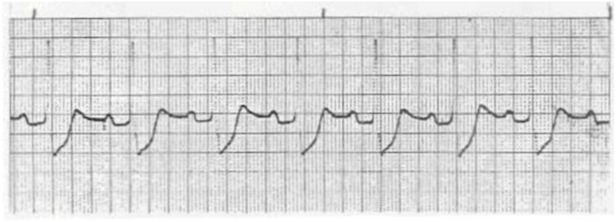
(Multiple Choice)
4.9/5 (82)
(82) A patient experiencing pulseless ventricular tachycardia is defibrillated twice and has received medications according to ACLS protocol. The following rhythm is now present. What should the nurse do next? 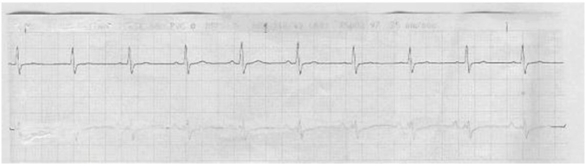
(Multiple Choice)
4.8/5 (81)
(81) A patient arrives in the emergency department for chest pain, lightheadedness, and shortness of breath (SOB). The cardiac monitor shows sinus rhythm with the presence of multifocal PVCs. Which order should the nurse question?
(Multiple Choice)
4.7/5 (81)
(81) A patient has the following rhythm. Which assessment finding indicates a need for further treatment? 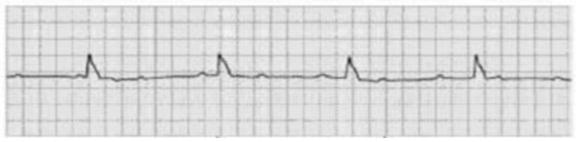
(Multiple Choice)
4.9/5 (71)
(71) The nurse determines that a patient is experiencing sinus tachycardia. What did the nurse assess on the patient's ECG rhythm strip? Select all that apply.
(Multiple Choice)
4.9/5 (72)
(72) 
Filters
- Essay(0)
- Multiple Choice(0)
- Short Answer(0)
- True False(0)
- Matching(0)