



 Chat with AI
Exam 7: The Efficiency of Markets

Exam 1: The Central Idea156 Questions
Exam 2: Observing and Explaining the Economy143 Questions
Exam 3: The Supply and Demand Model166 Questions
Exam 4: Subtleties of the Supply and Demand Model176 Questions
Exam 5: The Demand Curve and the Behavior of Consumers176 Questions
Exam 6: The Supply Curve and the Behavior of Firms179 Questions
Exam 7: The Efficiency of Markets163 Questions
Exam 8: Costs and the Changes at Firms Over Time191 Questions
Exam 9: The Rise and Fall of Industries139 Questions
Exam 10: Monopoly184 Questions
Exam 11: Product Differentiation, Monopolistic Competition, and Oligopoly169 Questions
Exam 12: Antitrust Policy and Regulation152 Questions
Exam 13: Labor Markets179 Questions
Exam 14: Taxes, Transfers, and Income Distribution179 Questions
Exam 15: Public Goods, Externalities, and Government Behavior197 Questions
Exam 16: Capital and Financial Markets188 Questions
Exam 17: Macroeconomics: the Big Picture159 Questions
Exam 18: Measuring the Production, Income, and Spending of Nations177 Questions
Exam 19: The Spending Allocation Model166 Questions
Exam 20: Unemployment and Employment212 Questions
Exam 21: Productivity and Economic Growth162 Questions
Exam 22: Money and Inflation153 Questions
Exam 23: The Nature and Causes of Economic Fluctuations185 Questions
Exam 24: The Economic Fluctuations Model205 Questions
Exam 25: Using the Economic Fluctuations Model176 Questions
Exam 26: Fiscal Policy138 Questions
Exam 27: Monetary Policy180 Questions
Exam 28: Economic Growth Around the World157 Questions
Exam 29: International Trade242 Questions
Exam 30: International Finance125 Questions
Select questions type


If a market is in equilibrium, then we know that price equals marginal cost because
(Multiple Choice)
4.8/5  (67)
(67) It is easier for buyers and sellers to exchange and process price information in market systems than in nonmarket systems.
(True/False)
4.9/5 (78)
(78) The price system has information advantages over nonmarket systems only when buyers and sellers can personally communicate their marginal benefits or marginal costs to each other.
(True/False)
4.9/5 (77)
(77) Exhibit 7-9  -When the government imposes a tax that must be paid by producers, economic theory indicates that the government's tax revenue
 (Multiple Choice)
4.8/5 (83)
(83) Typically, when government imposes an ad valorem or a specific tax on producers,
(Multiple Choice)
4.8/5 (70)
(70) If the price of a good increases, other things held constant, then
(Multiple Choice)
4.9/5 (75)
(75) The change in a product's price when a per-unit tax is assessed on producers is greatest when
(Multiple Choice)
4.8/5 (70)
(70) The primary problem with nonmarket economic coordination is
(Multiple Choice)
4.9/5 (87)
(87) Informational efficiency is achieved in the market system only because government has required producers to disclose characteristics of their products.
(True/False)
4.9/5 (67)
(67) The best way to achieve income equality and efficiency is to regulate prices so that everyone can afford what they need.
(True/False)
4.9/5 (94)
(94) Exhibit 7-5 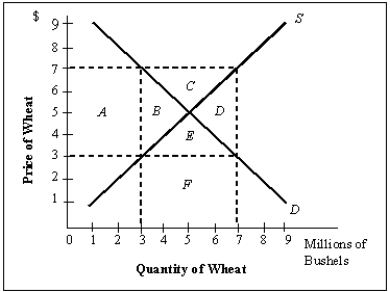 -Refer to Exhibit 7-5. If the government establishes a price floor of $7 in this wheat market, buying any surplus or filling any shortage as necessary, the deadweight loss is represented by area
 (Multiple Choice)
4.8/5 (80)
(80) Regarding price floors on prices, the result of a higher-than-equilibrium market price is
(Multiple Choice)
4.9/5 (78)
(78) Exhibit 7-9
-Exhibit 7-9 shows the effect of a tax on a market. The deadweight loss equals
-Exhibit 7-9 shows the effect of a tax on a market. The deadweight loss equals (Multiple Choice)
4.7/5 (87)
(87) All of the following contribute to the attainment of efficiency in a competitive market except
(Multiple Choice)
4.8/5 (75)
(75) Suppose there are three buyers (A, B, and C) and three sellers (D, E, and F) in a competitive market with the marginal benefit (MB) schedules shown in Table 1 and the marginal cost (MC) schedules shown in Table 2. 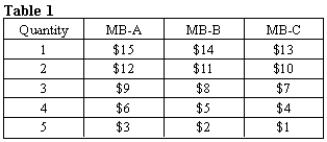
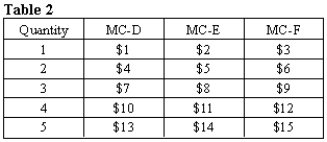 Verify that the three efficiency conditions are satisfied for the market when the equilibrium price is $8.
(Essay)
4.7/5 (84)
(84) 
Filters
- Essay(0)
- Multiple Choice(0)
- Short Answer(0)
- True False(0)
- Matching(0)