



 Chat with AI
Exam 7: The Efficiency of Markets

Exam 1: The Central Idea156 Questions
Exam 2: Observing and Explaining the Economy143 Questions
Exam 3: The Supply and Demand Model166 Questions
Exam 4: Subtleties of the Supply and Demand Model176 Questions
Exam 5: The Demand Curve and the Behavior of Consumers176 Questions
Exam 6: The Supply Curve and the Behavior of Firms179 Questions
Exam 7: The Efficiency of Markets163 Questions
Exam 8: Costs and the Changes at Firms Over Time191 Questions
Exam 9: The Rise and Fall of Industries139 Questions
Exam 10: Monopoly184 Questions
Exam 11: Product Differentiation, Monopolistic Competition, and Oligopoly169 Questions
Exam 12: Antitrust Policy and Regulation152 Questions
Exam 13: Labor Markets179 Questions
Exam 14: Taxes, Transfers, and Income Distribution179 Questions
Exam 15: Public Goods, Externalities, and Government Behavior197 Questions
Exam 16: Capital and Financial Markets188 Questions
Exam 17: Macroeconomics: the Big Picture159 Questions
Exam 18: Measuring the Production, Income, and Spending of Nations177 Questions
Exam 19: The Spending Allocation Model166 Questions
Exam 20: Unemployment and Employment212 Questions
Exam 21: Productivity and Economic Growth162 Questions
Exam 22: Money and Inflation153 Questions
Exam 23: The Nature and Causes of Economic Fluctuations185 Questions
Exam 24: The Economic Fluctuations Model205 Questions
Exam 25: Using the Economic Fluctuations Model176 Questions
Exam 26: Fiscal Policy138 Questions
Exam 27: Monetary Policy180 Questions
Exam 28: Economic Growth Around the World157 Questions
Exam 29: International Trade242 Questions
Exam 30: International Finance125 Questions
Select questions type


A price floor that is higher than the equilibrium market price results in
(Multiple Choice)
4.9/5  (85)
(85) Exhibit 7-2 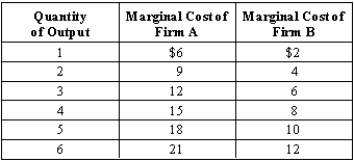 -The sum of producer and consumer surplus is maximized when
 (Multiple Choice)
4.9/5 (75)
(75) Deadweight loss is the amount of benefits transferred from consumers to producers.
(True/False)
4.9/5 (84)
(84) Besides processing information, an economic system must perform two other tasks. Name them.
(Essay)
4.9/5 (77)
(77) If the government imposes a sales tax on a good, then the deadweight loss of the tax is the
(Multiple Choice)
4.9/5 (73)
(73) Pareto efficiency is achieved when deadweight loss is equal to zero.
(True/False)
4.8/5 (80)
(80) The transfer of income from high-income to low-income individuals
(Multiple Choice)
4.8/5 (83)
(83) Deadweight loss is zero when quantity supplied equals quantity demanded.
(True/False)
4.9/5 (87)
(87) When it is possible to make someone better off without hurting someone else, the condition is
(Multiple Choice)
4.9/5 (84)
(84) Which of the following is an example of an ad valorem tax?
(Multiple Choice)
4.8/5 (89)
(89) Which of the following makes consumers unambiguously worse off?
(Multiple Choice)
4.8/5 (71)
(71) Suppose that the government imposes a sales tax that causes the equilibrium price to go up. Draw a graph showing the original supply curve, the new supply curve, and the demand curve. Use this graph to show:

(Essay)
4.9/5 (87)
(87) A principle states that when the supply and demand curves cross in a competitive market, Pareto efficiency is achieved. This principle is called
(Multiple Choice)
4.9/5 (87)
(87) Pareto efficiency occurs when it is not possible to improve one person's situation without hurting someone else.
(True/False)
4.8/5 (68)
(68) 
Filters
- Essay(0)
- Multiple Choice(0)
- Short Answer(0)
- True False(0)
- Matching(0)