



 Chat with AI
Exam 7: The Efficiency of Markets

Exam 1: The Central Idea156 Questions
Exam 2: Observing and Explaining the Economy143 Questions
Exam 3: The Supply and Demand Model166 Questions
Exam 4: Subtleties of the Supply and Demand Model176 Questions
Exam 5: The Demand Curve and the Behavior of Consumers176 Questions
Exam 6: The Supply Curve and the Behavior of Firms179 Questions
Exam 7: The Efficiency of Markets163 Questions
Exam 8: Costs and the Changes at Firms Over Time191 Questions
Exam 9: The Rise and Fall of Industries139 Questions
Exam 10: Monopoly184 Questions
Exam 11: Product Differentiation, Monopolistic Competition, and Oligopoly169 Questions
Exam 12: Antitrust Policy and Regulation152 Questions
Exam 13: Labor Markets179 Questions
Exam 14: Taxes, Transfers, and Income Distribution179 Questions
Exam 15: Public Goods, Externalities, and Government Behavior197 Questions
Exam 16: Capital and Financial Markets188 Questions
Exam 17: Macroeconomics: the Big Picture159 Questions
Exam 18: Measuring the Production, Income, and Spending of Nations177 Questions
Exam 19: The Spending Allocation Model166 Questions
Exam 20: Unemployment and Employment212 Questions
Exam 21: Productivity and Economic Growth162 Questions
Exam 22: Money and Inflation153 Questions
Exam 23: The Nature and Causes of Economic Fluctuations185 Questions
Exam 24: The Economic Fluctuations Model205 Questions
Exam 25: Using the Economic Fluctuations Model176 Questions
Exam 26: Fiscal Policy138 Questions
Exam 27: Monetary Policy180 Questions
Exam 28: Economic Growth Around the World157 Questions
Exam 29: International Trade242 Questions
Exam 30: International Finance125 Questions
Select questions type


For a given tax assessed on producers, market price changes the most if demand is perfectly inelastic and supply is perfectly elastic.
(True/False)
4.9/5  (98)
(98) Realistically speaking, complete income equality can be achieved only when
(Multiple Choice)
4.8/5 (80)
(80) Exhibit 7-12  -Refer to Exhibit 7-12. Calculate the total tax revenue that the government will receive if it imposes a tax of $4 per unit of output.
(Essay)
4.9/5 (76)
(76) Society achieves Pareto efficiency when individuals can achieve more utility while no one loses any utility.
(True/False)
4.9/5 (84)
(84) Exhibit 7-8 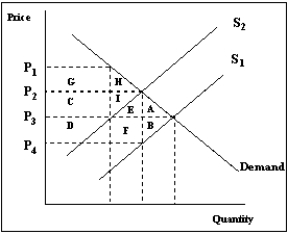 -Refer to the Exhibit 7-8. Suppose that the government imposes a sales tax on a good such that S1 represents the supply curve without the tax and S2 represents the supply curve with the tax. The deadweight loss as a result of the tax is the combined area of
 (Multiple Choice)
4.7/5 (88)
(88) Suppose there are three buyers (A, B, and C) in a competitive market with the marginal benefit (MB) schedules like those shown in the table below. Calculate the consumer surplus using the market demand curve. Assume that the market price is $10. Show that you get the same answer by adding the consumer surplus for all three buyers. How much does consumer surplus increase for the market as a whole and for each individual when the market price falls to $8? 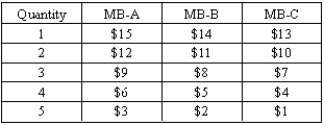
(Essay)
4.7/5 (77)
(77) If a market is efficient, then it is possible that an increase in one person's consumption would not lower another person's consumption.
(True/False)
4.7/5 (75)
(75) A market system relies primarily on prices to motivate individuals and coordinate economic activity.
(True/False)
4.8/5 (72)
(72) The deadweight loss from a tax on a good equals the tax revenue that goes to the government.
(True/False)
4.9/5 (77)
(77) Exhibit 7-12
-Refer to Exhibit 7-12. Calculate the deadweight loss of a government program that establishes a minimum price of $7 per unit and requires that the government buy the resulting surplus.
-Refer to Exhibit 7-12. Calculate the deadweight loss of a government program that establishes a minimum price of $7 per unit and requires that the government buy the resulting surplus.
(Essay)
4.9/5 (78)
(78) What happens to the net benefit that is called a deadweight loss when such a loss occurs?
(Essay)
4.9/5 (80)
(80) Income equality is usually defined as a state of the world in which all individuals have
(Multiple Choice)
4.8/5 (80)
(80) In a market, price provides information only to sellers but not to buyers.
(True/False)
4.9/5 (73)
(73) The effects of a tax can be captured by rightward shifts of both the supply and demand curves.
(True/False)
4.9/5 (80)
(80) Exhibit 7-4 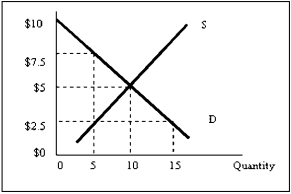 -Refer to Exhibit 7-4. Deadweight loss is greater than zero if price is at all of the following except
 (Multiple Choice)
5.0/5 (97)
(97) Exhibit 7-2  -Refer to Exhibit 7-2. What would be the total cost of Firm A and Firm B producing 4 units of output each? Is it possible to reduce this total cost and still produce the same total output? How?
(Essay)
5.0/5 (79)
(79) 
Filters
- Essay(0)
- Multiple Choice(0)
- Short Answer(0)
- True False(0)
- Matching(0)