



 Chat with AI
Exam 10: Monopoly

Exam 1: The Central Idea156 Questions
Exam 2: Observing and Explaining the Economy143 Questions
Exam 3: The Supply and Demand Model166 Questions
Exam 4: Subtleties of the Supply and Demand Model176 Questions
Exam 5: The Demand Curve and the Behavior of Consumers176 Questions
Exam 6: The Supply Curve and the Behavior of Firms179 Questions
Exam 7: The Efficiency of Markets163 Questions
Exam 8: Costs and the Changes at Firms Over Time191 Questions
Exam 9: The Rise and Fall of Industries139 Questions
Exam 10: Monopoly184 Questions
Exam 11: Product Differentiation, Monopolistic Competition, and Oligopoly169 Questions
Exam 12: Antitrust Policy and Regulation152 Questions
Exam 13: Labor Markets179 Questions
Exam 14: Taxes, Transfers, and Income Distribution179 Questions
Exam 15: Public Goods, Externalities, and Government Behavior197 Questions
Exam 16: Capital and Financial Markets188 Questions
Exam 17: Macroeconomics: the Big Picture159 Questions
Exam 18: Measuring the Production, Income, and Spending of Nations177 Questions
Exam 19: The Spending Allocation Model166 Questions
Exam 20: Unemployment and Employment212 Questions
Exam 21: Productivity and Economic Growth162 Questions
Exam 22: Money and Inflation153 Questions
Exam 23: The Nature and Causes of Economic Fluctuations185 Questions
Exam 24: The Economic Fluctuations Model205 Questions
Exam 25: Using the Economic Fluctuations Model176 Questions
Exam 26: Fiscal Policy138 Questions
Exam 27: Monetary Policy180 Questions
Exam 28: Economic Growth Around the World157 Questions
Exam 29: International Trade242 Questions
Exam 30: International Finance125 Questions
Select questions type


Exhibit 10-8  -Refer to Exhibit 10-8. The deadweight loss from monopoly is area
 (Multiple Choice)
4.7/5  (73)
(73) A firm with market power can always sell more by raising the price of its product.
(True/False)
4.9/5 (91)
(91) Explain why participants in an industry would want the government to require licenses for them to operate, even if the licenses are costly to obtain.
(Essay)
4.7/5 (87)
(87) The market demand curve that a monopoly faces implies that
(Multiple Choice)
5.0/5 (75)
(75) A clothing store can sell two shirts for $20 each or three shirts for $15 each. At a quantity of three shirts sold, marginal revenue
(Multiple Choice)
4.9/5 (78)
(78) Exhibit 10-9  -Refer to Exhibit 10-9. The difference between marginal benefit and marginal cost for the profit-maximizing monopoly is
 (Multiple Choice)
4.8/5 (74)
(74) Exhibit 10-4  -Refer to Exhibit 10-4. The firm's maximum profit is
 (Multiple Choice)
4.8/5 (102)
(102) Exhibit 10-8
-Refer to Exhibit 10-8. The difference in output levels between a profit-maximizing monopoly and a profit-maximizing competitive firm can be measured by the distance between points
-Refer to Exhibit 10-8. The difference in output levels between a profit-maximizing monopoly and a profit-maximizing competitive firm can be measured by the distance between points (Multiple Choice)
4.9/5 (79)
(79) Exhibit 10-8
-Which of the following statements is always correct?
-Which of the following statements is always correct? (Multiple Choice)
4.8/5 (72)
(72) Exhibit 10-2 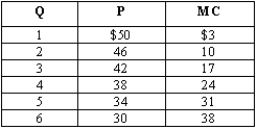 -To ascertain the profit-maximizing price on a monopoly diagram, one must first determine output by finding where
 (Multiple Choice)
4.8/5 (76)
(76) In the generic diagram for a monopoly, the firm's total profits are determined by
(Multiple Choice)
4.9/5 (75)
(75) Which of the following statements about natural monopolies is not true?
(Multiple Choice)
4.8/5 (75)
(75) Why is the marginal revenue curve for a monopoly steeper than its demand curve?
(Essay)
4.9/5 (77)
(77) Suppose a monopoly is producing at an output such that the price elasticity of demand is 0.8. Then
(Multiple Choice)
4.7/5 (85)
(85) A market in which a single seller is required for efficient production is called a
(Multiple Choice)
4.8/5 (77)
(77) The profit-maximizing behavior of a monopoly is different from that of a competitive firm in that
(Multiple Choice)
4.9/5 (89)
(89) 
Filters
- Essay(0)
- Multiple Choice(0)
- Short Answer(0)
- True False(0)
- Matching(0)