



 Chat with AI
Exam 10: Monopoly

Exam 1: The Central Idea156 Questions
Exam 2: Observing and Explaining the Economy143 Questions
Exam 3: The Supply and Demand Model166 Questions
Exam 4: Subtleties of the Supply and Demand Model176 Questions
Exam 5: The Demand Curve and the Behavior of Consumers176 Questions
Exam 6: The Supply Curve and the Behavior of Firms179 Questions
Exam 7: The Efficiency of Markets163 Questions
Exam 8: Costs and the Changes at Firms Over Time191 Questions
Exam 9: The Rise and Fall of Industries139 Questions
Exam 10: Monopoly184 Questions
Exam 11: Product Differentiation, Monopolistic Competition, and Oligopoly169 Questions
Exam 12: Antitrust Policy and Regulation152 Questions
Exam 13: Labor Markets179 Questions
Exam 14: Taxes, Transfers, and Income Distribution179 Questions
Exam 15: Public Goods, Externalities, and Government Behavior197 Questions
Exam 16: Capital and Financial Markets188 Questions
Exam 17: Macroeconomics: the Big Picture159 Questions
Exam 18: Measuring the Production, Income, and Spending of Nations177 Questions
Exam 19: The Spending Allocation Model166 Questions
Exam 20: Unemployment and Employment212 Questions
Exam 21: Productivity and Economic Growth162 Questions
Exam 22: Money and Inflation153 Questions
Exam 23: The Nature and Causes of Economic Fluctuations185 Questions
Exam 24: The Economic Fluctuations Model205 Questions
Exam 25: Using the Economic Fluctuations Model176 Questions
Exam 26: Fiscal Policy138 Questions
Exam 27: Monetary Policy180 Questions
Exam 28: Economic Growth Around the World157 Questions
Exam 29: International Trade242 Questions
Exam 30: International Finance125 Questions
Select questions type


A single seller can set a high price for its product because
(Multiple Choice)
4.7/5  (82)
(82) Suppose that for a monopoly average total cost is $3.50, marginal cost is $3.00, and marginal revenue is $3.00 with a selling price of $4.00. To maximize profits, the monopoly should
(Multiple Choice)
4.8/5 (80)
(80) The profit-maximizing output level is determined on a monopoly diagram by noting where the demand and marginal cost curves cross.
(True/False)
4.8/5 (77)
(77) To maximize profits, a monopoly charges a price greater than its marginal cost.
(True/False)
4.9/5 (80)
(80) An industry in which there are low startup costs and a single firm prices its product very low for fear of new entry is called
(Multiple Choice)
4.8/5 (85)
(85) A firm's market power can be realized by considering how much price changes in response to an output change.
(True/False)
4.7/5 (85)
(85) Exhibit 10-7 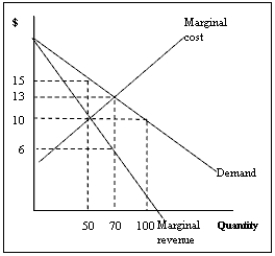 -Refer to Exhibit 10-7 for a monopoly. The profit-maximizing level of production is
 (Multiple Choice)
4.9/5 (86)
(86) A profit-maximizing monopoly with a straight-line demand will never produce when demand is inelastic because
(Multiple Choice)
4.9/5 (78)
(78) Exhibit 10-10  -Refer to Exhibit 10-10. Calculate the deadweight loss from the monopoly.
(Essay)
5.0/5 (86)
(86) Exhibit 10-4  -Refer to Exhibit 10-4. At the profit-maximizing output level, total revenue is
 (Multiple Choice)
4.7/5 (80)
(80) Exhibit 10-4
-For a monopoly, price can remain greater than average total cost in the long run.
-For a monopoly, price can remain greater than average total cost in the long run. (True/False)
5.0/5 (83)
(83) Exhibit 10-3  -Refer to Exhibit 10-3. The profit-maximizing monopoly is earning economic profits in the amount of
 (Multiple Choice)
4.9/5 (70)
(70) What do you think about the merits and demerits of the patent law that protects newly-developed products in medical research?
(Essay)
4.9/5 (65)
(65) Consumer surplus is smaller if an industry is operated by a monopolistic firm than it is if an industry is operated by competitive firms.
(True/False)
4.9/5 (72)
(72) Which of the following statements concerning price discrimination among consumers with different price elasticities is true?
(Multiple Choice)
5.0/5 (78)
(78) 
Filters
- Essay(0)
- Multiple Choice(0)
- Short Answer(0)
- True False(0)
- Matching(0)