



 Chat with AI
Exam 10: Monopoly

Exam 1: The Central Idea156 Questions
Exam 2: Observing and Explaining the Economy143 Questions
Exam 3: The Supply and Demand Model166 Questions
Exam 4: Subtleties of the Supply and Demand Model176 Questions
Exam 5: The Demand Curve and the Behavior of Consumers176 Questions
Exam 6: The Supply Curve and the Behavior of Firms179 Questions
Exam 7: The Efficiency of Markets163 Questions
Exam 8: Costs and the Changes at Firms Over Time191 Questions
Exam 9: The Rise and Fall of Industries139 Questions
Exam 10: Monopoly184 Questions
Exam 11: Product Differentiation, Monopolistic Competition, and Oligopoly169 Questions
Exam 12: Antitrust Policy and Regulation152 Questions
Exam 13: Labor Markets179 Questions
Exam 14: Taxes, Transfers, and Income Distribution179 Questions
Exam 15: Public Goods, Externalities, and Government Behavior197 Questions
Exam 16: Capital and Financial Markets188 Questions
Exam 17: Macroeconomics: the Big Picture159 Questions
Exam 18: Measuring the Production, Income, and Spending of Nations177 Questions
Exam 19: The Spending Allocation Model166 Questions
Exam 20: Unemployment and Employment212 Questions
Exam 21: Productivity and Economic Growth162 Questions
Exam 22: Money and Inflation153 Questions
Exam 23: The Nature and Causes of Economic Fluctuations185 Questions
Exam 24: The Economic Fluctuations Model205 Questions
Exam 25: Using the Economic Fluctuations Model176 Questions
Exam 26: Fiscal Policy138 Questions
Exam 27: Monetary Policy180 Questions
Exam 28: Economic Growth Around the World157 Questions
Exam 29: International Trade242 Questions
Exam 30: International Finance125 Questions
Select questions type


Suppose a firm decides to cut its production in half. One could claim that this firm has market power if there is a significant change in the
(Multiple Choice)
4.8/5  (84)
(84) Exhibit 10-9  -The price-cost margin is approximately equal to the
 (Multiple Choice)
4.8/5 (78)
(78) Refer to the figure below. Calculate the monopolist's profit at the profit-maximizing output level. 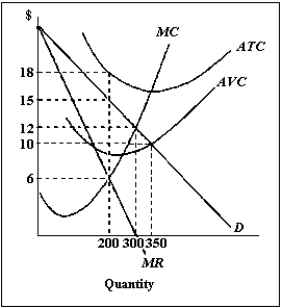
(Essay)
4.9/5 (93)
(93) When the price elasticity of demand is less than 1, then marginal revenue is
(Multiple Choice)
4.7/5 (78)
(78) Many U.S. cities limit the number of taxis by restricting the number of licenses. The result, in comparison with free entry into the taxi industry, is
(Multiple Choice)
4.9/5 (88)
(88) When long-run average cost falls over such a great range of output that it reaches a minimum at a greater output than consumers demand, we call a firm in such a market a natural
(Multiple Choice)
4.9/5 (86)
(86) Exhibit 10-1  -Refer to Exhibit 10-1. Profits are maximized when the level of output is
 (Multiple Choice)
4.8/5 (72)
(72) Marginal revenue is positive when the price elasticity of demand is greater than 1.
(True/False)
4.9/5 (74)
(74) Exhibit 10-10  -A firm that takes advantage of economies of scale and expands to become the only producer in the industry is called
 (Multiple Choice)
4.9/5 (79)
(79) If, at a sales level of 100 units, a monopoly's marginal revenue is $5, then
(Multiple Choice)
5.0/5 (85)
(85) 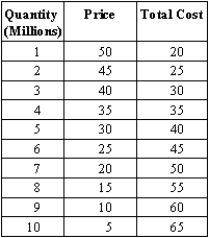
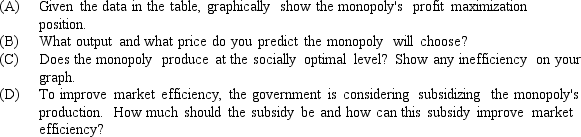
Suppose the government wants to encourage a monopolist to produce more by paying a subsidy (a negative tax) for each unit produced. Draw a diagram to explain this situation. How do price and quantity change? Show what happens to deadweight loss.
(Essay)
4.8/5 (87)
(87) Exhibit 10-4  -Refer to Exhibit 10-4. The profit-maximizing price is
 (Multiple Choice)
4.7/5 (91)
(91) The reason a monopoly produces less than a competitive industry with identical costs is that
(Multiple Choice)
4.9/5 (81)
(81) A monopoly's marginal revenue is less than its price because
(Multiple Choice)
4.9/5 (82)
(82) Exhibit 10-8  -Refer to Exhibit 10-8. The loss to consumers from monopoly includes area
 (Multiple Choice)
4.9/5 (68)
(68) 
Filters
- Essay(0)
- Multiple Choice(0)
- Short Answer(0)
- True False(0)
- Matching(0)