



 Chat with AI
Exam 14: Taxes, Transfers, and Income Distribution

Exam 1: The Central Idea156 Questions
Exam 2: Observing and Explaining the Economy143 Questions
Exam 3: The Supply and Demand Model166 Questions
Exam 4: Subtleties of the Supply and Demand Model176 Questions
Exam 5: The Demand Curve and the Behavior of Consumers176 Questions
Exam 6: The Supply Curve and the Behavior of Firms179 Questions
Exam 7: The Efficiency of Markets163 Questions
Exam 8: Costs and the Changes at Firms Over Time191 Questions
Exam 9: The Rise and Fall of Industries139 Questions
Exam 10: Monopoly184 Questions
Exam 11: Product Differentiation, Monopolistic Competition, and Oligopoly169 Questions
Exam 12: Antitrust Policy and Regulation152 Questions
Exam 13: Labor Markets179 Questions
Exam 14: Taxes, Transfers, and Income Distribution179 Questions
Exam 15: Public Goods, Externalities, and Government Behavior197 Questions
Exam 16: Capital and Financial Markets188 Questions
Exam 17: Macroeconomics: the Big Picture159 Questions
Exam 18: Measuring the Production, Income, and Spending of Nations177 Questions
Exam 19: The Spending Allocation Model166 Questions
Exam 20: Unemployment and Employment212 Questions
Exam 21: Productivity and Economic Growth162 Questions
Exam 22: Money and Inflation153 Questions
Exam 23: The Nature and Causes of Economic Fluctuations185 Questions
Exam 24: The Economic Fluctuations Model205 Questions
Exam 25: Using the Economic Fluctuations Model176 Questions
Exam 26: Fiscal Policy138 Questions
Exam 27: Monetary Policy180 Questions
Exam 28: Economic Growth Around the World157 Questions
Exam 29: International Trade242 Questions
Exam 30: International Finance125 Questions
Select questions type


One determinant of the official poverty-line income is the cost of
(Multiple Choice)
4.9/5  (84)
(84) In the United States, the top quintile of families earn about ____ percent of the income.
(Multiple Choice)
4.7/5 (69)
(69) Exhibit 14-5  -Refer to Exhibit 14-5. We can say that the poorest 20 percent of Urbanal's population receives
 (Multiple Choice)
4.8/5 (75)
(75) The ability-to-pay principle is the idea that only those who have very high incomes should pay any taxes at all.
(True/False)
4.8/5 (73)
(73) In a progressive tax system, anyone earning a positive amount of income must pay some income tax.
(True/False)
4.8/5 (88)
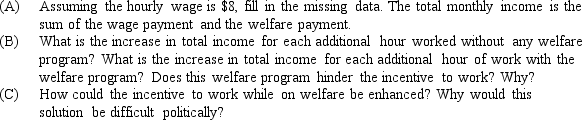
(88) The table below gives hours worked per month and welfare payments received. 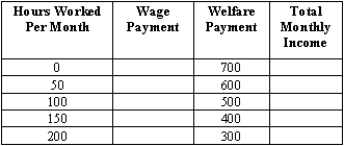
(Essay)
4.9/5 (77)
(77) In looking at the distribution of income provided by quintile statistics and the Lorenz curve, it must be kept in mind that
(Multiple Choice)
4.8/5 (91)
(91) If the demand for a good is very price-elastic, then the imposition of a per-unit tax on that good will cause
(Multiple Choice)
4.8/5 (68)
(68) Exhibit 14-1  -Refer to Exhibit 14-1. An individual making $75,000 pays an average tax rate of
 (Multiple Choice)
4.9/5 (81)
(81) An efficient tax system should include all the following except
(Multiple Choice)
4.8/5 (66)
(66) Under what circumstance would an increase in the payroll tax paid by employers cause the wage to fall by the same percentage as the tax increase, regardless of the labor supply curve's elasticity?
(Essay)
4.9/5 (76)
(76) In the United States, income distribution is more even than wealth distribution.
(True/False)
4.8/5 (73)
(73) Which of the following statements about mandated employer benefits is not true?
(Multiple Choice)
4.9/5 (75)
(75) Which of the following statements concerning the income distribution in the world is true?
(Multiple Choice)
4.8/5 (80)
(80) If an individual earns an additional $200 and has to pay an additional $25 in income tax, his or her marginal tax rate is
(Multiple Choice)
4.9/5 (79)
(79) Means-tested government transfer programs may reduce work incentives because
(Multiple Choice)
4.9/5 (92)
(92) In terms of income, the top fifth of households in the United States earn approximately half of the nation's income.
(True/False)
4.8/5 (95)
(95) 
Filters
- Essay(0)
- Multiple Choice(0)
- Short Answer(0)
- True False(0)
- Matching(0)