



 Chat with AI
Exam 14: Taxes, Transfers, and Income Distribution

Exam 1: The Central Idea156 Questions
Exam 2: Observing and Explaining the Economy143 Questions
Exam 3: The Supply and Demand Model166 Questions
Exam 4: Subtleties of the Supply and Demand Model176 Questions
Exam 5: The Demand Curve and the Behavior of Consumers176 Questions
Exam 6: The Supply Curve and the Behavior of Firms179 Questions
Exam 7: The Efficiency of Markets163 Questions
Exam 8: Costs and the Changes at Firms Over Time191 Questions
Exam 9: The Rise and Fall of Industries139 Questions
Exam 10: Monopoly184 Questions
Exam 11: Product Differentiation, Monopolistic Competition, and Oligopoly169 Questions
Exam 12: Antitrust Policy and Regulation152 Questions
Exam 13: Labor Markets179 Questions
Exam 14: Taxes, Transfers, and Income Distribution179 Questions
Exam 15: Public Goods, Externalities, and Government Behavior197 Questions
Exam 16: Capital and Financial Markets188 Questions
Exam 17: Macroeconomics: the Big Picture159 Questions
Exam 18: Measuring the Production, Income, and Spending of Nations177 Questions
Exam 19: The Spending Allocation Model166 Questions
Exam 20: Unemployment and Employment212 Questions
Exam 21: Productivity and Economic Growth162 Questions
Exam 22: Money and Inflation153 Questions
Exam 23: The Nature and Causes of Economic Fluctuations185 Questions
Exam 24: The Economic Fluctuations Model205 Questions
Exam 25: Using the Economic Fluctuations Model176 Questions
Exam 26: Fiscal Policy138 Questions
Exam 27: Monetary Policy180 Questions
Exam 28: Economic Growth Around the World157 Questions
Exam 29: International Trade242 Questions
Exam 30: International Finance125 Questions
Select questions type


Under the flat tax system, taxpayers have to pay more as their incomes increase.
(True/False)
4.9/5  (87)
(87) You can expect to see a higher percentage of a nation's population with low incomes as the percentage of elderly persons increases.
(True/False)
4.7/5 (95)
(95) Exhibit 14-1  -If the average tax rate is the same for all levels of income, the tax is called a
 (Multiple Choice)
4.9/5 (72)
(72) Exhibit 14-5  -Refer to Exhibit 14-5. Which of the following statements is true?
 (Multiple Choice)
5.0/5 (82)
(82) Of the two classes of participants in a market, buyers and sellers, the one who pays most of an excise tax is the one with the greater elasticity.
(True/False)
4.9/5 (78)
(78) According to economic theory, the personal income tax reduces the amount of income-producing work done in an economy.
(True/False)
4.9/5 (77)
(77) The Gini coefficient is greatest when complete income equality is attained.
(True/False)
4.8/5 (81)
(81) Which of the following violates the ability-to-pay principle as defined by the text?
(Multiple Choice)
4.9/5 (77)
(77) To keep deadweight losses to a minimum, products with high elasticities of supply and demand should be taxed.
(True/False)
4.9/5 (69)
(69) Which of the following forms of income is not taxed under the personal income tax?
(Multiple Choice)
5.0/5 (78)
(78) Which of the following are tradeoffs in the design of a tax system?
(Multiple Choice)
4.8/5 (69)
(69) Which of the following conditions results in the highest deadweight loss from a tax?
(Multiple Choice)
4.8/5 (84)
(84) The more price-elastic the demand, the larger the increase in tax revenues resulting from a per-unit tax on a good.
(True/False)
4.8/5 (89)
(89) The poverty line is three times the amount required to feed a given number of people a nutritionally-adequate diet.
(True/False)
4.9/5 (76)
(76) If an individual earns an additional $200 and has to pay an additional $25 in income tax, his or her average tax rate is
(Multiple Choice)
4.8/5 (93)
(93) Which of the following statements about income distribution in the United States is true?
(Multiple Choice)
4.8/5 (87)
(87) The Gini coefficient measures the degree of wage discrimination.
(True/False)
4.7/5 (73)
(73) Exhibit 14-3 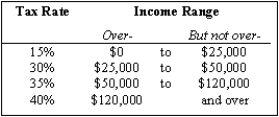 -Refer to Exhibit 14-3. Calculate the tax if an individual makes a total of $150,000 in income, has deductions of $8,000, and receives an exemption of $2,500 for each of five dependents.
(Essay)
4.8/5 (79)
(79) The amount of tax an individual pays divided by the individual's total income is the
(Multiple Choice)
4.8/5 (76)
(76) 
Filters
- Essay(0)
- Multiple Choice(0)
- Short Answer(0)
- True False(0)
- Matching(0)