



 Chat with AI
Exam 14: Taxes, Transfers, and Income Distribution

Exam 1: The Central Idea156 Questions
Exam 2: Observing and Explaining the Economy143 Questions
Exam 3: The Supply and Demand Model166 Questions
Exam 4: Subtleties of the Supply and Demand Model176 Questions
Exam 5: The Demand Curve and the Behavior of Consumers176 Questions
Exam 6: The Supply Curve and the Behavior of Firms179 Questions
Exam 7: The Efficiency of Markets163 Questions
Exam 8: Costs and the Changes at Firms Over Time191 Questions
Exam 9: The Rise and Fall of Industries139 Questions
Exam 10: Monopoly184 Questions
Exam 11: Product Differentiation, Monopolistic Competition, and Oligopoly169 Questions
Exam 12: Antitrust Policy and Regulation152 Questions
Exam 13: Labor Markets179 Questions
Exam 14: Taxes, Transfers, and Income Distribution179 Questions
Exam 15: Public Goods, Externalities, and Government Behavior197 Questions
Exam 16: Capital and Financial Markets188 Questions
Exam 17: Macroeconomics: the Big Picture159 Questions
Exam 18: Measuring the Production, Income, and Spending of Nations177 Questions
Exam 19: The Spending Allocation Model166 Questions
Exam 20: Unemployment and Employment212 Questions
Exam 21: Productivity and Economic Growth162 Questions
Exam 22: Money and Inflation153 Questions
Exam 23: The Nature and Causes of Economic Fluctuations185 Questions
Exam 24: The Economic Fluctuations Model205 Questions
Exam 25: Using the Economic Fluctuations Model176 Questions
Exam 26: Fiscal Policy138 Questions
Exam 27: Monetary Policy180 Questions
Exam 28: Economic Growth Around the World157 Questions
Exam 29: International Trade242 Questions
Exam 30: International Finance125 Questions
Select questions type


The number of people living below the poverty line divided by the total number of people in a nation is the nation's
(Multiple Choice)
4.8/5  (80)
(80) If the government imposes a tax on snack food, which has a higher elasticity of demand than non-snack food, then the deadweight loss from the tax
(Multiple Choice)
4.9/5 (73)
(73) If a tax is imposed on a good to be paid by the seller of the good, what will happen to the market price and quantity? State whether the price will go up or down and whether the change in price will be as large as the tax.
(Essay)
4.8/5 (86)
(86) A means-tested transfer program intended to help poor preschool children is
(Multiple Choice)
4.8/5 (86)
(86) The effect of the personal income tax on the amount of labor employed in the economy is greatest when
(Multiple Choice)
4.8/5 (73)
(73) A government payment to an individual because he/she is elderly is called a(n)
(Multiple Choice)
4.9/5 (74)
(74) For a mandated benefit to decrease total employment, demand would have to
(Multiple Choice)
4.9/5 (84)
(84) Exhibit 14-3 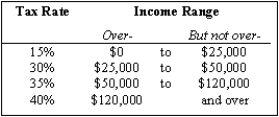 -Refer to Exhibit 14-3. Calculate the average tax rate of an individual whose taxable income is $65,000 and who has total deductions and exemptions of $10,000.
(Essay)
4.7/5 (73)
(73) The table below gives the income distribution in two countries, A and B. Draw the Lorenz Curve for each country. Which country has the larger Gini coefficient? 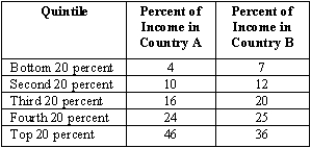
(Essay)
4.8/5 (67)
(67) U.S. government tax and transfer policies have tended to lower income inequality.
(True/False)
4.9/5 (74)
(74) Property taxes are the largest sources of revenue for local governments.
(True/False)
4.9/5 (74)
(74) Exhibit 14-5  -Refer to Exhibit 14-5. In looking at Rural's income distribution, one could say that
 (Multiple Choice)
4.9/5 (91)
(91) A corporate income tax is based on employees' income in a corporation.
(True/False)
4.8/5 (75)
(75) Many politicians argue against taxing home heating oil because it is a regressive tax. Explain. If the demand for heating oil is very elastic, what happens to the quantity demanded after the tax is imposed? Who will bear most of the burden of the tax in this case?
(Essay)
5.0/5 (80)
(80) Twenty percent of the population grouped in terms of a range of income is called a(n)
(Multiple Choice)
4.9/5 (85)
(85) 
Filters
- Essay(0)
- Multiple Choice(0)
- Short Answer(0)
- True False(0)
- Matching(0)