



 Chat with AI
Exam 20: Unemployment and Employment

Exam 1: The Central Idea156 Questions
Exam 2: Observing and Explaining the Economy143 Questions
Exam 3: The Supply and Demand Model166 Questions
Exam 4: Subtleties of the Supply and Demand Model176 Questions
Exam 5: The Demand Curve and the Behavior of Consumers176 Questions
Exam 6: The Supply Curve and the Behavior of Firms179 Questions
Exam 7: The Efficiency of Markets163 Questions
Exam 8: Costs and the Changes at Firms Over Time191 Questions
Exam 9: The Rise and Fall of Industries139 Questions
Exam 10: Monopoly184 Questions
Exam 11: Product Differentiation, Monopolistic Competition, and Oligopoly169 Questions
Exam 12: Antitrust Policy and Regulation152 Questions
Exam 13: Labor Markets179 Questions
Exam 14: Taxes, Transfers, and Income Distribution179 Questions
Exam 15: Public Goods, Externalities, and Government Behavior197 Questions
Exam 16: Capital and Financial Markets188 Questions
Exam 17: Macroeconomics: the Big Picture159 Questions
Exam 18: Measuring the Production, Income, and Spending of Nations177 Questions
Exam 19: The Spending Allocation Model166 Questions
Exam 20: Unemployment and Employment212 Questions
Exam 21: Productivity and Economic Growth162 Questions
Exam 22: Money and Inflation153 Questions
Exam 23: The Nature and Causes of Economic Fluctuations185 Questions
Exam 24: The Economic Fluctuations Model205 Questions
Exam 25: Using the Economic Fluctuations Model176 Questions
Exam 26: Fiscal Policy138 Questions
Exam 27: Monetary Policy180 Questions
Exam 28: Economic Growth Around the World157 Questions
Exam 29: International Trade242 Questions
Exam 30: International Finance125 Questions
Select questions type


Which of the following will cause the natural unemployment rate to decline?
(Multiple Choice)
4.8/5  (57)
(57) The unemployment rate reported in the newspaper is usually adjusted so it doesn't include seasonal fluctuations.
(True/False)
4.9/5 (74)
(74) Which of the following might cause the natural unemployment rate to increase?
(Multiple Choice)
4.9/5 (69)
(69) Which of the following statements about the natural rate of unemployment is true?
(Multiple Choice)
4.8/5 (85)
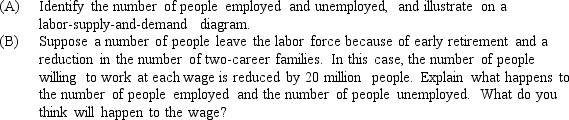
(85) Suppose the wage is $15 per hour. At this wage, firms are willing to hire 200 million people, and 220 million people are willing to work.
(Essay)
4.7/5 (74)
(74) The average number of hours worked per week has increased as a result of more people working part-time.
(True/False)
5.0/5 (82)
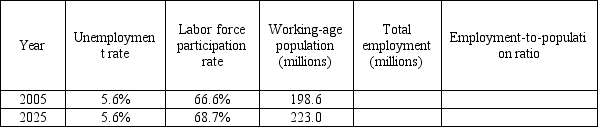
(82) Various projections have been made about the size of the labor force in a country in 2025. These projections are contingent on estimates of the participation rates of various demographic groups and estimates for net immigration. Based on the scenario in the table below, calculate total employment and the employment-to-population ratio.
(Essay)
4.8/5 (74)
(74) Which of the following is not in agreement with the definition of frictional unemployment?
(Multiple Choice)
4.9/5 (91)
(91) Which of the following was the approximate unemployment rate of the United States by the end of 2016?
(Multiple Choice)
4.9/5 (87)
(87) Among the United States, France, and Spain, the United States has the second lowest minimum wage (as a fraction of the average wage) and the lowest unemployment rate among young adults.
(True/False)
4.8/5 (78)
(78) The unemployment rate for young adults is higher in France and Spain than it is in the United States. Why do economists attribute this to differences in the natural unemployment rate and not to cyclical factors?
(Essay)
4.8/5 (85)
(85) The employment-to-population ratio is the highest it has been in U.S. history.
(True/False)
4.8/5 (81)
(81) Ceteris paribus, a leftward shift in the labor demand curve would cause
(Multiple Choice)
4.8/5 (70)
(70) Roughly, the percentage of U.S. workers that is employed part-time is about 1 percent.
(True/False)
4.8/5 (90)
(90) Of the unemployment rate, the employment-to-population ratio, and the labor force participation rate, which of the three is(are) unaffected by the discouraged worker phenomenon?
(Multiple Choice)
4.9/5 (95)
(95) According to the labor-supply-and-demand model if the economy enters a recession then the demand for labor shifts to the left.
(True/False)
5.0/5 (79)
(79) Which of the following statements about the U.S. employment statistics is not true?
(Multiple Choice)
4.8/5 (80)
(80) 
Filters
- Essay(0)
- Multiple Choice(0)
- Short Answer(0)
- True False(0)
- Matching(0)